
AP Chemistry Unit 9 Progress Check Free Response Guide

AP Chemistry Unit 9 Progress Check Free Response Guide

AP Chemistry Unit 9 Progress Check focuses on free-response questions designed to assess students' understanding of thermodynamics, entropy, and redox reactions. This guide provides detailed explanations and calculations for various chemical processes, including the evaluation of standard entropy changes and thermodynamic favorability. It is essential for AP Chemistry students preparing for the exam, offering practice with real exam-style questions and solutions. The guide also includes scoring criteria to help students understand how to maximize their points on free-response sections.

Key Points

  • Analyzes thermodynamic favorability of chemical reactions at standard conditions.
  • Calculates standard entropy changes for various chemical processes.
  • Explains oxidation-reduction reactions using oxidation states.
  • Demonstrates how to combine reactions to derive new chemical equations.
  • Includes scoring criteria for AP Chemistry free-response questions.
189
/ 7
1.
For parts of the free-response question that require calculations, clearly show the method used and the steps
involved in arriving at your answers. You must show your work to receive credit for your answer. Examples and
equations may be included in your answers where appropriate.
Answer the following questions related to
.
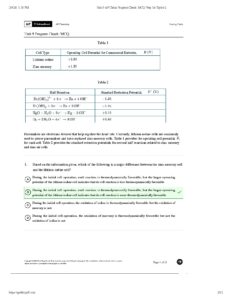
Substance
at
(a) Using the information in the table above, determine the value of at for the process represented by
the equation .
(b) Considering your answer to part (a), indicate whether the process is thermodynamically favorable at
.
Justify your answer.
(c) Considering your answer to part (b), explain why
has a measurable equilibrium vapor pressure at
.
Water vapor can be produced in two different processes, as represented below.
Process 1 Process 2
(d) In terms of concepts of entropy and the particle-level structure of the different phases of water, explain why
the change in entropy, , is greater for process 1 than for process 2.
Part (a)
Select a point value to view scoring criteria, solutions, and/or examples and to score the response.
0 1
The response includes both the following criteria:
Part (b)
AP CHEMISTRY Scoring Guide
Unit 9 Progress Check: FRQ
AP Chemistry
Page 1 of 7
Select a point value to view scoring criteria, solutions, and/or examples and to score the response. The answer to part (b)
must be consistent with part (a). If a student makes an error in a previous part of the question, the student can still earn
credit in a later part if the incorrect answer is used correctly.
0 1
The response indicates that the process is not thermodynamically favorable at
because is positive.(OR, if
part (a) indicates a negative value of
,the response indicates that the process is thermodynamically favorable
because
is negative.)
Part (c)
Select a point value to view scoring criteria, solutions, and/or examples and to score the response.
0 1
The response indicates that even though the process is not thermodynamically favorable, it does not follow that the
process does not occur at all. At equilibrium, the reactant (liquid water) is
favored over the product (water vapor). This
does not mean that some of the liquid water cannot evaporate to become water vapor.
Part (d)
Select a point value to view scoring criteria, solutions, and/or examples and to score the response.
0 1
The response indicates that the change in entropy between ice,
, and water vapor, , is greater because the
entropy of water in the solid phase, with molecules bound in fixed positions within the solid, is less than the entropy of
water in the liquid phase, with molecules able to move more freely and form a greater number of spatial configurations.
Water in the gas phase, with molecules much more dispersed and even more free to move, has the highest entropy of the
three phases. Therefore, process 1 (sublimation) involves a greater change in entropy than process 2 (vaporization of a
liquid) does.
Scoring Guide
Unit 9 Progress Check: FRQ
Page 2 of 7
AP Chemistry
2.
For parts of the free-response question that require calculations, clearly show the method used and the steps
involved in arriving at your answers. You must show your work to receive credit for your answer. Examples and
equations may be included in your answers where appropriate.
Reaction 1:
A chemist wants to produce from a sample of pure according to reaction 1, represented by the
equation above.
(a) Using the data in the following table, calculate the value of the standard entropy change,
, for the
reaction.
Substance
Absolute Entropy at
33
205
43
(b) Given that for reaction 1 is positive , what must be true about the sign of for
the reaction? Justify your answer.
The decomposition of
into and is not a thermodynamically favored reaction. However, to
produce
from , the chemist decides to pass gas over the as it is heated strongly,
as represented below.
Reaction 2:
(c) Is reaction 2 an oxidation-reduction reaction? Justify your answer using oxidation numbers.
A third chemical reaction is represented below.
Reaction 3:
(d) Show how a combination of reaction 1 and reaction 3 can be used to produce reaction 2.
(e) Determine the value of
for reaction 2.
The chemist takes the
produced from reaction 2 and uses it to make an electrode in a galvanic cell, as
shown in the following diagram.
Scoring Guide
Unit 9 Progress Check: FRQ
AP Chemistry
Page 3 of 7
/ 7
End of Document
189
You May Also Like
Faqs of AP Chemistry Unit 9 Progress Check Free Response Guide
What topics are covered in the AP Chemistry Unit 9 Progress Check?
The AP Chemistry Unit 9 Progress Check covers essential topics such as thermodynamics, entropy changes, and oxidation-reduction reactions. Students will engage with free-response questions that require them to calculate standard entropy changes and evaluate the thermodynamic favorability of various reactions. Additionally, the guide includes explanations of how to combine different chemical reactions to produce desired outcomes, which is crucial for understanding reaction mechanisms.
How does the guide help students prepare for the AP Chemistry exam?
This guide assists AP Chemistry students by providing practice with free-response questions that mimic the format of the actual exam. It includes detailed solutions and explanations for each question, helping students understand the underlying concepts and improve their problem-solving skills. By reviewing the scoring criteria, students can learn how to effectively communicate their answers to maximize points during the exam.
What is the significance of calculating standard entropy changes in chemistry?
Calculating standard entropy changes is crucial in thermodynamics as it helps predict the spontaneity of chemical reactions. A positive change in entropy typically indicates that a reaction is thermodynamically favorable, while a negative change suggests the opposite. Understanding these concepts allows chemists to manipulate conditions to favor desired reactions, which is essential in both academic and industrial chemistry.
What are oxidation-reduction reactions and why are they important?
Oxidation-reduction reactions, or redox reactions, involve the transfer of electrons between substances, resulting in changes in oxidation states. These reactions are fundamental in various chemical processes, including combustion, respiration, and corrosion. Understanding redox reactions is vital for students as they form the basis for many practical applications in chemistry, such as electrochemistry and energy production.
How can students use the scoring criteria provided in the guide?
The scoring criteria in the guide serve as a valuable tool for students to understand how their answers will be evaluated in the AP Chemistry exam. By familiarizing themselves with the criteria, students can focus on key aspects of their responses, such as clarity, accuracy, and completeness. This understanding helps them structure their answers effectively, ensuring they meet the expectations of the examiners.