
AP Chemistry Equations and Constants Reference Sheet

AP Chemistry Equations and Constants Reference Sheet

AP Chemistry Equations and Constants Reference Sheet provides essential formulas and constants for students preparing for the AP Chemistry exam. This resource includes key equations related to kinetics, equilibrium, thermodynamics, and gas laws, making it invaluable for exam preparation. It also features the periodic table of elements, unit conversions, and metric prefixes, all crucial for mastering chemistry concepts. Designed for AP Chemistry students, this reference sheet aids in quick recall and application of important principles during study sessions and exams.

Key Points

  • Includes essential AP Chemistry equations for kinetics and equilibrium.
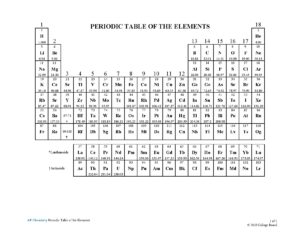
  • Features a comprehensive periodic table of elements with atomic weights.
  • Lists important unit conversions and metric prefixes for chemistry calculations.
  • Provides thermodynamic equations relevant to AP Chemistry curriculum.
225
/ 4
NOTE: You may use any blank space in this booklet for scratch work during the exam. Proctors should collect this
reference information at the conclusion of the exam.
Name: ___________________________________________________
AP
®
Chemistry
2026 EXAM REFERENCE INFORMATION
1 18
PERIODIC TABLE OF THE ELEMENTS
1 2
H
He
1.008
2 13 14 15 16 17
4.00
3
Li
6.94
11
Na
22.99
4
Be
9.01
12
Mg
24.30
3 4 5 6 7 8 9 10 11 12
5
B
10.81
13
Al
26.98
6
C
12.01
14
Si
28.09
7
N
14.01
15
P
30.97
8
O
16.00
16
S
32.06
9
F
19.00
17
Cl
35.45
10
Ne
20.18
18
Ar
39.95
19
K
39.10
20
Ca
40.08
21
Sc
44.96
22
Ti
47.87
23
V
50.94
24
Cr
52.00
25
Mn
54.94
26
Fe
55.85
27
Co
58.93
28
Ni
58.69
29
Cu
63.55
30
Zn
65.38
31
Ga
69.72
32
Ge
72.63
33
As
74.92
34
Se
78.97
35
Br
79.90
36
Kr
83.80
37
Rb
85.47
38
Sr
87.62
39
Y
88.91
40
Zr
91.22
41
Nb
92.91
42
Mo
95.95
43
Tc
44
Ru
101.07
45
Rh
102.91
46
Pd
106.42
47
Ag
107.87
48
Cd
112.41
49
In
114.82
50
Sn
118.71
51
Sb
121.76
52
Te
127.60
53
I
126.90
54
Xe
131.29
55
Cs
132.91
56
Ba
137.33
57-71
72
Hf
178.49
73
Ta
180.95
74
W
183.84
75
Re
186.21
76
Os
190.23
77
Ir
192.22
78
Pt
195.08
79
Au
196.97
80
Hg
200.59
81
Tl
204.38
82
Pb
207.2
83
Bi
208.98
84
Po
85
At
86
Rn
87
Fr
88
Ra
89-103
104
Rf
105
Db
106
Sg
107
Bh
108
Hs
109
Mt
110
Ds
111
Rg
112
Cn
113
Nh
114
Fl
115
Mc
116
Lv
117
Ts
118
Og
57 58 59 60 61 62 63 64 65 66 67 68 69 70 71
*Lanthanoids
La Ce Pr Nd Pm Sm Eu Gd Tb Dy Ho Er Tm Yb Lu
138.91
89
Actinoids
Ac
140.12 140.91 144.24 150.36 151.97 157.25 158.93 162.50 164.93 167.26 168.93 173.05 174.97
90
Th
232.04
91
Pa
231.04
92
U
238.03
93
Np
94
Pu
95
Am
96
Cm
97
Bk
98
Cf
99
Es
100
Fm
101
Md
102
No
103
Lr
*
AP Chemistry
|
1
© 2025 College Board
AP
®
CHEMISTRY EQUATIONS AND CONSTANTS
UNIT SYMBOLS
gram, g
mole, mol
liter, L
meter, m
second, s
hertz, Hz
atmosphere, atm
millimeter of mercury, mm Hg
degree Celsius, °C
kelvin, K
joule, J
volt, V
coulomb, C
ampere, A
UNIT CONVERSIONS
1 hertz = 1 s
1
1 atm = 760 mm Hg = 760 torr
K= °+C 273.15
1 joule
1 volt =
1 coulomb
1 ampere =
1 coulomb
1 second
METRIC PREFIXES
Factor Prefix Symbol
10
9
giga G
10
6
mega M
10
3
kilo k
10
2
centi c
10
3
milli m
10
6
micro μ
10
9
nano n
10
12
pico p
ATOMIC STRUCTURE
E = h
c =
12
F
coulombic
qq
2
r
GASES, LIQUIDS, AND SOLUTIONS
PV
11
=
PV
22
T
1
T
2
PV
=
nRT
P
A
= P
total
×
X
A
, where X
A
=
moles A
total moles
P
total
=
P
A
+
P
B
+
P
C
+ ...
n
=
m
M
D
=
m
V
KE
=
1
2
mv
2
M
=
n
solute
L
solution
A = bc
E = energy
= frequency
= wavelength
F
= force
q
= charge
r
= separation
Planck's constant,
h
= 6.626 × 10
34
J s
8 1
Speed of light,
c
= 2.998 × 10 m s
Avogadro's number = 6.022 × 10
23
mol
1
P = pressure
V = volume
T = temperature
n = numberofmoles
X = mole fraction
m = mass
M
= molarmass
D
= density
KE
= kinetic energy
v
= velocity
M
= molarity
A
= absorbance
= molarabsorptivity
b
= path length
c
= concentration
1
Gasconstant,
R
= 8.314 Jmol
K
1
= 0.08206L atmmol
1
K
1
STP = 273.15 Kand 1.0 atm
Ideal gasatSTP = 22.4 Lmol
1
AP Chemistry
© 2025 College Board
2
/ 4
End of Document
225
You May Also Like
Faqs of AP Chemistry Equations and Constants Reference Sheet
What key equations are included in the AP Chemistry reference sheet?
The AP Chemistry Equations and Constants Reference Sheet includes vital equations for kinetics, such as the rate law and integrated rate laws, as well as equilibrium expressions for both Kc and Kp. It also covers thermodynamic equations, including the relationship between enthalpy, entropy, and Gibbs free energy. These equations are essential for solving problems related to chemical reactions and understanding reaction dynamics.
How does the reference sheet assist with gas law calculations?
The reference sheet provides the ideal gas law equation PV=nRT, which is crucial for calculating the behavior of gases under various conditions. It also includes specific gas constants and unit conversions, allowing students to easily switch between different units of pressure, volume, and temperature. This makes it an essential tool for solving gas law problems in AP Chemistry.
What is the significance of the periodic table included in the reference sheet?
The periodic table included in the AP Chemistry reference sheet lists all elements along with their atomic numbers and weights, which are fundamental for understanding chemical properties and reactions. It serves as a quick reference for students to identify elements and their characteristics, aiding in the study of periodic trends, bonding, and stoichiometry.
What topics are covered in the thermodynamics section of the reference sheet?
The thermodynamics section of the reference sheet covers key concepts such as enthalpy changes, entropy, and Gibbs free energy. It provides equations that relate these concepts, helping students understand the energy changes associated with chemical reactions. This section is vital for mastering the principles of thermodynamics as they apply to chemical processes.
How can students use this reference sheet during their AP Chemistry exam?
Students can use the AP Chemistry Equations and Constants Reference Sheet during the exam to quickly access important formulas and constants. This allows them to efficiently solve problems related to kinetics, thermodynamics, and equilibrium without the need to memorize every equation. Having this resource at hand can significantly enhance their performance by saving time and reducing errors.