AP English Language and Composition Exam Practice Test

AP English Language and Composition Exam Practice Test

The AP English Language and Composition Exam Practice Test prepares students for the AP exam by providing a comprehensive set of multiple-choice questions and free-response prompts. This practice test includes selections from notable prose works, such as Jonathan Swift's satirical essay 'A Modest Proposal' and Mary Wollstonecraft's 'A Vindication of the Rights of Women.' Designed for high school students aiming to excel in AP English, the test covers various literary themes, rhetorical devices, and critical analysis skills. It also features detailed instructions and scoring guidelines to help students understand the exam format and expectations.

Key Points

  • Includes multiple-choice questions based on classic literature and essays.
  • Features free-response questions that encourage critical thinking and analysis.
  • Covers significant works like 'A Modest Proposal' and 'A Vindication of the Rights of Women.'
  • Provides insights into rhetorical strategies and literary devices used by authors.
245
/ 23
AP
®
English Language
and Composition Exam
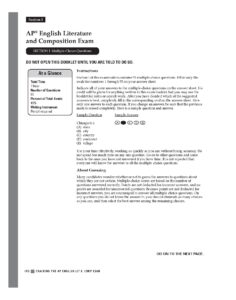
SECTION I: Multiple-Choice Questions
DO NOT OPEN THIS BOOKLET UNTIL YOU ARE TOLD TO DO SO.
Instructions
Section I of this examination contains 54 multiple-choice questions. Fill in only the ovals for
numbers 1 through 54 on your answer sheet.
Indicate all of your answers to the multiple-choice questions on the answer sheet. No credit
will be given for anything written in this exam booklet, but you may use the booklet for notes
or scratch work. After you have decided which of the suggested answers is best, completely
fill in the corresponding oval on the answer sheet. Give only one answer to each question. If
you change an answer, be sure that the previous mark is erased completely. Here is a sample
question and answer.
Sample Question Sample Answer
Chicago is a
A
B
C
D
E
(A) state
(B) city
(C) country
(D) continent
(E) village
Use your time effectively, working as quickly as you can without losing accuracy. Do not
spend too much time on any one question. Go on to other questions and come back to the
ones you have not answered if you have time. It is not expected that everyone will know the
answers to all the multiple-choice questions.
About Guessing
Many candidates wonder whether or not to guess the answers to questions about which
they are not certain. Multiple choice scores are based on the number of questions answered
correctly. Points are not deducted for incorrect answers, and no points are awarded for
unanswered questions. Because points are not deducted for incorrect answers, you are
encouraged to answer all multiple-choice questions. On any questions you do not know the
answer to, you should eliminate as many choices as you can, and then select the best answer
among the remaining choices.
The Exam
At a Glance
Total Time
1 hour
Number of Questions
54
Percent of Total Grade
45%
Writing Instrument
Pencil required
Section I
GO ON TO THE NEXT PAGE.
154
|
Cracking the AP English Language & Composition Exam
ENGLISH LANGUAGE AND COMPOSITION
SECTION I
Time—1 hour
Directions: This part consists of selections from prose works and questions on their content, form, and style. After reading each
passage, choose the best answer to each question and completely fill in the corresponding oval on the answer sheet.
Note: Pay particular attention to the requirement of questions that contain the words NOT, LEAST, or EXCEPT.
Questions 1-10. Read the following passage carefully before
you choose your answers.
(The following passage is from Jonathan Swift’s 1729 essay
“A Modest Proposal.”)
There only remains one hundred and twenty thousand
children of poor parents annually born. The question
therefore is, how this number shall be reared and provided
for, which, as I have already said, under the present situation
of affairs, is utterly impossible by all the methods hitherto
proposed. For we can neither employ them in handicraft or
agriculture; we neither build houses (I mean in the country)
nor cultivate land: they can very seldom pick up a livelihood
by stealing, till they arrive at six years old, except where
they are of towardly parts, although I confess they learn the
rudiments much earlier, during which time, they can however
be properly looked upon only as probationers, as I have been
informed by a principal gentleman in the county of Cavan,
who protested to me that he never knew above one or two
instances under the age of six, even in a part of the kingdom
so renowned for the quickest proficiency in that art.
I am assured by our merchants, that a boy or a girl
before twelve years old is no salable commodity; and even
when they come to this age they will not yield above three
pounds, or three pounds and half-a-crown at most on the
exchange; which cannot turn to account either to the parents
or kingdom, the charge of nutriment and rags having been at
least four times that value.
I shall now therefore humbly propose my own thoughts,
which I hope will not be liable to the least objection.
I have been assured by a very knowing American of my
acquaintance in London, that a young healthy child well
nursed is at a year old a most delicious, nourishing, and
wholesome food, whether stewed, roasted, baked, or boiled;
and I make no doubt that it will equally serve in a fricassee
or a ragout.
I do therefore humbly offer it to public consideration
that of the hundred and twenty thousand children already
computed, twenty thousand may be reserved for breed,
whereof only one-fourth part to be males; which is more
than we allow to sheep, black cattle or swine; and my reason
is, that these children are seldom the fruits of marriage, a
circumstance not much regarded by our savages, therefore
one male will be sufficient to serve four females. That the
remaining hundred thousand may, at a year old, be offered
in the sale to the persons of quality and fortune through
the kingdom; always advising the mother to let them suck
plentifully in the last month, so as to render them plump
and fat for a good table. A child will make two dishes at an
entertainment for friends; and when the family dines alone,
the fore or hind quarter will make a reasonable dish, and
seasoned with a little pepper or salt will be very good boiled
on the fourth day, especially in winter.
I have reckoned upon a medium that a child just born
will weigh 12 pounds, and in a solar year, if tolerably nursed,
increaseth to 28 pounds.
I grant this food will be somewhat dear, and therefore
very proper for landlords, who, as they have already
devoured most of the parents, seem to have the best title to
the children.
1. This text can best be described as
(A) scientific
(B) satirical
(C) forthright
(D) humanitarian
(E) sadistic
2. In the first, second, and fourth paragraphs the
author relies on dubious
(A) similes
(B) ad hominem arguments
(C) extended metaphors
(D) arguments from authority
(E) appeals to ignorance
Line
5
10
15
20
25
30
35
40
45
50
55
Section I
GO ON TO THE NEXT PAGE.
156
|
Cracking the AP English Language & Composition Exam

3. It can be inferred that the “merchants” (line 17) and the
American” (line 26) represent
(A) cannibals who routinely eat children
(B) the author’s fictional acquaintances
(C) aristocrats who exploit the poor
(D) businessmen well-versed in commerce
(E) typical Londoners
4. The phrase “the charge of nutriment and rags having
been at least four times that value” (lines 22-23) is ironic
chiefly because
(A) food was relatively cheap at that time
(B) “four times” is a mere approximation
(C) twelve pounds is a very small sum of money
(D) the parents could not support their children without
the aid of the kingdom
(E) there is no evidence that the children were wearing
rags
5. The word “fricassee” (line 30) is best interpreted to mean
(A) animal
(B) child
(C) dish
(D) place
(E) master
6. Which of the following rhetorical devices does the author
employ in lines 32-39?
(A) process analysis
(B) example
(C) cause and effect
(D) deductive reasoning
(E) analogy
7. The phrase “always advising the mother to let them suck
plentifully in the last month” (lines 42-43) extends the
comparison between the children and
(A) properly nourished mammals
(B) poor and ruthless parents
(C) savages
(D) animals raised for slaughter
(E) the poor treatment of animals
8. In line 52, “dear” means
(A) expensive
(B) sweet
(C) cherished
(D) unforgettable
(E) unhealthy
9. In context, “devoured” (line 54) is an effective word
choice because
(A) it fits both figuratively and literally
(B) it is appropriate only literally
(C) it is indicative of the landlords’ plight
(D) it works as a sentimental appeal
(E) it reveals the author’s point of view
10. The author mentions “sheep, black cattle, or swine” (line
36) in order to convey which of the following ideas?
(A) Animals are often treated more humanely than are
children.
(B) Large numbers of animals should be kept for
breeding purposes.
(C) Male animals are often more effective for breeding
than female animals.
(D) The poor are often used as commodities to profit
their owners.
(E) Marriage is not universally valued in all cultures.
Section I
GO ON TO THE NEXT PAGE.
Practice Test 1
|
157
/ 23
End of Document
245
You May Also Like
Faqs of AP English Language and Composition Exam Practice Test
What types of questions are included in the AP English Language practice test?
The practice test includes multiple-choice questions that assess comprehension of prose selections, as well as free-response prompts that require students to analyze and interpret texts. These questions are designed to mirror the format of the actual AP exam, helping students familiarize themselves with the types of content and skills they will need to demonstrate.
How does the practice test help students prepare for the AP exam?
By simulating the exam experience, the practice test allows students to practice their reading comprehension and analytical skills. It provides exposure to a variety of texts, including essays and literary excerpts, which are crucial for the AP English Language exam. Additionally, the test includes scoring guidelines that help students understand how their responses will be evaluated.
What literary works are analyzed in the practice test?
The practice test features excerpts from significant literary works, including Jonathan Swift's 'A Modest Proposal' and Mary Wollstonecraft's 'A Vindication of the Rights of Women.' These texts are selected for their rich themes and rhetorical techniques, providing students with opportunities to engage deeply with the material and develop their critical thinking skills.
What skills are emphasized in the AP English Language practice test?
The practice test emphasizes skills such as critical reading, analytical writing, and understanding of rhetorical devices. Students are encouraged to identify the author's purpose, analyze the effectiveness of arguments, and articulate their thoughts clearly in written responses. These skills are essential for success not only on the AP exam but also in college-level coursework.
How many questions are included in the multiple-choice section of the practice test?
The multiple-choice section of the practice test includes 54 questions. These questions are designed to assess students' understanding of various prose works, literary devices, and rhetorical strategies, reflecting the content and structure of the actual AP English Language and Composition exam.