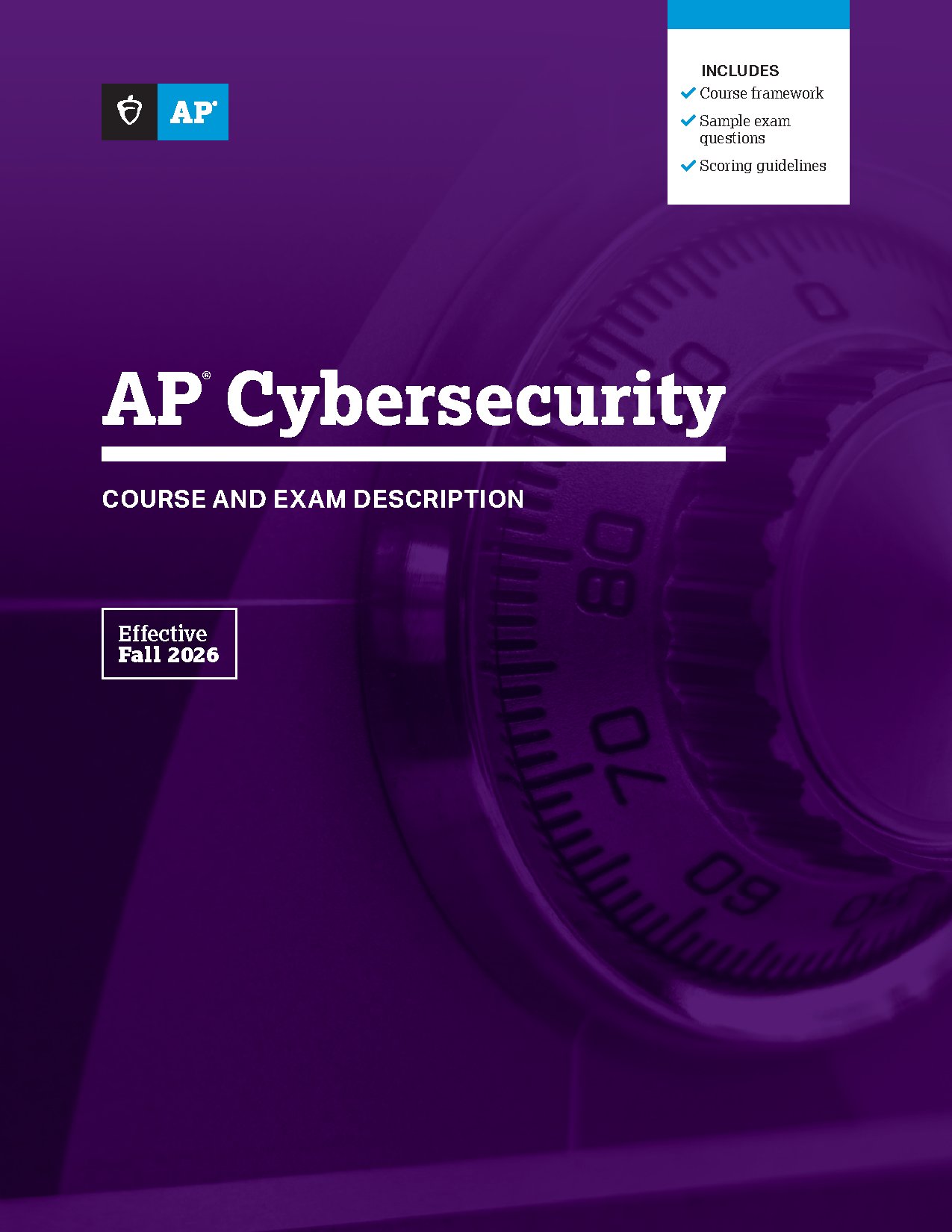
AP Cybersecurity Course and Exam Description

AP Cybersecurity Course and Exam Description

AP Cybersecurity provides a comprehensive framework for understanding cybersecurity concepts and practices. This course equips students with the skills needed to analyze risks, mitigate threats, and detect cyberattacks. It covers essential topics such as device security, network vulnerabilities, and application protection. Designed for high school students, the course prepares them for the AP exam and future careers in cybersecurity. The curriculum aligns with industry standards and includes hands-on learning opportunities.

Key Points

  • Covers risk analysis, threat mitigation, and attack detection
  • Includes hands-on learning and real-world applications
  • Prepares students for the AP Cybersecurity exam
  • Aligns with industry standards and NICE Workforce Framework
282
/ 192
Effective
Fall 2026
INCLUDES
Course framework
Sample exam
questions
Scoring guidelines
AP
®
Cybersecurity
COURSE AND EXAM DESCRIPTION
i
AP COURSE AND EXAM DESCRIPTIONS ARE UPDATED PERIODICALLY
Please visit AP Central to determine whether a more recent course and
exam description is available.
Effective
Fall 2026
AP
®
Cybersecurity
COURSE AND EXAM DESCRIPTION
ii
What AP
®
Stands For
Thousands of Advanced Placement teachers have contributed to the principles
articulated here. These principles are not new; they are, rather, a reminder of how AP
already works in classrooms nationwide. The following principles are designed to
ensure that teachers’ expertise is respected, required course content is understood,
and that students are academically challenged and free to make up their own minds.
1.
AP stands for clarity and transparency. Teachers and students deserve clear
expectations. The Advanced Placement Program makes public its course
frameworks and sample assessments. Confusion about what is permitted in the
classroom disrupts teachers and students as they navigate demanding work.
2.
fl
develop as independent thinkers and to draw their own conclusions. Evidence
fi
3.
AP opposes censorship. AP is animated by a deep respect for the intellectual
freedom of teachers and students alike. If a school bans required topics from
their AP courses, the AP Program removes the AP designation from that course
and its inclusion in the AP Course Ledger provided to colleges and universities.
For example, the concepts of evolution are at the heart of college biology, and a
course that neglects such concepts does not pass muster as AP Biology.
4.
ff
perspectives from their own, and no points on the AP Exam are awarded for
fi
certain ways about themselves or the course content. AP courses instead
develop students’ abilities to assess the credibility of sources, draw conclusions,
and make up their own minds.
As the AP English Literature course description states: “AP students are not
fi
ff
ff
within the literary work as a whole.
5.
AP courses foster an open-minded approach to the histories and cultures
ffff
races, and ethnicities is essential within a variety of academic disciplines. AP
courses ground such studies in primary sources so that students can evaluate
experiences and evidence for themselves.
6.
Every AP student who engages with evidence is listened to and respected.
Students are encouraged to evaluate arguments but not one another. AP
classrooms respect diversity in backgrounds, experiences, and viewpoints. The
perspectives and contributions of the full range of AP students are sought and
considered. Respectful debate of ideas is cultivated and protected; personal
attacks have no place in AP.
7.
AP is a choice for parents and students. Parents and students freely choose to enroll
in AP courses. Course descriptions are available online for parents and students to
fi
AP courses; AP course and exam materials are crafted by committees of professors
fi
fi
AP scores for college credits by thousands of colleges and universities nationwide.
The AP Program encourages educators to review these principles with parents
and students so they know what to expect in an AP course. Advanced Placement is
always a choice, and it should be an informed one. AP teachers should be given the
fi
they have agreed to a classroom experience that embodies these principles.
© 2026 The Advanced Placement Program, AP, AP Central, and the acorn logo are registered trademarks
of the College Board. All other products and services may be trademarks of their respective owners.
Visit College Board on the web:
collegeboard.org.

/ 192
End of Document
282
You May Also Like
Faqs of AP Cybersecurity Course and Exam Description
What topics are covered in the AP Cybersecurity course?
The AP Cybersecurity course covers a wide range of topics including risk analysis, device security, network vulnerabilities, and application protection. Students learn about common cyber threats and how to mitigate them using various security controls. The curriculum emphasizes hands-on learning, allowing students to apply theoretical knowledge to real-world scenarios. Additionally, the course prepares students for the AP exam, equipping them with the skills necessary for careers in cybersecurity.
How does the AP Cybersecurity exam assess student knowledge?
The AP Cybersecurity exam consists of multiple-choice questions and a free-response section. It assesses students' understanding of the skills and learning objectives outlined in the course framework. Students must analyze provided sources, identify security issues, and demonstrate their ability to apply cybersecurity concepts. The exam is designed to evaluate both theoretical knowledge and practical application, ensuring that students are well-prepared for future challenges in the field.
What is the significance of the NICE Workforce Framework in the AP Cybersecurity course?
The NICE Workforce Framework provides a structured approach to cybersecurity education and workforce development. It outlines the skills and competencies necessary for various roles in the cybersecurity field. By aligning the AP Cybersecurity course with this framework, students gain relevant knowledge that meets industry standards. This alignment helps prepare students for successful careers in cybersecurity, ensuring they possess the skills employers are seeking.
What are some key skills students develop in the AP Cybersecurity course?
Students in the AP Cybersecurity course develop critical skills such as risk assessment, threat detection, and incident response. They learn to analyze vulnerabilities in devices and networks, implement security controls, and respond to cyber threats effectively. The course also emphasizes collaboration and communication skills, which are essential in the cybersecurity field. By engaging in hands-on projects, students gain practical experience that enhances their understanding of cybersecurity principles.