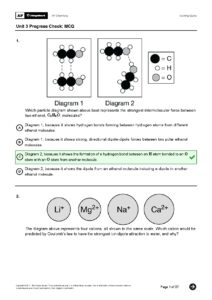

AP Chemistry Unit 8 Progress Check MCQ Answers

AP Chemistry Unit 8 Progress Check MCQ Answers

AP Chemistry Unit 8 Progress Check focuses on key concepts of chemical equilibrium, acid-base reactions, and titration processes. It includes multiple-choice questions (MCQs) designed for students preparing for the AP Chemistry exam. The content covers topics such as the autoionization of water, percent ionization of weak acids, and buffer solutions. This resource is essential for AP Chemistry students aiming to enhance their understanding and performance in the May exam.

Key Points

  • Includes multiple-choice questions on chemical equilibrium and acid-base chemistry.
  • Covers topics such as autoionization of water and buffer solutions.
  • Designed for AP Chemistry students preparing for the May exam.
  • Focuses on percent ionization and titration processes.
322
/ 20
AP Chemistry Scoring Guide
Unit 8 Progress Check: MCQ
Copyright © 2017. The College Board. These materials are part of a College Board program. Use or distribution of these materials online or
in print beyond your school’s participation in the program is prohibited.
Page 1 of 20
1.
Pure water autoionizes as shown in the equation above. Based on this information, which of the
following is correct?
A
The autoionization equilibrium for pure water favors the formation of reactants at compared to
.
B
The autoionization equilibrium for pure water produces the same amount of ions at and
.
C
At , for pure water.
D
At , for pure water.
2.
at
Based on the information above, which of the following is true for a sample of pure water at ?
A
B
C
D
3.
The endothermic autoionization of pure water is represented by the chemical equation shown
above. The of pure water is measured to be 7.00 at and 6.02 at . Which of the
following statements best explains these observations?
AP Chemistry Scoring Guide
Unit 8 Progress Check: MCQ
Copyright © 2017. The College Board. These materials are part of a College Board program. Use or distribution of these materials online or
in print beyond your school’s participation in the program is prohibited.
Page 2 of 20
A
At the higher temperature water dissociates less, , and the water becomes basic.
B
At the higher temperature water dissociates less, , and the water remains neutral.
C
At the higher temperature water dissociates more, , and the water becomes acidic.
D
At the higher temperature water dissociates more, , and the water remains neutral.
4.
Which of the following gives the best estimate for the of a solution at
?
A
because is a strong acid.
B
because is a weak acid.
C
because is a weak base.
D
because is a strong base.
5. Which of the following gives the best estimate for the of a solution at
?
AP Chemistry Scoring Guide
Unit 8 Progress Check: MCQ
Copyright © 2017. The College Board. These materials are part of a College Board program. Use or distribution of these materials online or
in print beyond your school’s participation in the program is prohibited.
Page 3 of 20
A
because is a strong acid.
B
because is a strong acid.
C
because is a strong base.
D
because is a strong base.
6. Which of the following is the correct mathematical relationship to use to calculate the of a
aqueous solution?
A
B
C
D
7. at
Initial
Percent Ionization Equilibrium
0.150 3.4%
0.100 4.2%
0.0500 5.8%
The equilibrium for the acid ionization of is represented by the equation above and the
table gives the percent ionization for at different initial concentrations of the weak acid at
. Based on the information, which of the following is true for a aqueous solution of
?
/ 20
End of Document
322
You May Also Like
Faqs of AP Chemistry Unit 8 Progress Check MCQ Answers
What topics are covered in the AP Chemistry Unit 8 Progress Check?
The AP Chemistry Unit 8 Progress Check covers essential topics such as chemical equilibrium, the autoionization of water, and the behavior of weak acids and bases. It includes multiple-choice questions that assess students' understanding of these concepts. Key themes include the calculation of pH, percent ionization, and the properties of buffer solutions. This comprehensive review is crucial for students preparing for the AP Chemistry exam.
How does the autoionization of water relate to pH?
The autoionization of water is a fundamental concept in acid-base chemistry, where water dissociates into hydrogen ions (H⁺) and hydroxide ions (OH⁻). At 25°C, pure water has a neutral pH of 7, indicating equal concentrations of H⁺ and OH⁻. Understanding this equilibrium is essential for calculating pH in various solutions, particularly when dealing with acids and bases. The relationship between ion concentrations and pH is critical for students to grasp in AP Chemistry.
What is the significance of buffer solutions in chemistry?
Buffer solutions play a crucial role in maintaining pH stability in chemical reactions and biological systems. They consist of a weak acid and its conjugate base, allowing them to resist changes in pH when small amounts of acids or bases are added. Understanding how buffers work is essential for students in AP Chemistry, as it applies to many real-world scenarios, including physiological processes and industrial applications. The ability to calculate the pH of buffer solutions is a key skill assessed in the AP exam.
What is percent ionization and why is it important?
Percent ionization measures the extent to which a weak acid or base dissociates in solution. It is calculated by dividing the concentration of ionized species by the initial concentration and multiplying by 100. This concept is important in understanding the strength of acids and bases, as well as their behavior in different concentrations. In the context of the AP Chemistry exam, students must be able to calculate and interpret percent ionization to predict the outcomes of acid-base reactions.