AP Chemistry Unit 9 Progress Check MCQ Questions

AP Chemistry Unit 9 Progress Check MCQ Questions

AP Chemistry Unit 9 Progress Check features multiple-choice questions designed to assess students' understanding of key concepts in electrochemistry, thermodynamics, and chemical reactions. This resource is ideal for AP Chemistry students preparing for the exam, covering topics such as cell potentials, half-reactions, and entropy changes. The questions align with the College Board's curriculum framework and provide a comprehensive review for students. With a focus on critical thinking and application, this progress check helps reinforce essential chemistry principles.

Key Points

  • Includes multiple-choice questions on electrochemistry and thermodynamics.
  • Covers key concepts such as cell potential and half-reaction analysis.
  • Designed for AP Chemistry students preparing for their exams.
  • Aligns with the College Board's curriculum framework for AP Chemistry.
222
/ 21
AP Chemistry Scoring Guide
Unit 9 Progress Check: MCQ
Copyright © 2020. The College Board. These materials are part of a College Board program. Use or distribution of these materials online or in print
beyond your school’s participation in the program is prohibited.
Page 1 of 21
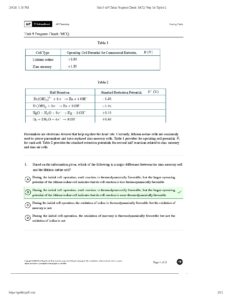
Table 1
Cell Type Operating Cell Potential for Commercial Batteries,
Lithium-iodine
Zinc-mercury
Table 2
Half-Reaction Standard Reduction Potential,
used to power pacemakers and have replaced zinc-mercury cells. Table 1 provides the operating cell potential, ,
for each cell. Table 2 provides the standard reduction potentials for several half-reactions related to zinc-mercury
and zinc-air cells.
1. Based on the information given, which of the following is a major difference between the zinc-mercury cell
and the lithium-iodine cell?
A
During the initial cell operation, each reaction is thermodynamically favorable, but the larger operating
potential of the lithium-iodine cell indicates that its cell reaction is less thermodynamically favorable.
B
During the initial cell operation, each reaction is thermodynamically favorable, but the larger operating
potential of the lithium-iodine cell indicates that its cell reaction is more thermodynamically favorable.
C
During the initial cell operation, the oxidation of iodine is thermodynamically favorable but the oxidation of
mercury is not.
D
During the initial cell operation, the oxidation of mercury is thermodynamically favorable but not the
oxidation of iodine is not.
5/9/26, 3:50 PM
Unit 9 AP Chem Progress Check: MCQ Prep for Taylor 2

https://getthispdf.com
1/21
AP Chemistry Scoring Guide
Unit 9 Progress Check: MCQ
Copyright © 2020. The College Board. These materials are part of a College Board program. Use or distribution of these materials online or in print
beyond your school’s participation in the program is prohibited.
Page 2 of 21
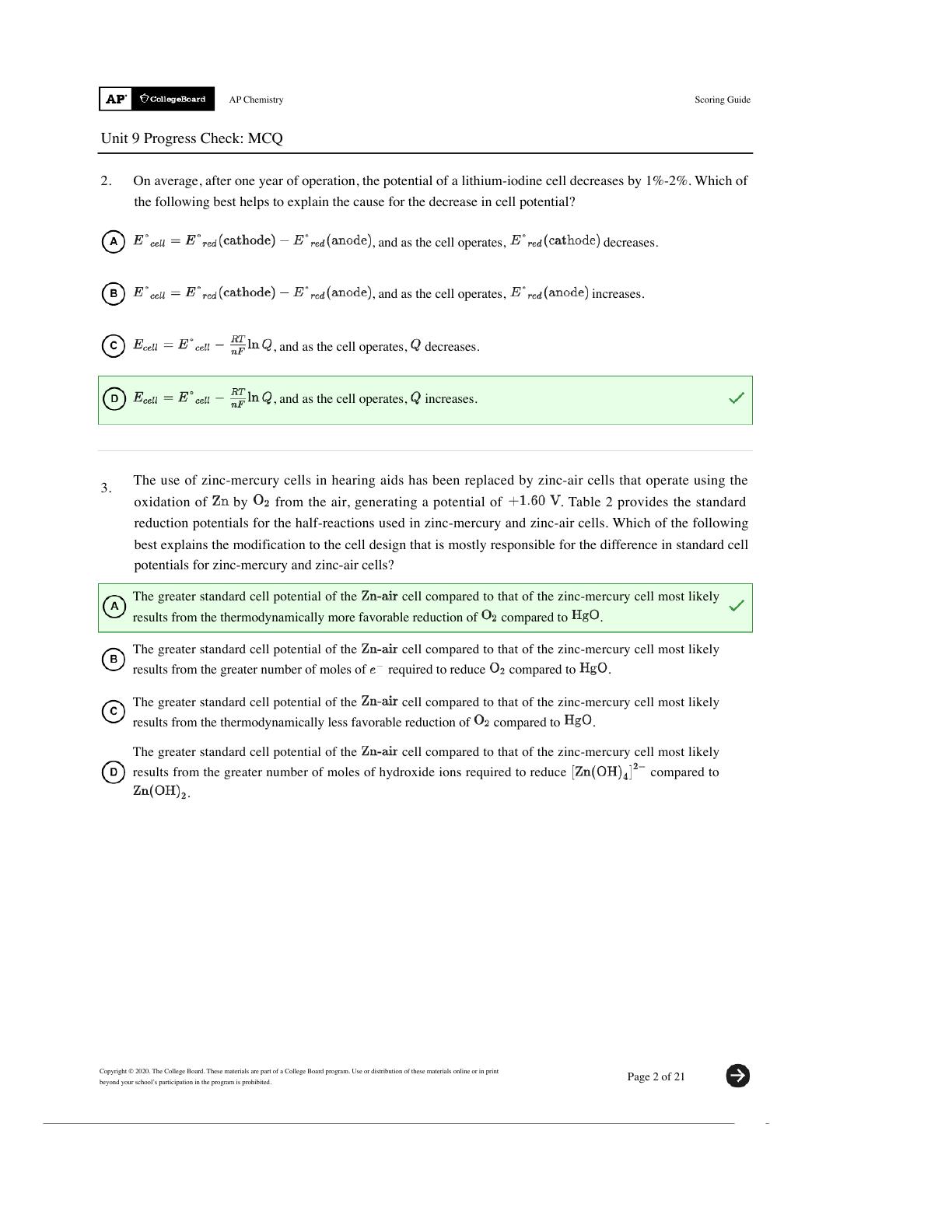
2. On average, after one year of operation, the potential of a lithium-iodine cell decreases by 1%-2%. Which of
the following best helps to explain the cause for the decrease in cell potential?
A
, and as the cell operates, decreases.
B
, and as the cell operates, increases.
C
, and as the cell operates, decreases.
D
, and as the cell operates, increases.
3.
The use of zinc-mercury cells in hearing aids has been replaced by zinc-air cells that operate using the
oxidation of by from the air, generating a potential of . Table 2 provides the standard
reduction potentials for the half-reactions used in zinc-mercury and zinc-air cells. Which of the following
best explains the modification to the cell design that is mostly responsible for the difference in standard cell
potentials for zinc-mercury and zinc-air cells?
A
The greater standard cell potential of the cell compared to that of the zinc-mercury cell most likely
results from the thermodynamically more favorable reduction of compared to .
B
The greater standard cell potential of the cell compared to that of the zinc-mercury cell most likely
results from the greater number of moles of required to reduce compared to .
C
The greater standard cell potential of the cell compared to that of the zinc-mercury cell most likely
results from the thermodynamically less favorable reduction of compared to .
D
The greater standard cell potential of the cell compared to that of the zinc-mercury cell most likely
results from the greater number of moles of hydroxide ions required to reduce compared to
.
5/9/26, 3:50 PM
Unit 9 AP Chem Progress Check: MCQ Prep for Taylor 2

https://getthispdf.com
2/21
AP Chemistry Scoring Guide
Unit 9 Progress Check: MCQ
Copyright © 2020. The College Board. These materials are part of a College Board program. Use or distribution of these materials online or in print
beyond your school’s participation in the program is prohibited.
Page 3 of 21
4.
The diagrams above represent physical changes for potassium. Which of the following correctly identifies
the physical process and provides the correct for the process in the indicated diagram?
A
In diagram 1, the process is freezing and is negative.
B
In diagram 2, the process is melting and is negative.
C
In diagram 3, the process is boiling and is negative.
D
In diagram 4, the process is condensation and is positive.
5.
Two samples containing an equal number of moles of are kept inside separate 1-liter rigid containers.
The particle diagrams above show the distribution of molecular speeds in each sample. Based on the
information given, which of the following identifies the sample with the greater , and why?
5/9/26, 3:50 PM
Unit 9 AP Chem Progress Check: MCQ Prep for Taylor 2
https://getthispdf.com
3/21
/ 21
End of Document
222
You May Also Like
Faqs of AP Chemistry Unit 9 Progress Check MCQ Questions
What topics are covered in the AP Chemistry Unit 9 Progress Check?
The AP Chemistry Unit 9 Progress Check covers essential topics in electrochemistry, including cell potentials, standard reduction potentials, and thermodynamic principles. Students will encounter questions related to the operation of galvanic and electrolytic cells, as well as the concepts of oxidation and reduction. Additionally, the check assesses understanding of entropy changes and Gibbs free energy, providing a comprehensive review of the unit's key concepts.
How does the progress check assess students' understanding of thermodynamics?
The progress check includes multiple-choice questions that require students to apply their knowledge of thermodynamic principles, such as enthalpy, entropy, and Gibbs free energy. Students must analyze scenarios involving chemical reactions and predict whether they are thermodynamically favorable. By working through these questions, students reinforce their understanding of how energy changes influence chemical processes and the spontaneity of reactions.
What types of questions can students expect in this progress check?
Students can expect a variety of multiple-choice questions that challenge their critical thinking and application skills. Questions may involve interpreting graphs, analyzing chemical equations, and calculating cell potentials based on given data. The format is designed to mimic the style of AP exam questions, helping students prepare effectively for the actual test.
How can this progress check help students prepare for the AP Chemistry exam?
This progress check serves as a valuable tool for AP Chemistry exam preparation by providing practice questions that align with the College Board's curriculum. By engaging with these multiple-choice questions, students can identify areas of strength and weakness in their understanding of key concepts. Additionally, the questions encourage active learning and application of knowledge, which are crucial for success on the AP exam.