(A)
The pressures of the gases used by the second chemist must have been lower than those used by the first
chemist, thus the collisions between reacting particles were less frequent than they were in the first
chemist's experiments.
(B)
The pressures of the gases used by the second chemist must have been lower than those used by the first
chemist, thus the number of collisions with sufficient energy to cause reaction was lower than it was in
the first chemist's experiments.
(C)
The second chemist must have added a catalyst for the reaction, thus providing a different reaction
pathway for the reactant particles to react with an activation energy that was lower than that of the
uncatalyzed reaction in the first chemist's experiments.
(D)
The second chemist must have added a catalyst for the reaction, thus providing energy to reactant
particles to increase their rate of reaction compared to their rate of reaction in the first chemist's
experiments.
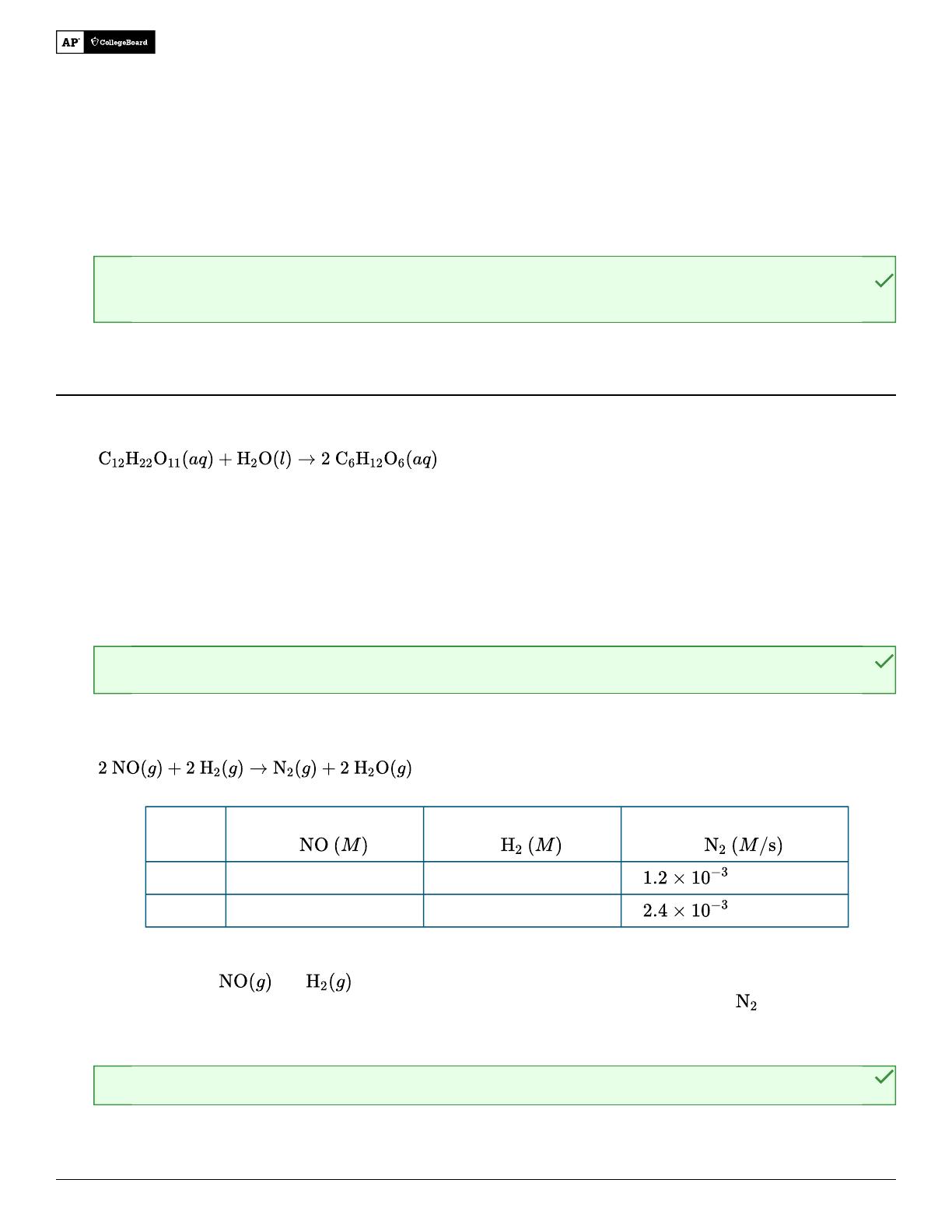
4.
The chemical equation shown above represents the hydrolysis of sucrose. Under certain conditions, the rate is
directly proportional to the concentration of sucrose. Which statement supports how a change in conditions can
increase the rate of this reaction?
(A)
Increasing the amount of water in which the sugar is dissolved will increase the frequency of collisions
between the sucrose molecules and the water molecules resulting in an increase in the rate of hydrolysis.
(B)
Decreasing the temperature will increase the frequency of the collisions between the sucrose molecules
and the water molecules resulting in an increase in the rate of hydrolysis.
(C)
Increasing the concentration of sucrose will increase the rate of hydrolysis by increasing the frequency
of the collisions between the sucrose and the water molecules.
(D)
Decreasing the concentration of sucrose will increase the rate of hydrolysis by increasing the frequency
of the collisions between the sucrose and the water molecules.
5.
Trial
Initial Concentration
of
Initial Concentration
of
Initial Rate of Formation
of
1 0.10 0.10
2 0.10 0.20
The information in the data table above represents two different trials for an experiment to study the rate of the
reaction between and , as represented by the balanced equation above the table. Which of the
following statements provides the correct explanation for why the initial rate of formation of
is greater in trial 2
than in trial 1? Assume that each trial is carried out at the same constant temperature.
(A) The activation energy of the reaction is smaller in trial 2 than it is in trial 1.
(B) The frequency of collisions between reactant molecules is greater in trial 2 than it is in trial 1.
(C) The value of the rate constant for the reaction is smaller in trial 2 than it is in trial 1.
(D) The value of the rate constant for the reaction is greater in trial 2 than it is in trial 1.
Scoring Guide
Unit 5 Progress Check: MCQ
Page 2 of 14
AP Chemistry