AP World History Unit 1: 100 Multiple Choice Questions Guide

AP World History Unit 1: 100 Multiple Choice Questions Guide

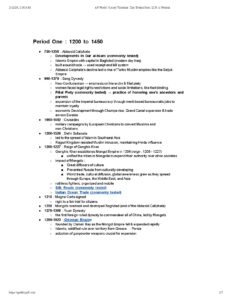
AP World History Unit 1 focuses on key themes and concepts relevant to early global interactions and civilizations. This guide includes 100 multiple-choice questions designed to help students prepare for the AP World History exam. Topics covered include trade networks, cultural exchanges, and significant historical figures from various regions. Ideal for high school students aiming to strengthen their understanding of world history concepts and improve their test-taking skills. Each question is crafted to align with the AP curriculum, ensuring comprehensive coverage of essential material.

Key Points

  • Includes 100 multiple-choice questions aligned with AP World History curriculum.
  • Covers themes such as trade networks and cultural exchanges in early civilizations.
  • Designed for high school students preparing for the AP World History exam.
  • Focuses on significant historical figures and events from various regions.
353
/ 38
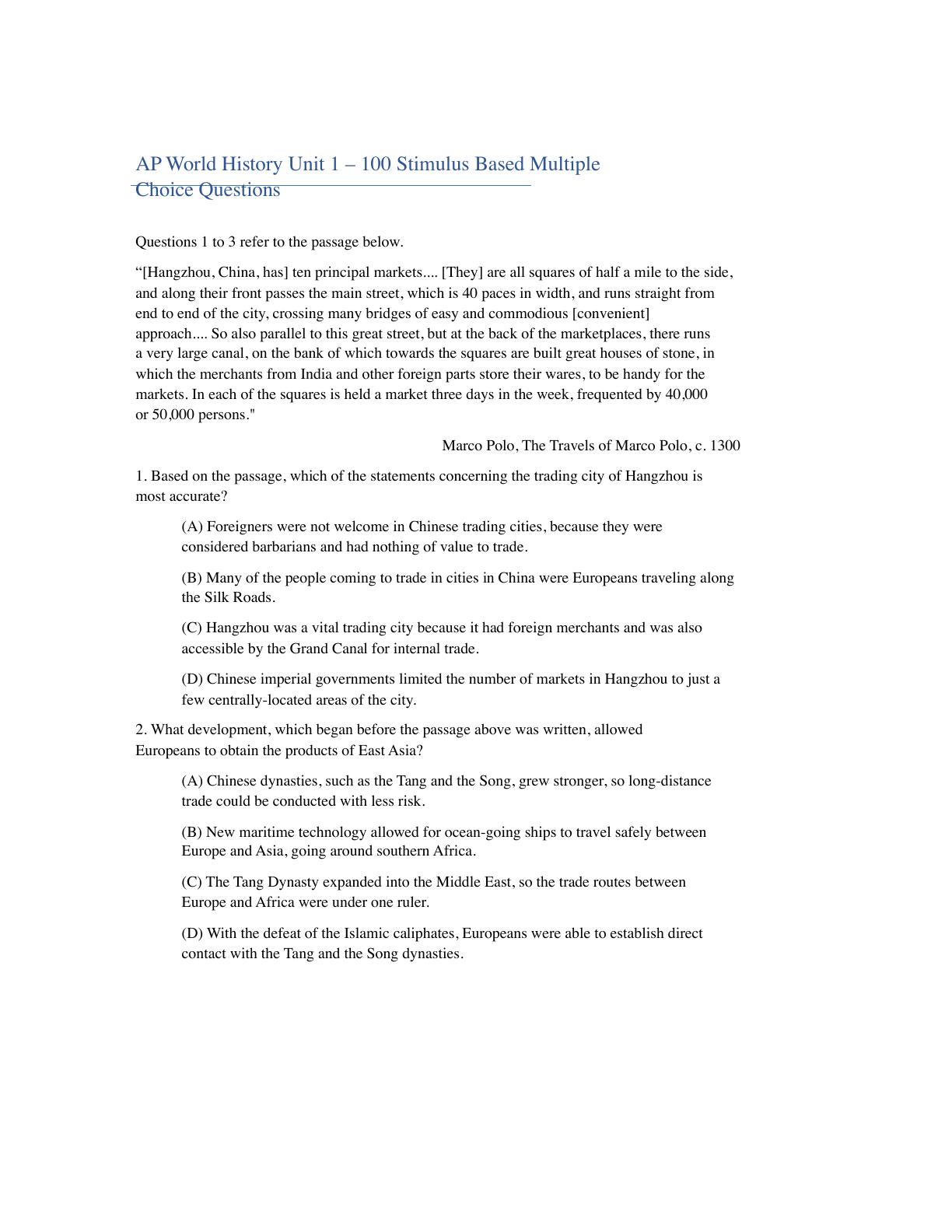
AP World History Unit 1 100 Stimulus Based Multiple
Choice Questions
Questions 1 to 3 refer to the passage below.
“[Hangzhou, China, has] ten principal markets.... [They] are all squares of half a mile to the side,
and along their front passes the main street, which is 40 paces in width, and runs straight from
end to end of the city, crossing many bridges of easy and commodious [convenient]
approach.... So also parallel to this great street, but at the back of the marketplaces, there runs
a very large canal, on the bank of which towards the squares are built great houses of stone, in
which the merchants from India and other foreign parts store their wares, to be handy for the
or 50,000 persons."
Marco Polo, The Travels of Marco Polo, c. 1300
1. Based on the passage, which of the statements concerning the trading city of Hangzhou is
most accurate?
(A) Foreigners were not welcome in Chinese trading cities, because they were
considered barbarians and had nothing of value to trade.
(B) Many of the people coming to trade in cities in China were Europeans traveling along
the Silk Roads.
(C) Hangzhou was a vital trading city because it had foreign merchants and was also
accessible by the Grand Canal for internal trade.
(D) Chinese imperial governments limited the number of markets in Hangzhou to just a
few centrally-located areas of the city.
2. What development, which began before the passage above was written, allowed
Europeans to obtain the products of East Asia?
(A) Chinese dynasties, such as the Tang and the Song, grew stronger, so long-distance
trade could be conducted with less risk.
(B) New maritime technology allowed for ocean-going ships to travel safely between
Europe and Asia, going around southern Africa.
(C) The Tang Dynasty expanded into the Middle East, so the trade routes between
Europe and Africa were under one ruler.
(D) With the defeat of the Islamic caliphates, Europeans were able to establish direct
contact with the Tang and the Song dynasties.
5/11/26, 1:59 AM
AP World History Unit 1: 100 Multiple Choice Questions Guide
https://getthispdf.com
1/38
3. What products would Indians and other non- Chinese merchants be most likely to purchase
in a market such as the one described in the passage?
(A) silk, porcelain, and tea
(B) pepper, nutmeg, and cinnamon
(C) cows, pigs, and oxen
(D) rugs, parchment, and horses
Questions 4 to 6 refer to the passage below.
"In the name of God the Merciful and the Compassionate: This is the safe conduct accorded by
the servant of God Umar, the Commander of the Faithful, to the people of [Jerusalem]. He
accords them safe-conduct for their persons, their property, their churches, their crosses, their
sound and their sick, and the rest of their worship. . . . No constraint shall be exercised against
them in religion nor shall any harm be done to any among them....
The people of [Jerusalem] must pay the jizya [required tax on non-Muslims] in the same way as
the people of other cities. They must expel the Romans [Byzantine soldiers and ofÏcials] and
the brigands from the city. Those who leave shall have safe-conduct for their persons and
property until they reach safety.
Those of the people of [Jerusalem] who wish to remove their persons and effects and depart
with the Romans [Byzantines] and abandon their churches and their crosses shall have safe-
conduct for their persons, their churches, and their crosses, until they reach safety."
Muhammad ibn Jarir al-Tabari, History of the Prophets and Kings,
"Peace Terms with Jerusalem, 636 C.E.," 10th century
4. Which trait of Islamic rule described in this passage was also evident in Islamic rule in al-
Andalus?
(A) The persecution of other religions by Islamic leaders
(B) The toleration of other religions by Muslims in conquered territory
(C) The conflict between Romans and Byzantines over territory
(D) The desire to improve relations with the Romans in Jerusalem
5/11/26, 1:59 AM
AP World History Unit 1: 100 Multiple Choice Questions Guide
https://getthispdf.com
2/38
5. What viewpoint led Umar to this trait of Islamic rule?
(A) He did not actively seek converts to his faith.
(B) He believed Christians and Jews were only a small threat to his faith.
(C) He was more concerned with political than religious issues.
(D) He considered Christians and Jews to be "People of the Book."
6. Which development resulted from a change in Umar's policy toward Jerusalem by the
Seljuks?
(A) The beginning of the Crusades by European Christians
(B) A shift in trade patterns
(C) An increase in the power of the Byzantine Empire
(D) A decrease in taxes paid by Jerusalem residents
Questions 7 to 9 refer to the excerpt below.
"The Hindus believe that there is no country but theirs, no nation like theirs, no kings like theirs,
no religion like theirs, no science like theirs. They are haughty, foolishly vain, self-conceited, and
stolid. They are by nature [reluctant] in communicating that which they know, and they take
the greatest possible care to withhold it from men of another caste among their own people,
still much more, of course, from any foreigner.... Their haughtiness is such that, if you tell them
of any science or scholar in Khorasan [a region in southwest Asia] and Persia, they will think you
to be both an ignoramus and a liar. If they traveled and mixed with other nations, they would
soon change their mind, for their ancestors were not as narrow-minded as the present
generation is."
Ghazni, Al-Beruni, Muslim scholar at the court of Mahmud of early 11th century
7. Which element of Al-Beruni's point of view does he express most clearly in this passage?
(A) He was a monotheist writing about people he considered polytheists.
(B) He was a non-Hindu who was writing about Hindus.
(C) He belonged to a group that had been conquered by the people he was writing
about.
(D) He grew up in a region to the west of the region he was describing.
5/11/26, 1:59 AM
AP World History Unit 1: 100 Multiple Choice Questions Guide
https://getthispdf.com
3/38
/ 38
End of Document
353
You May Also Like
Faqs of AP World History Unit 1: 100 Multiple Choice Questions Guide
What topics are covered in the AP World History Unit 1 guide?
The AP World History Unit 1 guide covers essential topics such as early trade networks, cultural exchanges, and the interactions between different civilizations. It includes questions related to significant historical figures and events that shaped the world during this period. Students will explore themes of globalization and the impact of trade on societies, providing a comprehensive overview of the historical context necessary for the AP exam.
How can the multiple-choice questions help students prepare for the AP exam?
The multiple-choice questions in this guide are specifically designed to mirror the format and content of the AP World History exam. By practicing with these questions, students can familiarize themselves with the types of questions they will encounter on the test. Additionally, the questions encourage critical thinking and application of historical concepts, which are vital skills for success in the AP exam.
Who is the intended audience for this AP World History guide?
This guide is intended for high school students enrolled in AP World History courses. It is particularly useful for those preparing for the AP exam, as it provides targeted practice and review of key concepts and themes. Teachers may also find it beneficial for creating assessments or supplementary materials for their students.
What is the significance of trade networks discussed in the guide?
Trade networks are significant as they facilitated the exchange of goods, ideas, and cultures between different civilizations. The guide highlights how these networks contributed to economic growth and cultural diffusion, shaping societies throughout history. Understanding these interactions is crucial for grasping the complexities of global history and the development of interconnected societies.
What skills can students develop by using this guide?
Students can develop critical thinking and analytical skills by engaging with the multiple-choice questions in this guide. It encourages them to apply historical knowledge to various scenarios, enhancing their ability to interpret and analyze historical events. Additionally, practicing with these questions helps improve test-taking strategies, which are essential for performing well on the AP exam.