AP Human Geography Unit 2 Population and Migration Patterns

AP Human Geography Unit 2 Population and Migration Patterns

AP Human Geography Unit 2 focuses on population distribution, composition, and migration patterns. It examines the factors influencing where people live, including physical and human elements. The unit also explores the consequences of population changes and the reasons behind migration, both voluntary and forced. Key topics include the demographic transition model, push and pull factors, and the impact of migration on societies. This resource is essential for AP Human Geography students preparing for exams and understanding global population dynamics.

Key Points

  • Explores the demographic transition model and its stages.
  • Analyzes push and pull factors influencing migration patterns.
  • Discusses the impact of migration on both origin and destination countries.
  • Covers the consequences of population growth and decline on society.
90
/ 77
+
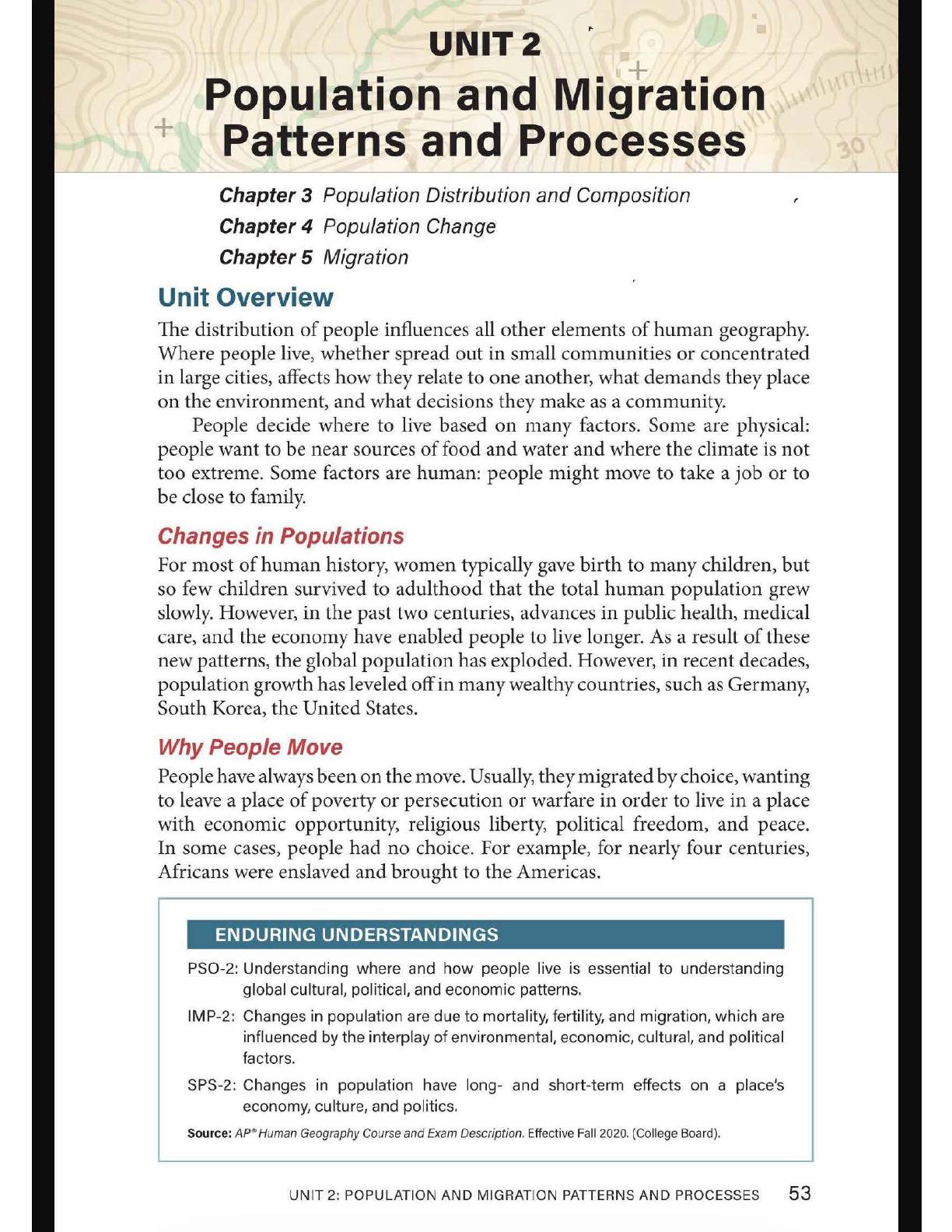
UNIT2
Population and Mig1'ation
Patterns and Processes
Chapter 3 Population Distribution
and
Composition
Chapter 4 Population Change
Chapter 5 Migration
Unit Overview
The distribution
of
people influences all other elements
of
human
geography.
Where people live, whether spread out in small communities
or
concentrated
in large cities, affects
how
they relate
to
one another, what demands they place
on
the environment,
and
what decisions they make
as
a community.
People decide where to live based
on
many factors. Some are physical:
people want to be near sources
of
food
and
water and where the climate is
not
too extreme. Some factors are
human
: people might move
to
take a job
or
to
be close to family.
Changes in Populations
For
most
of
human
history, women typically gave
birth
to many children,
but
so few children survived
to
adulthood
that
the total
human
population grew
slowly. However,
in
the past two centuries, advances
in
public health, medical
care,
and
Lhe
economy have enabled people
Lo
live longer.
As
a resull
of
Lhe
se
new patterns, the global population has exploded. However, in recent decades,
population growth has leveled off
in
many wealthy countries, such as Germany,
South Korea, the United States.
Why People Move
People have always been
on
the move. Usually, they migrated by choice, wanting
to leave a place
of
poverty
or
persecution
or
warfare in order to live in a place
with economic opportunity, religious liberty, political freedom,
and
peace.
In some c
as
es, people had
no
choice. For exampl
e,
for nearly four centurie
s,
Africans were enslaved
and
brought to the Americas.
ENDURING
UNDERSTANDINGS
PS0-2: Understanding where and how people live
is
essential to understanding
global cultura
l,
political, and economic patterns.
IMP-2: Changes in population are due
to
mortality, fertility, and migration, which
are
influenced by the interplay of environmental, economic, cultural, and politic
al
factor
s.
SPS-2: Changes in population have long- and
sh
ort-term effects on a place's
economy, culture, and politics.
Source: AP® Human
Geog
raphy
Cou
r
se
and
Ex
am Description. Eff
ec
ti
ve
Fa
ll 2020. (College Board).
UN
IT 2: POPULATION
AND
MIGRATION PATTERNS
AND
PROCESSES
53

CHAPTER 3
Population Distribution
and Composition
Topics
2.1-2.3
Topic
2.1
Population Distribution
Learning Objectives: Identify the factors that influence the distribution
of
human
populations at different scales. (PS0-2.A)
Define methods geographers use to calculate population density. (PS0-2.B)
Explain the differences between and the impact
of
methods used to calculate
population density. (PS0-2.C)
Topic
2.2
Consequences of Population Distribution
Learning Objective: Explain how population distribution and density affect
society and the environment. (PS0-2.D)
Topic 2.3 Population Composition
Learning Objectives: Describe elements
of
population composition used by
geographers. (PS0-2.E)
Explain ways that geographers depict and analyze population composition.
(PS0-2.
F)
Half
the world's population lives
in
just
7 percent
of
the land.
-M
ax Galk
a,
Metrocosm, January
4,
2
016
Source: Getty Images
The
image shows city traffic in India. Rapid population growth a
nd
de
nsity impacts
society
and
the enviro
nm
ent. (See Topic 2.2 for
th
e effects
of
popu
lation growth.)
54
CHAPTER 3: POPULATION DISTRIBUTION
AND
COMPOSITION
2.1
Population Distribution
Essential
Question: What are the factors that influence population
distribution and what are the impacts of different methods used to
calculate population density?
Humans
live
on
a small percentage
of
the planet. The world contains seven
times as many people today
as
it did two centuries ago. Population density
has increased significantly. However, population distribution has not. The
vast majority
of
growth has been
in
areas already settled. For example, eastern
China was one
of
the most populated parts
of
the world
in
1800-and
it still is
today. Why have people chosen to live
in
such crowded places?
Where People Live
People want to live
in
places where they can survive with relative ease and
comfort-places
where they can raise
or
obtain food and live in moderate
climates. Around 1800, when the population was only one billion, people
were dispersed throughout such desirable lands.
As
population increased,
the amount
of
suitable land stayed about the same, so people chose to live in
greater densities
on
that same land.
Human geography tries to explain why people live where they do.
It
includes the study
of
two distinct but related concepts:
Population distribution is the pattern
of
human
settlement-the
spread
of
people across the earth. Representing it
on
a map highlights places that
are crowded, sparsely settled,
or
even empty.
Population density is a measure
of
the average population
per
square
mile
or
kilometer
of
an area.
It
measures how crowded a place is.
Understanding both population distribution and density helps people
make important decisions on issues such as where to set the boundaries
of
an electoral district
or
where to develop new housing. These are among the
many issues influenced by the number, distribution, and density
of
current and
projected populations.
Physical Factors Influencing Population Distribution
Survival for the earliest humans depended
on
food, water, and shelter. Thus,
these hunter-gatherers settled where these features were most readily available.
Similarly, people today have the same basic needs, which helps explain why the
population distribution has remained so similar over time. The map
of
Earth's
population distribution today below shows where the highest densities and
largest numbers
of
people live today.
2.1:
POPULATION DISTRIBUTION
55
/ 77
End of Document
90
You May Also Like
Faqs of AP Human Geography Unit 2 Population and Migration Patterns
What are the stages of the demographic transition model?
The demographic transition model outlines five stages of population change as countries develop. Stage 1 is characterized by high birth and death rates, leading to a stable population. In Stage 2, death rates drop due to improvements in healthcare, resulting in rapid population growth. Stage 3 sees declining birth rates as urbanization occurs, while Stage 4 features low birth and death rates, stabilizing the population. Stage 5, which some suggest exists, indicates a declining population due to very low birth rates.
What are common push factors that lead to migration?
Common push factors include economic hardship, political persecution, and environmental disasters. For instance, individuals may leave their home countries due to lack of job opportunities or oppressive government regimes. Natural disasters like earthquakes or droughts can also force people to flee their homes in search of safety and stability. These negative conditions compel individuals to seek better living circumstances in other regions or countries.
How does migration impact the countries of origin?
Migration can relieve overcrowding in countries of origin by reducing competition for jobs and resources. When working-age individuals leave, it can create a demographic shift towards a higher dependency ratio, where fewer workers support more dependents. Additionally, remittances sent back home can significantly boost the economy of the origin country. However, a brain drain occurs when highly skilled individuals emigrate, leading to a loss of talent and expertise that could benefit their home country.
What are the effects of migration on receiving countries?
Receiving countries often benefit from immigration through cultural enrichment and economic contributions. Immigrants bring diverse skills, fill labor shortages, and start businesses, which can stimulate economic growth. However, conflicts may arise due to cultural differences or competition for jobs, leading to xenophobia. Ethnic enclaves can form, enhancing cultural diversity but sometimes leading to social tensions.
What is the significance of the migration transition model?
The migration transition model connects migration patterns to the demographic transition model, indicating that countries in Stages 2 and 3 experience significant out-migration as populations grow rapidly. This model helps explain why individuals from less-developed regions migrate to more developed areas seeking better economic opportunities. Understanding this relationship is crucial for policymakers to address the challenges and benefits of migration.