AP Human Geography Unit 4 Political Patterns and Processes

AP Human Geography Unit 4 Political Patterns and Processes

AP Human Geography Unit 4 focuses on political patterns and processes that shape the modern world. It explores the evolution of political boundaries, the nature of political power, and the challenges faced by states in a globalized context. Key topics include the definitions of states and nations, the impact of colonialism, and the significance of sovereignty. This unit is essential for AP students preparing for the exam, covering critical concepts like devolution, nationalism, and the effects of globalization on state sovereignty.

Key Points

  • Examines the definitions and differences between states and nations in political geography.
  • Explores the impact of colonialism on modern political boundaries and state formation.
  • Discusses the challenges to state sovereignty in the context of globalization and transnationalism.
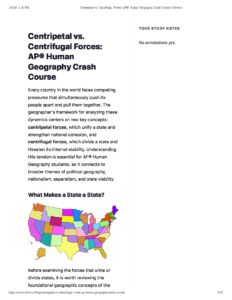
  • Analyzes the role of centripetal and centrifugal forces in maintaining or disrupting national unity.
102
/ 78
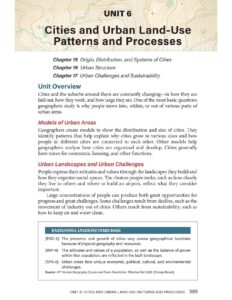
UNIT4
+ Political Patterns and Processes
Chapter 8 Political Processes
and
Power
Chapter 9 Political Boundaries
and
Forms
of
Governance
Chapter
10
Challenges in the Modern State
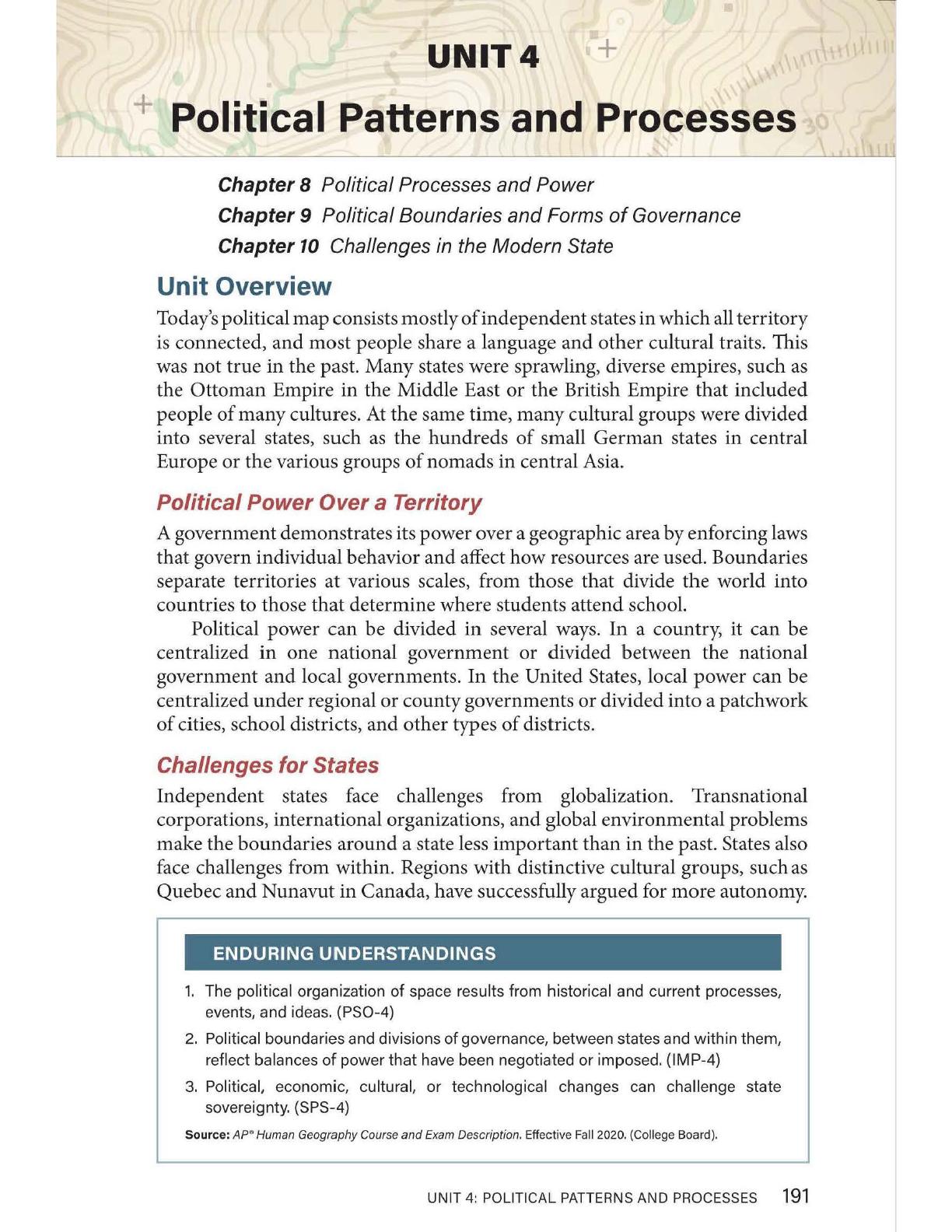
Unit Overview
Today's political map consists mostly
of
independent states
in
which all territory
is connected, and
most
people share a language
and
other cultural traits. This
was
not
true in
the
past. Many states were sprawling, diverse empires, such as
the
Ottoman
Empire in the Middle East
or
the
British Empire that included
people
of
many cultures.
At
the
same time, many cultural groups were divided
into several states, such as
the
hundreds
of
small German states in central
Europe
or
the
various groups
of
nomads
in
central Asia.
Political Power
Over
a Territory
A government demonstrates its power over a geographic area by enforcing laws
that govern individual behavior
and
affect how resources are used. Boundaries
separate territories
at
various scales, from those that divide the world into
countries to those
that
determine where students attend school.
Political power can be divided
in
several ways.
In
a country, it can be
centralized
in
one national government
or
divided between the national
government
and
local governments.
In
the United States, local power can be
centralized
under
regional
or
county governments
or
divided into a patchwork
of
cities, school districts,
and
other types
of
districts.
Challenges for States
Independent states face challenges from globalization. Transnational
corporations, international organizations,
and
global environmental problems
make the boundaries around a state less important than in the past. States also
face challenges from within. Regions with distinctive cultural groups, such as
Quebec
and
Nunavut
in
Canada, have successfully argued for
more
autonomy.
ENDURING
UNDERSTANDINGS
1.
The political organization of space results from historical and current processes,
events, and ideas. (PS0-4)
2.
Political boundaries and divisions
of
governance, between states and within them,
reflect balances
of
power
that
have been negotiated or imposed. (IMP-4)
3. Political, economic, cultural,
or
technological changes can challenge state
sovereignty.
(SPS
-
4)
Source:
AP
Human Geography Course
and
Exam Description. Effective Fall 2020. (College Board).
UNIT
4: POLITICAL PATTERNS
AND
PROCESSES
191

CHAPTER 8
Political Processes and Power
Topics
4.7-4.3
Topic
4.1
Introduction to Political Geography
Learning Objective: For world political maps:
a.
Define
the
different types
of
political entities.
b.
Identify a contemporary example
of
political entities. (PS0-4.A)
Topic 4.2 Political Processes
Learning Objective: Explain
the
processes that have shaped contemporary
political geography. (PS0-4.B)
Topic 4.3 Political Power and Territoriality
Learning Objective: Describe
the
concepts
of
political power and territoriality
as
used by geographers. (PS0-4.C)
[Soviet] General Secretary Gorbachev,
if
you
seek peace,
if
you
seek prosperity for the Soviet Union
and
Eastern Europe,
if
you
seek
liberalization, come here to this gate.
Mr.
Gorbachev, open this gate!
Source: Dav
id
P
alm
er
Mr.
Gorbachev, tear down this wall!
-
Pr
esident
Ron
ald Reagan, speech, 1987
The Berlin Wall has mostly been to
rn
down after
th
e unifica
ti
on
of
East and West Germany
in 1989. P
ar
ts of
th
e wa
ll
have been
pr
eserved to express messages of unifi
ca
tion a
nd
reme
mb
rance. (See Topic 4.2
fo
r how
po
litical processes shape
bound
ar
i
es
.)
192 CHAPTER 8:
POLITICAL
PROCESSES
AND
POWER
4.1
Introduction to Political Geography
Essential
Question:
What are the different types of political entities,
with current examples, on a world map?
Empires
and
kingdoms were common in most
of
the world for the past
2,000 years. However, global forces, wars, and changing ideas about political
power, economics,
and
self-rule have reshaped
the
world map over
the
last few
centuries.
The Structure of the Contemporary Political Map
People often use the words country, state,
and
nation to mean
the
same thing.
But they have different meanings. Country
is
the most general term. It
is
often
used to describe any political entity
that
is
independent from the control
of
any
other entity. State
and
nation have more precise meanings.
Independent States
as
Building Blocks
Political units exist at various scales.
In
the United States, for example, a person
resides
in
several political units at once: maybe a town
or
city, a county, a state,
and
finally, in the country as a whole. The
term
state can be confusing because
it can be used
in
two different ways. In this example, it refers to one
of
the
50
states that make up the United States. But in international relations, a state
is
the largest political unit,
the
formal term for a country.
To
be defined as a state,
several criteria must be met:
has a defined
boundary
contains a permanent population
maintains sovereignty ( defined below) over its domestic
and
international
affairs
is
recognized by other states
The United States recognizes
195
states based
on
these criteria,
but
the
number
can vary depending
on
which government
or
international
organization makes the list. These four requirements are easily defined,
but
in
the geopolitical arena, they can be difficult to recognize.
Understanding Sovereignty The power
of
a political unit,
or
government,
to rule over its own affairs
is
known as sovereignty. It
is
a key principle in
understanding
how
governments function.
In
order for a political unit to
have legitimacy over its domestic and international affairs, it
must
maintain
sovereignty over its own land.
In
the
modern
world, a territory
must
have
4.1:
INTRODUCTION TO POLITICAL GEOGRAPHY 193
/ 78
End of Document
102
You May Also Like
Faqs of AP Human Geography Unit 4 Political Patterns and Processes
What are the main themes of AP Human Geography Unit 4?
AP Human Geography Unit 4 covers themes related to political patterns and processes, including the definitions of states and nations, the evolution of political boundaries, and the challenges faced by modern states. It discusses how historical events like colonialism have shaped current political landscapes and examines the impact of globalization on state sovereignty. The unit also explores concepts such as nationalism, devolution, and the role of various forces that can either unify or divide populations.
How does colonialism affect modern political boundaries?
Colonialism has significantly influenced modern political boundaries by imposing arbitrary borders that often disregard ethnic, cultural, and linguistic divisions. This has led to ongoing conflicts and tensions in many regions, as diverse groups find themselves within the same political entity. The legacy of colonialism can be seen in countries where multiple ethnic groups vie for power, leading to instability and demands for autonomy or independence. Understanding this historical context is crucial for analyzing contemporary political issues.
What is the significance of sovereignty in political geography?
Sovereignty refers to the authority of a state to govern itself and make decisions without external interference. It is a fundamental concept in political geography, as it defines the power dynamics between states and influences international relations. Challenges to sovereignty can arise from globalization, where transnational corporations and international organizations exert influence over national policies. Additionally, internal factors such as ethnic separatism and regionalism can threaten a state's sovereignty, leading to demands for greater autonomy or independence.
What are centripetal and centrifugal forces in political geography?
Centripetal forces are factors that promote unity and stability within a state, such as shared culture, language, and economic interests. These forces help to strengthen national identity and foster cooperation among diverse groups. In contrast, centrifugal forces are those that divide a population, such as ethnic tensions, economic disparities, and regionalism. Understanding the balance between these forces is essential for analyzing a state's political stability and the potential for conflict or cohesion.
How does globalization challenge state sovereignty?
Globalization challenges state sovereignty by increasing interconnectedness and interdependence among nations. As trade, communication, and cultural exchanges expand, the ability of individual states to control their borders and policies diminishes. This can lead to tensions as states navigate the demands of global markets while trying to maintain local governance. Additionally, the rise of supranational organizations, such as the European Union, further complicates traditional notions of sovereignty by requiring member states to adhere to collective agreements that may override national laws.