
AP English Literature Unit 4 Progress Check MCQ Study Guide

AP English Literature Unit 4 Progress Check MCQ Study Guide

AP English Literature Unit 4 Progress Check focuses on key literary concepts and analysis relevant for AP students. This resource includes multiple-choice questions that assess understanding of poetry, tone, imagery, and symbolism. Students will explore themes such as the inevitability of death and the significance of allusions, enhancing their critical thinking skills. Designed for AP Literature students preparing for exams, this guide provides essential practice and insights into literary devices and their effects. It covers various aspects of poetry analysis, making it a valuable tool for exam preparation.

Key Points

  • Includes multiple-choice questions on literary analysis for AP English Literature
  • Covers themes like death, tone shifts, and symbolism in poetry
  • Explores the significance of allusions and imagery in literary texts
  • Designed for AP Literature students preparing for the exam
120
/ 3
AP English Literature: Unit 4 Progress Check
Comprehensive MCQ Study Guide & Answer Key
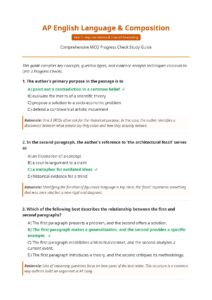
1. In the poem, the speaker characterizes 'the forest' primarily as a place of
A) renewal and growth
B) mystery and potential danger
C) social gathering
D) scientific discovery
Rationale: The speaker's use of words like 'shadowed,' 'unseen,' and 'whispers' suggests a setting that is
enigmatic and threatening.
2. The use of the first-person point of view in the poem allows the author to
A) present an objective view of the events
B) emphasize the speaker's personal emotional response
C) create a sense of distance from the subject
D) offer a historical account of the setting
Rationale: First-person perspective ('I') provides direct access to the speaker's internal feelings and
subjective experiences.
3. The repetition of the phrase 'again and again' in the third stanza serves to
A) indicate the speaker's boredom
B) emphasize the cyclical and relentless nature of the struggle
C) show the speaker's lack of vocabulary
D) suggest that the event only happened twice
Rationale: Repetition is a structural device used to reinforce the persistence and importance of a
specific idea or action.
4. The speaker's description of 'the clock' (line 15) functions as a metaphor for
A) the inevitability of death
B) the character's wealth
C) the importance of punctuality
D) the sound of a heartbeat
Rationale: In literary analysis, time-keeping devices often symbolize the passage of time and the finite
nature of life.
5. The shift in tone from the beginning to the end of the poem can best be described
as
A) joyful to angry
B) curious to resigned
C) indifferent to passionate
D) fearful to courageous
Rationale: The poem opens with questioning but concludes with an acceptance of the situation as
unchangeable.
6. Which of the following best describes the function of the stanza break between
lines 10 and 11?
A) To introduce a new character
B) To mark a transition from physical description to philosophical reflection
C) To signal the end of the poem's narrative
D) To provide a rhyme for the word 'blue'
Rationale: Stanza breaks often indicate a shift in the speaker's focus or the direction of the argument.
7. The personification of 'the wind' in line 5 serves to
A) make the setting feel more alive and antagonistic
B) provide a scientific explanation for weather
C) show the speaker's love for nature
D) indicate the speed at which time passes
Rationale: Attributing human traits like 'howling' or 'grabbing' to nature creates a sense of conflict
between the environment and the speaker.
8. The reference to 'Eden' is an allusion that primarily serves to
A) describe a local garden
B) evoke a sense of lost innocence and perfection
C) prove the speaker is religious
D) suggest the poem takes place in ancient times
Rationale: Biblical allusions like 'Eden' are used to tap into universal themes of paradise and its
subsequent loss.
9. The imagery of 'decaying leaves' and 'fading light' most directly establishes a mood
of
A) Optimism
B) Nostalgia
C) Melancholy
D) Confusion
Rationale: Images associated with death and the end of the day typically evoke sadness or gloom.
10. In the context of the poem, the 'locked door' most likely symbolizes
A) a physical barrier in a house
B) the speaker's inability to access their own memories
C) a lack of privacy
D) the character's desire to travel
Rationale: Locked objects often represent internal psychological barriers or secrets in literary
symbolism.
/ 3
End of Document
120
You May Also Like
Faqs of AP English Literature Unit 4 Progress Check MCQ Study Guide
What themes are explored in the AP English Literature Unit 4 Progress Check?
The AP English Literature Unit 4 Progress Check explores various themes including the inevitability of death, the significance of lost innocence, and the complexities of human emotions. Through multiple-choice questions, students analyze how these themes are represented in poetry and prose. The guide emphasizes the importance of tone shifts and imagery, helping students understand how these elements contribute to the overall meaning of a text. Additionally, the resource encourages critical thinking about the implications of literary devices used by authors.
How does the Unit 4 Progress Check assess understanding of poetry?
The Unit 4 Progress Check assesses understanding of poetry through a series of multiple-choice questions that focus on key literary elements. Students are required to analyze tone, imagery, and symbolism, which are crucial for interpreting poetic texts. The questions challenge students to think critically about the author's intent and the emotional impact of the poem. By engaging with these questions, students enhance their analytical skills and prepare effectively for the AP Literature exam.
What literary devices are highlighted in the AP English Literature guide?
The AP English Literature guide highlights several literary devices, including metaphor, personification, and allusion. These devices are essential for understanding the depth of literary works and their thematic significance. For example, metaphors may illustrate complex ideas, while personification can bring inanimate objects to life, creating a more vivid reading experience. The guide encourages students to identify and analyze these devices within the context of the poems and prose they study, fostering a deeper appreciation for literature.
What is the significance of the 'locked door' metaphor in the progress check?
The 'locked door' metaphor in the progress check symbolizes psychological barriers and the speaker's inability to access their own memories or emotions. This metaphor serves as a powerful representation of internal conflict and the struggle to confront one's past. By analyzing this metaphor, students can explore themes of isolation and the complexities of human experience. Understanding such symbols enhances their interpretative skills and prepares them for deeper literary analysis in the AP exam.
How does the guide help students prepare for the AP Literature exam?
The guide helps students prepare for the AP Literature exam by providing a structured approach to literary analysis through multiple-choice questions. It covers essential topics such as tone, imagery, and thematic elements, which are frequently tested on the exam. By practicing with these questions, students can familiarize themselves with the exam format and improve their critical thinking skills. Additionally, the rationales provided for each question help students understand the reasoning behind correct answers, reinforcing their learning.