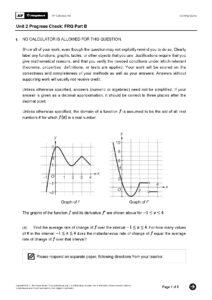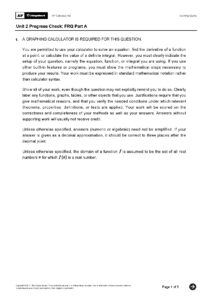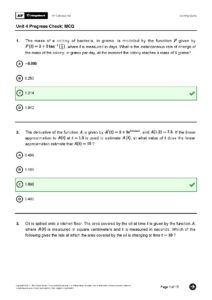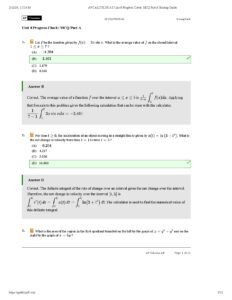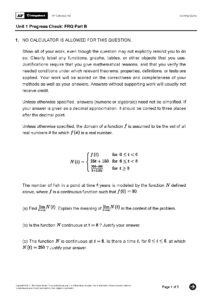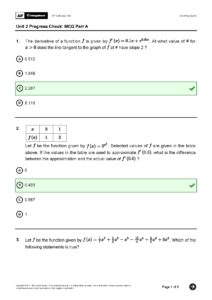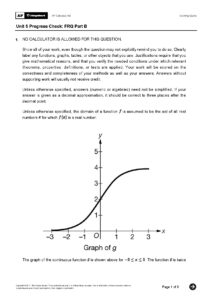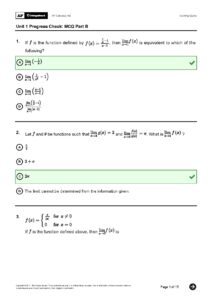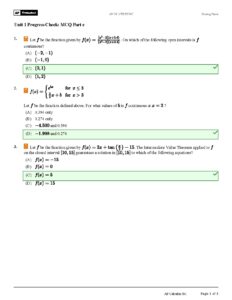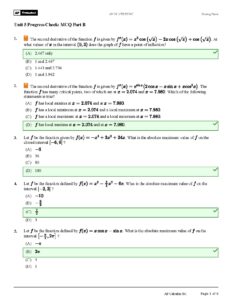

Unit 3 Progress Check for AP Calculus BC focuses on multiple-choice questions designed to assess students' understanding of calculus concepts. Topics include derivatives, the chain rule, implicit differentiation, and the behavior of functions. This assessment is ideal for AP Calculus BC students preparing for the AP exam, providing practice with real exam-style questions. It includes a variety of problems that challenge students' analytical and problem-solving skills, ensuring they are well-prepared for the May exam.
Key Points
Includes multiple-choice questions on derivatives and the chain rule.
Covers implicit differentiation and its applications in calculus.
Designed for AP Calculus BC students preparing for the AP exam.
Offers a variety of problems to enhance analytical and problem-solving skills.
This link leads to an external site. We do not know or endorse its content, and are not responsible for its safety. Click the link to proceed only if you trust this site.
What topics are covered in the Unit 3 Progress Check?
The Unit 3 Progress Check for AP Calculus BC covers essential topics such as derivatives, the chain rule, and implicit differentiation. Students will encounter questions that require them to apply these concepts to solve problems effectively. Additionally, the assessment includes questions that test understanding of function behavior and tangent lines, which are crucial for mastering calculus principles. This comprehensive approach ensures that students are well-prepared for the AP exam.
How does the chain rule apply in calculus problems?
The chain rule is a fundamental concept in calculus used to differentiate composite functions. It states that if a function y is composed of two functions u and v, then the derivative of y with respect to x can be found by multiplying the derivative of y with respect to u by the derivative of u with respect to x. This technique is essential for solving problems where one function is nested within another, allowing students to tackle complex differentiation tasks efficiently.
What is implicit differentiation and when is it used?
Implicit differentiation is a technique used to find the derivative of a function when it is not explicitly solved for one variable in terms of another. This method is particularly useful in cases where the relationship between variables is defined by an equation rather than a function. By differentiating both sides of the equation with respect to the independent variable and applying the chain rule, students can solve for the derivative of the dependent variable. This approach is crucial for analyzing curves and relationships in calculus.
What types of problems can students expect in the AP Calculus BC exam?
Students preparing for the AP Calculus BC exam can expect a variety of problem types, including multiple-choice questions that assess their understanding of derivatives, integrals, and the behavior of functions. The exam will feature questions that require the application of the chain rule, implicit differentiation, and the analysis of function graphs. Additionally, students may encounter real-world applications of calculus concepts, which test their ability to apply theoretical knowledge to practical scenarios.