
AP English Language Unit 3 Argumentation MCQ Progress Check

AP English Language Unit 3 Argumentation MCQ Progress Check

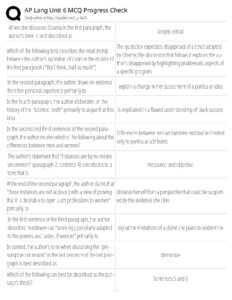
AP English Language Unit 3 focuses on argumentation and line of reasoning, providing multiple-choice questions (MCQs) that assess students' understanding of rhetorical strategies and evidence analysis. This progress check includes questions that challenge students to identify the author's purpose, analyze figurative language, and evaluate the effectiveness of arguments presented in various passages. Ideal for AP Language students preparing for exams, it covers key concepts such as tone, evidence strength, and the relationship between paragraphs. The guide is designed to enhance critical thinking and reading comprehension skills essential for success in AP English assessments.

Key Points

  • Includes multiple-choice questions on argumentation and reasoning for AP English Language students.
  • Focuses on identifying authors' purposes and analyzing rhetorical strategies in various texts.
  • Covers key concepts such as tone, evidence strength, and paragraph relationships.
  • Designed to enhance critical thinking and reading comprehension skills for AP exam preparation.
139
/ 3
AP English Language & Composition
Unit 3: Argumentation & Line of Reasoning
Comprehensive MCQ Progress Check Study Guide
This guide compiles key concepts, question types, and evidence analysis techniques common to
Unit 3 Progress Checks.
1. The author's primary purpose in the passage is to
A) point out a contradiction in a common belief
B) evaluate the merits of a scientific theory
C) propose a solution to a socio-economic problem
D) defend a controversial artistic movement
Rationale: Unit 3 MCQs often ask for the rhetorical purpose. In this case, the author identifies a
disconnect between what people say they value and how they actually behave.
2. In the second paragraph, the author's reference to 'the architectural fossil' serves
as
A) an illustration of a concept
B) a counterargument to a claim
C) a metaphor for outdated ideas
D) historical evidence for a trend
Rationale: Identifying the function of figurative language is key. Here, the 'fossil' represents something
that was once vital but is now rigid and stagnant.
3. Which of the following best describes the relationship between the first and
second paragraphs?
A) The first paragraph presents a problem, and the second offers a solution.
B) The first paragraph makes a generalization, and the second provides a specific
example.
C) The first paragraph establishes a historical context, and the second analyzes a
current event.
D) The first paragraph introduces a theory, and the second critiques its methodology.
Rationale: Line of reasoning questions focus on how parts of the text relate. This structure is a common
way authors build an argument in AP Lang.
4. The author mentions 'the library' primarily to
A) emphasize the importance of education
B) evoke a sense of nostalgia in the reader
C) support a claim about the accessibility of information
D) contrast with the modern digital landscape
Rationale: Specific details are almost always used as evidence to back up a broader claim in the line of
reasoning.
5. Which of the following claims is explicitly made by the author in the passage?
A) Technology has fundamentally changed human cognition.
B) Society must return to traditional values to survive.
C) The current system of evaluation is inherently flawed.
D) Creativity is a skill that can be taught to anyone.
Rationale: This tests reading comprehension and the ability to identify the central thesis or supporting
claims.
6. The tone of the passage is best described as
A) dismissive and cynical
B) earnest and persuasive
C) detached and analytical
D) urgent and alarming
Rationale: The author uses direct address and calls to action, indicating a desire to convince the
audience of a particular viewpoint.
7. In sentence 4, the author uses the word 'plastic' to suggest that the subject is
A) synthetic and cheap
B) flexible and adaptable
C) rigid and unchanging
D) popular and widespread
Rationale: Contextual meaning of diction. In a rhetorical context, 'plastic' often refers to plasticity or
the ability to be shaped.
8. The author's use of a rhetorical question at the end of the passage serves to
A) admit a lack of knowledge
B) challenge the reader to reconsider their assumptions
C) introduce a new topic for discussion
D) provide a definitive answer to the main question
Rationale: Closing with a rhetorical question is a common rhetorical strategy to leave the reader
thinking about the author's argument.
9. Which of the following pieces of evidence would most strengthen the author's
argument?
A) A series of anecdotes from personal friends
B) Statistical data from a reputable academic study
C) A quote from a fictional character in a novel
D) A description of the author's childhood home
Rationale: Unit 3 focuses heavily on evidence. Quantitative data and expert testimony are considered
'strong' evidence in a logical argument.
10. The author objects to the 'mechanized approach' because it
A) is too expensive for most schools
B) ignores the nuances of human experience
C) is based on outdated technology
D) promotes teamwork over individual effort
Rationale: Understanding the basis of an author's critique is essential for following their line of
reasoning.
/ 3
End of Document
139
You May Also Like
Faqs of AP English Language Unit 3 Argumentation MCQ Progress Check
What types of questions are included in the AP English Language Unit 3 Progress Check?
The AP English Language Unit 3 Progress Check includes multiple-choice questions that assess students' understanding of argumentation and line of reasoning. Questions focus on identifying the author's purpose, analyzing figurative language, and evaluating the effectiveness of arguments in various passages. Students will encounter scenarios that require them to interpret tone, assess evidence, and understand the relationships between different paragraphs. This variety ensures a comprehensive review of essential skills needed for AP English assessments.
How does the Unit 3 Progress Check help students prepare for the AP exam?
The Unit 3 Progress Check is designed to enhance students' critical thinking and reading comprehension skills, which are crucial for success on the AP exam. By engaging with multiple-choice questions that reflect the types of passages and prompts found on the exam, students can practice their analytical skills and improve their ability to interpret complex texts. The guide also encourages students to think critically about the arguments presented in various passages, helping them to develop a deeper understanding of rhetorical strategies.
What is the significance of understanding the author's purpose in AP English Language?
Understanding the author's purpose is a key component of analyzing texts in AP English Language. It allows students to grasp the main ideas and arguments presented, as well as the techniques used to persuade or inform the audience. By identifying the author's intent, students can better evaluate the effectiveness of the argument and the use of rhetorical devices. This skill is essential not only for answering multiple-choice questions but also for crafting their own arguments in essays and discussions.
What skills are emphasized in the AP English Language Unit 3 Progress Check?
The AP English Language Unit 3 Progress Check emphasizes critical reading and analytical skills necessary for evaluating arguments and understanding rhetorical strategies. Students are encouraged to analyze tone, assess the strength of evidence, and explore the relationships between paragraphs. These skills are vital for interpreting complex texts and constructing coherent arguments in their writing. Additionally, the progress check prepares students for the types of questions they will encounter on the AP exam, enhancing their overall performance.