AP English Literature and Composition Exam Overview

AP English Literature and Composition Exam Overview

The AP English Literature and Composition Exam assesses students' understanding of literary works and their analytical skills. It includes multiple-choice questions and free-response sections that require critical thinking and interpretation of various texts. Students engage with poetry, prose, and drama, analyzing themes, characters, and literary techniques. This exam is designed for high school students preparing for college-level coursework in literature and composition. It provides a comprehensive evaluation of students' abilities to read closely and write effectively about literature.

Key Points

  • Includes multiple-choice questions and free-response sections for literary analysis.
  • Covers a range of literary genres, including poetry, prose, and drama.
  • Designed for high school students preparing for college-level literature courses.
  • Focuses on critical thinking and interpretation of texts.
149
/ 15
182
CraCking The aP english liT & ComP exam
GO ON TO THE NEXT PAGE.
Section I
Questions 1-15. Choose your answers to questions 1-15
based on a careful reading of the following passage.
An Invective Against Enemies of Poetry
With the enemies of poetry I care not if I have a
bout, and those are they that term our best writers but
babbling ballad-makers, holding them fantastical fools,
that have wit but cannot tell how to use it. I myself
have been so censured among some dull-headed
divines, who deem it no more cunning to write an
exquisite poem than to preach pure Calvin or distill
the juice of a commentary in a quarter sermon. Prove
it when you will, you slow-spirited Saturnists, that
have nothing but the pilferies of your pen to polish
an exhortation withal; no eloquence but tautologies to
tie the ears of your auditory unto you; no invention
but “here it is to be noted, I stole this note out of Beza
or Marlorat”; no wit to move, no passion to urge, but
only an ordinary form of preaching, blown up by use
fi
goes more exquisite pains and purity of wit to the
writing of one such rare poem as “Rosamund” than to
a hundred of your dunstical sermons.
Should we (as you) borrow all out of others, and
gather nothing of ourselves our names should be
baffuld on every bookseller’s stall, and not a chandler’s
mustard pot but would wipe his mouth with our
waste paper. “New herrings, new!” we must cry, every
time we make ourselves public, or else we shall be
christened with a hundred new titles of idiotism. Nor is
poetry an art whereof there is no use in a man’s whole
life but to describe discontented thoughts and youthful
desires; for there is no study but it doth illustrate and
beautify.
To them that demand what fruits the poets of our
time bring forth, or wherein they are able to prove
fi
and foremost, they have cleansed our language from
barbarism and made the vulgar sort here in London
fl
England) to aspire to a richer purity of speech than is
communicated with the commonality of any nation
under heaven. The virtuous by their praises they
Line
(5)
(10)
(15)
(20)
(25)
(30)
(35)
AP
®
English Literature
and Composition Exam
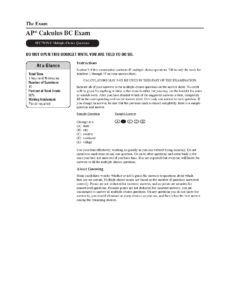
SECTION I: Multiple-Choice Questions
DO NOT OPEN THIS BOOKLET UNTIL YOU ARE TOLD TO DO SO.
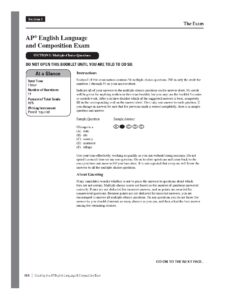
Instructions
Section I of this examination contains 55 multiple-choice questions. Fill in only the
ovals for numbers 1 through 55 on your answer sheet.
Indicate all of your answers to the multiple-choice questions on the answer sheet. No
credit will be given for anything written in this exam booklet, but you may use the
booklet for notes or scratch work. After you have decided which of the suggested
fi
only one answer to each question. If you change an answer, be sure that the previous
mark is erased completely. Here is a sample question and answer.
Sample Question Sample Answer
Chicago is a
A
B
C
D
E
(A) state
(B) city
(C) country
(D) continent
(E) village
Use your time effectively, working as quickly as you can without losing accuracy. Do

back to the ones you have not answered if you have time. It is not expected that
everyone will know the answers to all the multiple-choice questions.
About Guessing
Many candidates wonder whether or not to guess the answers to questions about
which they are not certain. Multiple choice scores are based on the number of
questions answered correctly. Points are not deducted for incorrect answers, and no
points are awarded for unanswered questions. Because points are not deducted for
incorrect answers, you are encouraged to answer all multiple-choice questions. On
any questions you do not know the answer to, you should eliminate as many choices
as you can, and then select the best answer among the remaining choices.
Total Time
1 hour
Number of Questions
55
Percent of Total Grade
45%
Writing Instrument
Pencil required
At a Glance
PraCTiCe TesT 2
183
GO ON TO THE NEXT PAGE.
Section I
Questions 1-15. Choose your answers to questions 1-15
based on a careful reading of the following passage.
An Invective Against Enemies of Poetry
With the enemies of poetry I care not if I have a
bout, and those are they that term our best writers but
babbling ballad-makers, holding them fantastical fools,
that have wit but cannot tell how to use it. I myself
have been so censured among some dull-headed
divines, who deem it no more cunning to write an
exquisite poem than to preach pure Calvin or distill
the juice of a commentary in a quarter sermon. Prove
it when you will, you slow-spirited Saturnists, that
have nothing but the pilferies of your pen to polish
an exhortation withal; no eloquence but tautologies to
tie the ears of your auditory unto you; no invention
but “here it is to be noted, I stole this note out of Beza
or Marlorat”; no wit to move, no passion to urge, but
only an ordinary form of preaching, blown up by use
fi
goes more exquisite pains and purity of wit to the
writing of one such rare poem as “Rosamund” than to
a hundred of your dunstical sermons.
Should we (as you) borrow all out of others, and
gather nothing of ourselves our names should be
baffuld on every bookseller’s stall, and not a chandler’s
mustard pot but would wipe his mouth with our
waste paper. “New herrings, new!” we must cry, every
time we make ourselves public, or else we shall be
christened with a hundred new titles of idiotism. Nor is
poetry an art whereof there is no use in a man’s whole
life but to describe discontented thoughts and youthful
desires; for there is no study but it doth illustrate and
beautify.
To them that demand what fruits the poets of our
time bring forth, or wherein they are able to prove
fi
and foremost, they have cleansed our language from
barbarism and made the vulgar sort here in London
fl
England) to aspire to a richer purity of speech than is
communicated with the commonality of any nation
under heaven. The virtuous by their praises they
Line
(5)
(10)
(15)
(20)
(25)
(30)
(35)
encourage to be more virtuous; to vicious men they
are as infernal hags to haunt their ghosts with eternal
infamy after death. The soldier, in hope to have his
high deeds celebrated by their pens, despiseth a whole
army of perils, and acteth wonders exceeding all

the devil, by their quills are kept in awe.

have the shame of the world. What age will not praise
immortal Sir Philip Sidney, whom noble Salustius
(that thrice singular French poet) hath famoused;
together with Sir Nicholas Bacon, Lord Keeper, and
merry Sir Thomas More, for the chief pillars of our
English speech. Not so much but Chaucer’s host, Bailly
in Southwark, and his wife of Bath he keeps such a
stir with, in his Canterbury Tales, shall be talked of
whilst the Bath is used, or there be ever a bad house in

that write of nothing but of mayors and sheriffs and
the dear year and the great frost, that can endow
your names with never-dated glory; for they want
fl
we have; they cannot sweeten a discourse, or wrest
admiration from men reading, as we can, reporting the
fl
the quintessence of all sciences, the marrow of wit and
the very phrase of angels. How much better is it, then,
to have an elegant lawyer to plead one’s cause, than
a stuttering townsman that loseth himself in his tale
and doth nothing but make legs; so much it is better
for a nobleman or gentleman to have his honor’s story
related, and his deeds emblazoned, by a poet, than a
citizen.
—Thomas Nashe
(40)
(45)
(50)
(55)
(60)
(65)
(70)

SECTION I
Time—1 hour
Directions: This section consists of selections from literary works and questions on their content, form, and style. After
fi
184
CraCking The aP english liT & ComP exam
GO ON TO THE NEXT PAGE.
Section I
 fi
the following EXCEPT
(A) plagiarism
(B) stupidity
(C) dullness
(D) eloquence
(E) laziness
2. “Saturnist” (line 9) means
(A) astrologer
(B) nymphomaniac
(C) depressed and depressing person
(D) pagan
(E) foolishly optimistic person
3. What are “divines” (line 6)?
(A) Preachers
 
(C) Dead writers
(D) Fools
(E) Saturnists
4. “New herrings, new!” (line 24)
(A) refers to an implied comparison between the
writers of new poems and the sellers of fresh
fi
(B) suggests that poetry is slippery and hard to
fi
(C) implies that poetry is just another commodity
(D) implies that poetry grows stale rapidly, like
fi
 fi
5. In lines 31-39 London is described as
 fl
(B) a damp, rainy city
 fl
(D) a cultural garden
(E) an important port city
6. The main idea of lines 39-46 is which of the
following?
(A) People are motivated by concern for their
reputations.
(B) Poetry is fair to the virtuous and the evil alike.
(C) Poetry is inspirational.
(D) Poetry is most attractive to atheists.
(E) Poets are very judgmental.
7. Who is Salustius (line 49)?
(A) A French poet
(B) Sidney’s nom de plume
(C) The Roman god of poetry
(D) The King of England
(E) The Wife of Bath
8. As it is referred to in line 56, what is Bath?
(A) A state of sin
(B) A character in Chaucer
(C) A married man
(D) A poet
(E) A town and spa in England
9. In the last paragraph, poets are said to be like
(A) lawyers
(B) mayors
(C) chronographers
(D) townsmen
(E) angels
10. Line 10 is an example of
(A) metaphor
(B) onomatoepeia
(C) paradox
(D) alliteration
(E) apostrophe
/ 15
End of Document
149
You May Also Like
Faqs of AP English Literature and Composition Exam Overview
What types of questions are on the AP English Literature Exam?
The AP English Literature and Composition Exam features multiple-choice questions that assess reading comprehension and analytical skills. Additionally, there are free-response questions that require students to write essays analyzing specific literary works. These essays may involve character analysis, thematic exploration, and examination of literary devices. The combination of question types aims to evaluate students' overall understanding of literature.
How is the AP English Literature Exam structured?
The exam is divided into two main sections: multiple-choice and free-response. The multiple-choice section consists of questions based on excerpts from various literary works, while the free-response section requires students to write essays. Typically, students analyze poetry, prose, and drama, demonstrating their ability to interpret and critique literature. The exam is designed to challenge students' analytical skills and their understanding of literary elements.
What is the purpose of the AP English Literature Exam?
The purpose of the AP English Literature and Composition Exam is to assess students' readiness for college-level coursework in literature and writing. It aims to evaluate their ability to read complex texts critically and to express their analyses in well-organized essays. By taking this exam, students can earn college credit or advanced placement in college literature courses, depending on their performance.
What skills are tested in the AP English Literature Exam?
The AP English Literature and Composition Exam tests a variety of skills, including critical reading, analytical writing, and interpretation of literary texts. Students must demonstrate their ability to identify themes, analyze characters, and understand literary devices. Additionally, the exam evaluates their writing skills through essay responses, requiring clear organization and effective argumentation.
What literary works are typically included in the AP English Literature Exam?
The AP English Literature and Composition Exam includes a diverse range of literary works from various genres and periods. Students may encounter poetry, novels, plays, and short stories from both classic and contemporary authors. The selection aims to expose students to different voices and styles, enriching their understanding of literature and its cultural contexts.