
AP Calculus BC Study Guide 2024 Edition

AP Calculus BC Study Guide 2024 Edition

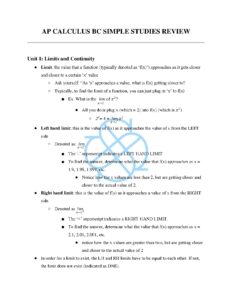
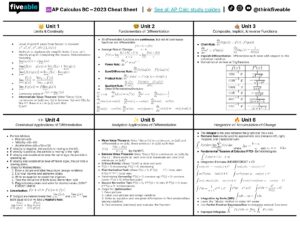
AP Calculus BC Study Guide provides comprehensive coverage of the AP Calculus BC curriculum, including topics such as limits, derivatives, integrals, and series. This guide is designed for high school students preparing for the AP Calculus BC exam, featuring practice problems, detailed explanations, and strategies for success. Key concepts include the Fundamental Theorem of Calculus, applications of derivatives, and techniques for integration. With sample questions and solutions, this resource helps students build a solid foundation in calculus principles and prepares them for the exam.

Key Points

  • Covers all major topics in AP Calculus BC, including limits, derivatives, and integrals.
  • Includes practice problems and detailed solutions for effective exam preparation.
  • Explains the Fundamental Theorem of Calculus and its applications in real-world scenarios.
  • Provides strategies for tackling multiple-choice and free-response questions on the AP exam.
176
/ 76
AP Calculus BC:
Study Guide
AP is a registered trademark of the College Board, which was not involved in the production of, and does not endorse, this
product.
Key Exam Details
The AP
®
Calculus BC exam is a 3-hour 15-minute, end-of-course test comprised of 45 multiple-
choice questions (50% of the exam) and 6 free-response questions (50% of the exam).
The exam covers the following course content categories:
Limits and Continuity: 47% of test questions
Differentiation: Definition and Fundamental Properties: 47% of test questions
Differentiation: Composite, Implicit, and Inverse Functions 47% of test questions
Contextual Applications of Differentiation: 69% of test questions
Analytical Applications of Differentiation: 811% of test questions
Integration and Accumulation of Change: 1720% of test questions
Differential Equations: 69% of test questions
Applications of Integration: 69% of test questions
Parametric Equations, Polar Coordinates, and Vector-Valued Functions: 1112% of test
questions
Infinite Sequences and Series: 1718% of test questions
This guide offers an overview of the main tested subjects, along with sample AP multiple-choice
questions that look like the questions youll see on test day.
Limits and Continuity
About 47% of the questions on your exam will cover Limits and Continuity.
Limits
The limit of a function f as x approaches c is L if the value of f can be made arbitrarily close to L
x sufficiently close to c (but not equal to c). If such a value exists, this is denoted
. If no such value exists, we say that the limit does not exist, abbreviated DNE.
Limits can be found using tables, graphs, and algebra.
Important algebraic techniques for finding limits include factoring and rationalizing radical
expressions. Other helpful tools are given by the following properties.
, and a is any real number.
by taking
lim ()
xc
f x L
=
Suppose
lim ()
xc
f x L
=
,
lim ()
xc
g x M
=
,
lim ()
xL
h x N
=
1
Then:
)l )im ((
xc
f x g x L M
+ = +
)l )im ((
xc
f x g x L M
=
lim ( )
xc
aLaf x
=
()
lim
()
xc
f x L
g x M
=
, as long as
0M
( )
lim ( )
xc
Nh f x
=
For many common functions, evaluating limits requires nothing more than evaluating the
function at the point c (assuming the function is defined at the point). These include polynomial,
rational, exponential, logarithmic, and trigonometric functions.
Two special limits that are important in calculus are
and
0
1 cos
lim 0
x
x
x
=
.
One-Sided Limits
Sometimes we are interested in the value that a function f approaches as x approaches c from
only a single direction. If the values of f get arbitrarily close to L as x approaches c while taking
on values greater than c, we say
lim ()
xc
f x L
+
=
. Similarly, if x is taking on values less than c, we
write .
lim ()
xc
f x L
=
We can now characterize limits by saying that
lim ( )
xc
fx
exists if and only if both
lim ( )
xc
fx
+
and
lim ( )
xc
fx
exist and have the same value. A limit, then, can fail to exist in a few ways:
does not exist
lim ( )
xc
fx
+
does not exist
lim ( )
xc
fx
Both of the one-sided limits exist, but have different values
2
/ 76
End of Document
176
You May Also Like
Faqs of AP Calculus BC Study Guide 2024 Edition
What topics are covered in the AP Calculus BC Study Guide?
The AP Calculus BC Study Guide covers a wide range of topics essential for the AP exam, including limits, derivatives, integrals, and series. Students will learn about the Fundamental Theorem of Calculus, techniques of integration, and applications of derivatives in various contexts. The guide also includes sections on parametric equations, polar coordinates, and vector-valued functions, ensuring comprehensive coverage of the curriculum.
How can students use this study guide to prepare for the AP exam?
Students can utilize the AP Calculus BC Study Guide by working through the practice problems and reviewing the detailed explanations provided for each topic. The guide is structured to help students understand complex concepts and apply them to solve problems effectively. Additionally, sample questions that mimic the format of the AP exam are included, allowing students to practice their test-taking strategies and improve their time management skills.
What is the significance of the Fundamental Theorem of Calculus in this study guide?
The Fundamental Theorem of Calculus is a central concept in calculus that connects differentiation and integration. This study guide emphasizes its importance by explaining how it allows students to evaluate definite integrals and understand the relationship between a function and its derivative. Mastery of this theorem is crucial for success on the AP exam, as it underpins many of the problems students will encounter.
Are there any specific strategies for solving AP Calculus BC exam questions?
Yes, the study guide provides various strategies for approaching both multiple-choice and free-response questions on the AP Calculus BC exam. Key strategies include understanding the problem context, identifying relevant calculus concepts, and applying appropriate techniques for solving. Additionally, practicing with past exam questions helps students familiarize themselves with the question formats and improve their problem-solving speed.