♾
AP Calculus BC – 2023 Cheat Sheet |
See all AP Calc study guides | @thinkfiveable
👑
Unit 1
Limits & Continuity
🤓
Unit 2
Fundamentals of Differentiation
Unit 3
Composite, Implicit, & Inverse Functions
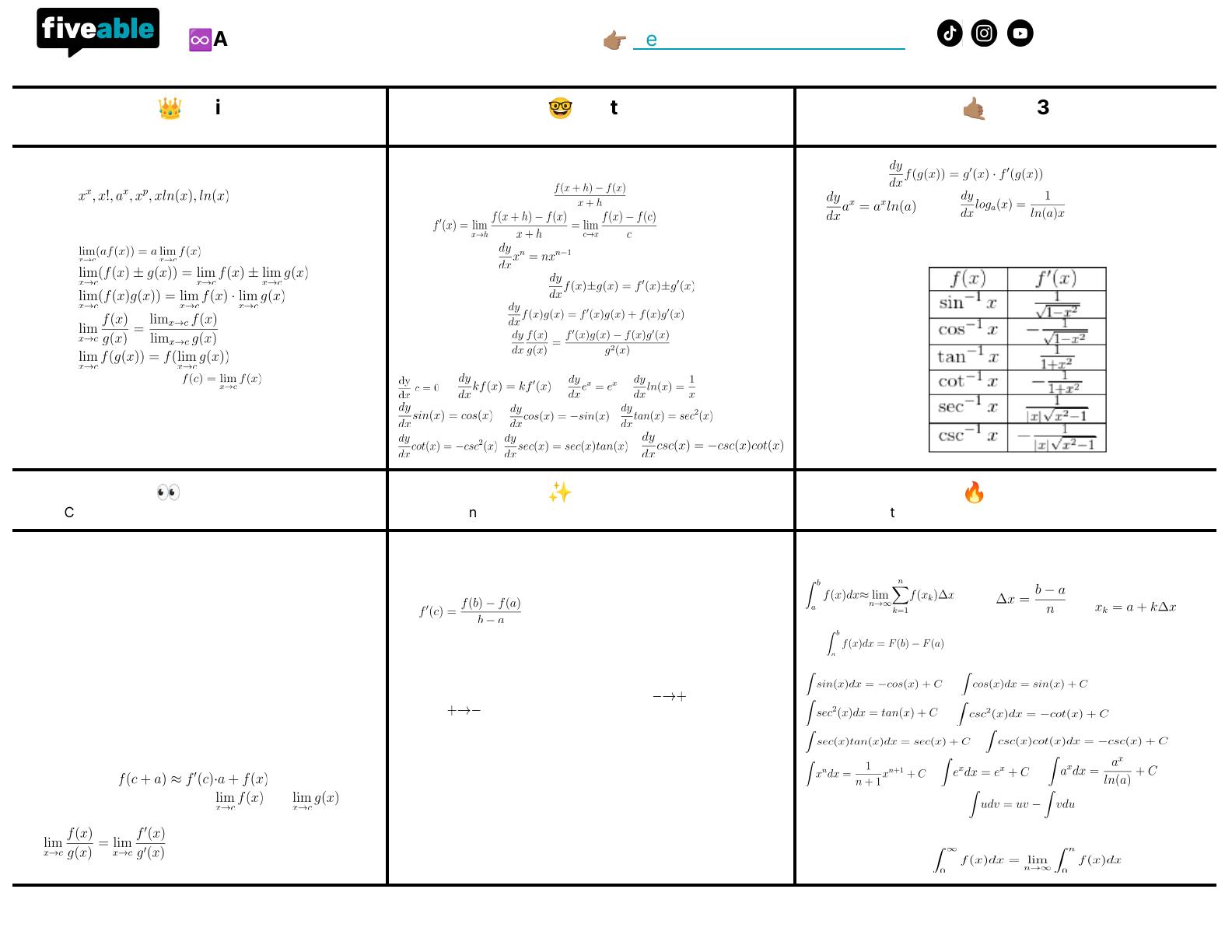
● Order of growth rates from fastest to slowest:
● Methods to algebraically simplify limits if you can’t
directly plug in: Completing the square, Rationalization,
Factoring
●
●
●
●
●
● Continuity exists if
● Intermediate Value Theorem: Write “Since f(x) is
continuous on [a,b] and f(c) is between f(a) and f(b), by
the IVT there is a c in (a,b) such that
f(c)=0”
● All differentiable functions are continuous, but not all continuous
functions are differentiable
● Average Rate of Change=
●
● Power Rule:
● Sum/Difference Rule:
● Product Rule:
● Quotient Rule:
● Other Differentiation Formulas:
● Chain Rule:
●
● Implicit Dierentiation: Dierentiate each term with respect to the
individual variables
● Derivatives of an Inverse Trig Function:
👀
Unit 4
Contextual Applications of Differentiation
✨
Unit 5
Analytical Applications of Differentiation
🔥
Unit 6
Integration of Accumulation of Change
● Particle Motion:
○ Position=s(t)
○ Velocity=v(t)=s’(t)
○ Acceleration=a(t)=v’(t)=s’’(t)
● If velocity is negative, the particle is moving to the left.
● If velocity is positive, the particle is moving to the right.
● If velocity and acceleration have the same sign, the particle is
speeding up.
● If velocity and acceleration have different signs, the particle is
slowing down.
● Steps for Related Rates:
1. Draw a picture and label the picture (assign variables)
2. List your knowns and unknown values
3. Write an equation to model the situation.
4. Take the derivative of both sides. Remember: d/dt
5. Plug in known values and solve for desired values. DON’T
FORGET UNITS!
● Linearization:
● If f(x)/g(x) are indeterminate that and are
both equal to 0 or ∞. Use L’Hopital’s Rule:
f aL or
● Mean Value Theorem: Write “Since f(x) is continuous on [a,b] and
dierentiable on (a.b), there exists a c in (a,b) such that
by the MVT.
● Extreme Value Theorem: Write “Since f(x) is continuous on (a,b), by
the EVT, there exists at least one local maximum and one local
minimum on (a,b).”
● Critical Points: where f’(x)=0 or does not exist
● f’(x) > 0: increasing; f’(x) < 0: decreasing
● First Derivative Test: where f ’(x) = 0, if f(x): : local min;
if f(x) : local max
● Determining Concavity: f”(x) > 0: concave up; f”(x) < 0: concave
down; f”(x) = 0: inflection point
● Second Derivative Test: f’(x) = 0, if f”(x) > 0: min; if f”(x) < 0: max;
if f”(x) = 0: indeterminate
● Steps for Optimization:
1. Draw picture
2. Label your picture and assign variables
3. Write an equation and use given information to find relationships
among variables
4. Find extrema (min/max) and evaluate the function
● The integral is the area between the graph and the x-axis
● Riemann Sum can be used to approximate area (includes left, right,
midpoint, and trapezoidal sum)
where and
● Fundamental Theorem of Calculus FTC- Definite Integrals
● Integration Formulas NEVER FORGET + C
● Integration by Parts (IBP):
● Learn the Tabular Method to make IBP easier
● Use Partial Fraction Decomposition to integrate rational functions
● Improper Integrals: