
AP Calculus BC Study Review Guide

AP Calculus BC Study Review Guide

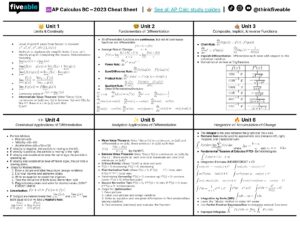
AP Calculus BC Simple Studies Review provides comprehensive coverage of key calculus concepts essential for success in the AP exam. It includes detailed explanations of limits, continuity, differentiation, and integration, along with practical examples and problem sets. This review guide is designed for AP Calculus BC students preparing for the May exam, helping them master complex topics such as the Fundamental Theorem of Calculus and Taylor series. With clear diagrams and step-by-step solutions, this resource is invaluable for reinforcing understanding and boosting exam readiness.

Key Points

  • Covers limits, continuity, differentiation, and integration topics for AP Calculus BC.
  • Includes detailed examples and problem sets to enhance understanding of calculus concepts.
  • Provides insights into the Fundamental Theorem of Calculus and Taylor series applications.
  • Designed for AP Calculus BC students preparing for the May exam with clear diagrams and solutions.
219
/ 61
AP CALCULUS BC SIMPLE STUDIES REVIEW
Unit 1: Limits and Continuity
Limit: the value that a function (typically denoted as ‘f(x)’) approaches as it gets closer
and closer to a certain ‘x’ value
Ask yourself: “As ‘x’ approaches a value, what is f(x) getting closer to?
Typically, to find the limit of a function, you can just plug in ‘x’ to f(x)
Ex. What is the 
2
of
2
?
All you do is plug x (which = 2) into f(x) (which is
2
)
2
2
= 4 = 
2
2
Left hand limit: this is the value of f(x) as it approaches the value of x from the LEFT
side
Denoted as: 
2
The ‘-’ superscript indicates a LEFT HAND LIMIT
To find the answer, determine what the value that f(x) approaches as x =
1.9, 1.99, 1.999, etc.
Notice how the x values are less than 2, but are getting closer and
closer to the actual value of 2.
Right hand limit: this is the value of f(x) as it approaches a value of x from the RIGHT
side.
Denoted as 
2
The ‘+’ superscript indicates a RIGHT HAND LIMIT.
To find the answer, determine what the value that f(x) approaches as x =
2.1, 2.01, 2.001, etc.
notice how the x values are greater than two, but are getting closer
and closer to the actual value of 2
In order for a limit to exist, the LH and RH limits have to be equal to each other. If not,
the limit does not exist (indicated as DNE).
Ex. 
0
1/x
The LH limit = ‘-∞’ but the RH limit = ‘+∞’. Thus lim x→ 0 of 1/x =
DNE
*REMEMBER: If the limit of a function equals ‘+∞’, that doesn’t mean that it
doesn’t exist. As long as both the RH and LH limits equal ‘+∞’, then the limit can
and does exist.
If given a graph, you can determine if the limit exists if there aren’t any breaks in
the graphs.
If a question asks for the limit of f(x) as x→ ‘∞’, this is just asking “what value does
f(x) approach as x gets bigger and bigger.
Ex. lim x→ ∞ of 1/x
As you plug in greater values of x (x value gets larger and larger), the
function gets closer and closer to 0, because 1/(a bigger number) gets
smaller (closer to 0). Thus, the answer would be 0.
When a function is a polynomial divided by another polynomial and x→ ∞ :
If the highest power of x for the numerator is greater than the denominator,
then the limit of that function as x→ ∞ is ∞
If the highest power of x for both the numerator and denominator are equal,
then the limit of that function as x→ ∞ is the coefficient of the highest power
of x in the numerator divided by the coefficient of the highest power of x in
the denominator.
If the highest power of x for the numerator is less than the denominator, then
the limit of that function as x→ ∞ is 0.
Continuity: A function is continuous ONLY if the LH limit = RH limit = f(x)
The limit of a function has to exist, and it has to equal the value of the function at
that ‘x’ value.
Ex. lim x→ 2of
2
= 4 (the limit exists because the RH limit and the LH
limit are equal) and f(2) = 4. The limit x→ 2 and f(2) are both equal to 4,
so the function is CONTINUOUS.
If given a graph, you can determine if it’s continuous if there are no breaks in the
graph, or open circles on that function on the graph.
Basically, the function on the graph looks continuous, with no holes in it.
Unit 2: Differentiation - Definition and Fundamental Properties
Differentiation: Finding the derivative, or rate of change, of a function
/ 61
End of Document
219
You May Also Like
Faqs of AP Calculus BC Study Review Guide
What are the key topics covered in the AP Calculus BC review?
The AP Calculus BC review covers essential topics such as limits, continuity, differentiation, and integration. It provides detailed explanations of each concept, including the properties of limits, the definition of continuity, and various differentiation techniques. Additionally, the review includes applications of integration and differentiation, as well as the Fundamental Theorem of Calculus, which connects the two concepts. This comprehensive coverage ensures that students are well-prepared for the AP exam.
How does the review guide help with understanding Taylor series?
The review guide includes a section dedicated to Taylor series, explaining their significance in approximating functions. It outlines the general formula for Taylor series and provides examples of how to derive them for common functions like sine and exponential functions. Additionally, the guide discusses the convergence of Taylor series and how to determine the interval of convergence, which is crucial for understanding their practical applications in calculus.
What types of problems are included in the AP Calculus BC review?
The review includes a variety of practice problems that range from basic to advanced calculus concepts. Students will find multiple-choice questions, free-response questions, and real-world application problems that require the use of calculus. Each problem is designed to reinforce the concepts covered in the review, helping students to apply their knowledge effectively. Detailed solutions are provided to guide students through the problem-solving process.
What is the significance of the Fundamental Theorem of Calculus in this review?
The Fundamental Theorem of Calculus is a central theme in the AP Calculus BC review, as it establishes the relationship between differentiation and integration. The review explains both parts of the theorem, illustrating how it allows for the evaluation of definite integrals using antiderivatives. This concept is crucial for students, as it simplifies the process of calculating areas under curves and solving problems involving rates of change, making it a vital topic for the AP exam.
How can students use this review guide to prepare for the AP exam?
Students can use the AP Calculus BC review guide as a comprehensive study tool to reinforce their understanding of calculus concepts. By working through the detailed explanations, examples, and practice problems, students can identify their strengths and weaknesses in the material. The guide also encourages active learning through problem-solving, which is essential for mastering calculus. Additionally, students can use the review to create a study schedule leading up to the exam, ensuring they cover all necessary topics.