

2026 AP Calculus AB Score Calculator
Calculate your AP Calculus AB exam score based on official College Board latest guidelines
Section 1: Multiple Choice
50% of total score
Questions correct:
Section 2: Free Response Questions
50% of total score
Part A: Calculator Active (9 pts each)
FRQ 1: Question 1 (Calculator Active)
Invasive species growth model involving arctangent functions, derivatives, integrals, and optimization.
FRQ 2: Question 2 (Calculator Active)
Area between curves, volume of solids with known cross sections, and parallel tangent lines.
Part B: No Calculator (9 pts each)
FRQ 3: Question 3 (No Calculator)
Reading rates, average rate of change, Intermediate Value Theorem, trapezoidal approximation, and integration.
FRQ 4: Question 4 (No Calculator)
Analyzing accumulation functions, points of inflection, and finding absolute extrema using candidate tests.
FRQ 5: Question 5 (No Calculator)
Particle motion involving velocity, position, speed, and relationship between position and velocity.
FRQ 6: Question 6 (No Calculator)
Implicit differentiation, tangent lines, vertical tangents, and related rates on curves.
This calculator estimates your AP Calculus AB score using modeled thresholds from the official College Board scoring metrics. Actual boundary cutoffs shift marginally each year. Historical datasets are calibrated using real curve distributions.
Your Predicted AP Score
Composite Score: 49.7 / 100
FRQ: 24.1 points (50% weight)
Making Progress!
You're building momentum. Consistent practice will push you higher.
Access free AP Calculus AB resources:
- Study guides & notes
- Practice questions
- Flashcards
- Cheat sheets
- Exam prep materials
- Class notes
National Performance (2025)
You scored better than 39.8% of test-takers
Score Distribution
Historical Score Trends (2020–2025)
Track how AP Calculus AB score distributions have changed over the past 6 years
Advanced Placement (AP) Resource Hub
Explore free class notes, summaries, assignments, cheat sheets shared by students to help you prepare for your AP exams.
What Is the AP Calculus AB Exam?
The AP Calculus AB exam is a College Board assessment covering the equivalent of a first-semester college calculus course — limits, derivatives, integrals, and the Fundamental Theorem of Calculus. It is one of the most widely taken STEM-track AP exams, sitting at the gateway between high school math and university-level mathematics.
Students who score a 3, 4, or 5 may earn college credit or placement out of Calculus I at thousands of U.S. universities, saving a semester of tuition and accelerating their math sequence. In 2025, approximately 300,000 students sat the AP Calculus AB exam. About 60% earned a 3 or higher, and a notable 20%+ earned a 5 — one of the stronger 5-rates among AP science and math exams, reflecting how well structured and predictable the exam's content coverage is for prepared students.
Not sure whether to take AB or BC? Check out the AP Calculus AB vs. BC Course Comparison Guide on Learro, or read the official AP Calculus AB and BC Course and Exam Description for a full breakdown of what each course covers.
AP Calculus AB Exam Format (2026)
The AP Calculus AB exam is 3 hours and 15 minutes long, split evenly between two sections. Each section is worth exactly 50% of your total composite score:
| Section | Format | Questions | Time | Calculator? | Score Weight |
|---|---|---|---|---|---|
| Section 1A — MCQ | Multiple Choice | 30 questions | 60 minutes | ❌ No | 50% |
| Section 1B — MCQ | Multiple Choice | 15 questions | 45 minutes | ✅ Yes | |
| Section 2A — FRQ | Free Response | 2 questions (9 pts each) | 30 minutes | ✅ Yes | 50% |
| Section 2B — FRQ | Free Response | 4 questions (9 pts each) | 60 minutes | ❌ No |
The Two FRQ Parts: Calculator vs. No Calculator
The FRQ section is divided into two distinct parts that test different skill sets. Understanding the difference is essential for preparation:
AP Calculus AB Units and Exam Weighting
College Board organizes AP Calculus AB into 8 units. Each carries a defined percentage of MCQ questions. Units 2, 3, 5, and 6 (derivatives and integrals) dominate the exam — together accounting for up to 70% of MCQ content:
For unit-by-unit progress check practice, Learro has several verified AP Calculus AB docs directly tied to specific units:
AP Calculus AB Score Cutpoints & Composite Ranges (2025)
Your raw MCQ and FRQ scores are each scaled to 50 points and added for a composite out of 100. College Board then converts that composite to a 1–5 AP score using annual cut-points. The ranges below are based on 2025 official data — the same data used in this calculator:
| AP Score | Composite Range (out of 100) | College Credit Recommendation | % of Students (2025) |
|---|---|---|---|
| 5 | 69 – 100 | Extremely Well Qualified | ~20% |
| 4 | 52 – 68 | Well Qualified | ~17% |
| 3 | 39 – 51 | Qualified | ~23% |
| 2 | 22 – 38 | Possibly Qualified | ~20% |
| 1 | 0 – 21 | No Recommendation | ~20% |
Cut-points are approximate and based on 2025 College Board data. Ranges shift slightly each year. The calculator above is updated annually each August.
MCQ and FRQ Targets for Each Score
Assuming average FRQ performance (roughly 50% of available FRQ points — about 27 out of 54), here are approximate MCQ thresholds for each AP score:
| Target AP Score | Approx. MCQ Correct (out of 45) | FRQ Points Needed (out of 54) |
|---|---|---|
| 5 | 37 – 45 | 40 – 54 |
| 4 | 28 – 36 | 30 – 39 |
| 3 | 20 – 27 | 22 – 29 |
| 2 | 10 – 19 | 12 – 21 |
| 1 | 0 – 9 | 0 – 11 |
These are estimates assuming balanced MCQ/FRQ performance. Use the calculator above to model your specific scenario.
To see exactly how the 2025 scoring rubrics work, check out the AP Calculus AB Scoring Guidelines 2025 and the AP Calculus AB 2018 International Practice Exam Scoring Guidelines — both available free on Learro.
How to Score More Points on AP Calculus AB FRQs
With 6 FRQs each worth 9 points, the free-response section offers 54 total points — and how you present your work matters as much as whether your answer is correct. Here's how to maximize your score on each part:
Notation and Justification: The Hidden Points
AP Calculus AB rubrics explicitly award points for correct mathematical notation and proper justifications — and deduct them for errors. These are the most commonly lost points among students who "understand the math" but write answers carelessly:
- Always include the differential. Writing ∫f(x) without dx will cost you a notation point. Every integral must be written as ∫f(x) dx.
- Use equals signs correctly. Writing f'(x) = 3x = 6 when x = 2 is a false statement chain. Write f'(2) = 3(2) = 6 instead. Misuse of the equals sign is flagged on rubrics.
- Justify extrema and inflection points with the correct test. Saying "f has a minimum at x = 2 because f'(2) = 0" is incomplete — you must state the sign change of f' or use the Second Derivative Test and confirm f''(2) > 0.
- State the FTC when you use it. When evaluating a definite integral using antiderivatives, a complete answer names the Fundamental Theorem of Calculus as the justification.
- Include units on contextual problems. If the problem involves feet per second, your answer for a rate must include the unit. Missing units on contextual answers costs a point on nearly every applicable rubric.
- Don't round intermediate values. Store full decimal precision in your calculator and round only the final answer. Rounding mid-problem cascades into errors that can cost multiple points.
Part A (Calculator Active) Strategy
- Use your calculator as a tool, not a crutch. Part A problems still require you to set up integrals and derivatives correctly by hand — the calculator only computes the numerical result. Showing the correct setup earns points even if you mis-key the calculation.
- Know how to use your calculator's integral and derivative functions. You must be able to compute definite integrals numerically (fnInt on TI-84) and find derivatives at a point (nDeriv). Practice using these fluently before exam day.
- Write down your calculator setup. Even on calculator-active questions, write the expression you entered into the calculator (e.g., "∫₁³ (x² + 1) dx ≈ 9.333"). This earns the setup point even if you state an incorrect numerical result.
Part B (No Calculator) Strategy
- Work through all four questions before perfecting any one. Each sub-part is independently scored. Getting through all of Part B at a basic level earns more points than spending 25 minutes perfecting FRQ 3 and leaving FRQ 6 blank.
- Particle motion questions follow a consistent pattern. Position → velocity → acceleration → speed. Know that speed = |v(t)| and that the particle changes direction when v(t) changes sign, not when v(t) = 0 alone.
- For implicit differentiation questions, differentiate both sides with respect to x, apply the chain rule to any y terms (writing dy/dx), then solve algebraically. This four-step pattern appears almost every year.
- For accumulation function questions (FTC Part 1), remember that if F(x) = ∫ₐˣ f(t) dt, then F'(x) = f(x). Questions often ask you to find where F is increasing, decreasing, concave up, or has extrema — all of which are determined by the sign of f(x) and f'(x).
AP Calculus AB MCQ Strategy: Getting More Right in 105 Minutes
With 45 questions across two sub-parts (30 no-calculator + 15 calculator), pacing and technique both matter. Here's how to approach the MCQ section systematically:
- Do Section 1A (no calculator) first — and carefully. These 30 questions test analytical skills. Work cleanly and show scratch work. Arithmetic errors are the primary cause of wrong answers on no-calculator MCQs, not conceptual misunderstanding.
- Use your calculator strategically on Section 1B. Not every 1B question requires a calculator — some are faster to solve analytically. Reach for the calculator when you need numerical integration, finding zeros, or evaluating a derivative at a point.
- Recognize the most common MCQ question types. AP Calc AB MCQs regularly test: evaluating limits (including L'Hôpital's Rule), finding derivatives using chain/product/quotient rules, interpreting the meaning of f'(a) or ∫f in context, and identifying behavior of f from the graph of f'.
- Read "f' graph" questions carefully. A very common question type gives you a graph of f'(x) and asks about properties of f(x) — increasing/decreasing, concavity, extrema. These are conceptually simple but cause many errors because students confuse the graph of f' with the graph of f.
- Eliminate answers using dimensional analysis. On contextual problems, wrong answers often have the wrong units or unreasonable magnitudes. If the question asks for a rate in meters/second and two choices are 0.003 and 300,000, you can often eliminate at least one purely from context.
- No penalty for wrong answers — guess on everything you flag. There is no point deduction for incorrect answers. If time is running out, fill in your best guess for every unanswered question.
For additional MCQ practice organized by question type, the Unit 8 Progress Check MCQ Scoring Guide and Unit 4 Progress Check MCQ on Learro are good worked examples of how the rubric assigns points on specific question styles.
Essential AP Calculus AB Theorems You Must Know
Several theorems are referenced directly on exam rubrics — either by name in the question itself or as required justification for full credit. Knowing the statement and conditions of each is non-negotiable for a score of 4 or 5:
| Theorem | What It Says | Exam Context |
|---|---|---|
| Intermediate Value Theorem (IVT) | If f is continuous on [a, b] and k is between f(a) and f(b), then there exists c in (a, b) where f(c) = k. | Proving a root or specific value exists; must state continuity as a condition to earn full credit. |
| Mean Value Theorem (MVT) | If f is continuous on [a, b] and differentiable on (a, b), then there exists c where f'(c) = [f(b) – f(a)] / (b – a). | Justifying the existence of a point where instantaneous rate equals average rate; must state both conditions. |
| Extreme Value Theorem (EVT) | If f is continuous on a closed interval [a, b], then f attains both an absolute maximum and minimum on [a, b]. | Justifying why absolute extrema must exist before finding them using the Candidate Test. |
| Fundamental Theorem of Calculus Part 1 | If F(x) = ∫ₐˣ f(t) dt, then F'(x) = f(x). | Differentiating accumulation functions; very commonly tested in FRQ Part B. |
| Fundamental Theorem of Calculus Part 2 | ∫ₐᵇ f(x) dx = F(b) – F(a), where F is any antiderivative of f. | Evaluating definite integrals analytically; the backbone of all integration FRQs. |
| L'Hôpital's Rule | If lim f/g gives 0/0 or ∞/∞, then lim f/g = lim f'/g', provided the latter limit exists. | Evaluating indeterminate limits; must confirm the indeterminate form before applying — saying "0/0" earns a condition point. |
AP Calculus AB Score Distribution: 2020–2025
AP Calculus AB has one of the more favorable score distributions among AP math and science exams — with a consistently high proportion of 4s and 5s compared to many other subjects:
| Year | % Score 5 | % Score 4 | % Score 3 | % Score 2 | % Score 1 | Mean Score |
|---|---|---|---|---|---|---|
| 2020 | 17.1% | 16.8% | 20.9% | 21.7% | 23.5% | 2.82 |
| 2021 | 18.9% | 17.2% | 21.5% | 21.1% | 21.3% | 2.91 |
| 2022 | 19.4% | 17.3% | 22.6% | 20.8% | 19.9% | 2.95 |
| 2023 | 20.0% | 17.1% | 23.1% | 20.4% | 19.4% | 2.98 |
| 2024 | 20.2% | 17.4% | 22.9% | 20.1% | 19.4% | 2.99 |
| 2025 | 20.3% | 17.3% | 22.6% | 20.2% | 19.6% | 2.99 |
Source: College Board AP Program national score distributions. 2025 figures are approximate based on released data.
The proportion earning a 5 has grown by over 3 percentage points since 2020 — a trend consistent with the data insight shown in this calculator. The distribution is notably bimodal: students who prepare well tend to score 4s and 5s, while underprepared students tend toward 1s. The 3-score band is relatively narrow, suggesting that targeted practice on weak units can push students across the 4 threshold more readily than on many other AP exams.
AP Calculus AB College Credit: What Score Do You Need?
AP Calculus AB is one of the most widely accepted AP exams for college credit, typically substituting for a semester of Calculus I (Math 1A / MATH 151 / Calc 1). Credit policies by score:
| Score | Typical Credit Policy | Example Placement |
|---|---|---|
| 5 | Credit + placement at nearly all schools | Place directly into Calculus II, Linear Algebra, or Multivariable Calculus depending on major |
| 4 | Credit at most schools including selective universities | Exempt from Calculus I; typically 3–4 credits awarded |
| 3 | Credit at many schools; top-tier schools often require 4+ | Calculus I credit at community colleges and many state universities |
| 2 | No credit at most schools | May allow placement into Calculus I without the prerequisite course |
| 1 | No credit | — |
Credit policies vary. Always verify with your prospective college's registrar or AP credit page before making enrollment decisions.
Free AP Calculus AB Study Resources on Learro
Use your calculator score to identify which units or skills need the most attention, then head to Learro's AP Calculus AB resource library for free notes, practice checks, scoring guides, and exam materials shared by students who've already taken the course.
AP Calculus AB Docs Available on Learro
These are the verified AP Calculus AB documents currently in the Learro library — click any to view or download:
AP Calculus AB vs. AP Calculus BC: What's the Difference?
A common question among students is whether to take AB or BC — or whether an AB score is "worth less" than a BC score. Here's the clear answer:
| AP Calculus AB | AP Calculus BC | |
|---|---|---|
| Content Covered | Limits, derivatives, integrals, FTC, differential equations basics | All of AB + series (Taylor/Maclaurin), parametric/polar, advanced integration techniques |
| College Equivalent | Calculus I (one semester) | Calculus I + Calculus II (two semesters) |
| Credit for a 5 | Calc I credit at most schools | Calc I + II credit at most schools |
| AB Sub-Score | Your final score | BC students also receive an AB sub-score reflecting their performance on AB-content questions only |
| Best For | Students who want to master calculus fundamentals deeply, or whose curriculum hasn't covered BC topics yet | Students with strong AB foundations who want to maximize college credit and are comfortable with a faster pace |
For a full side-by-side breakdown, read the AP Calculus AB vs. BC Course Comparison Guide on Learro.
Other AP Score Calculators
Taking more than one AP exam this year? Use Learro's other subject calculators to predict and plan across all your exams. Each uses official College Board scoring data for that subject.
Explore More AP Subject Resources
Whether you're studying alongside AP Calculus AB or planning next year's exams, Learro's AP resource hub covers every major subject:
- AP Calculus AB — progress checks, scoring guidelines, and practice materials
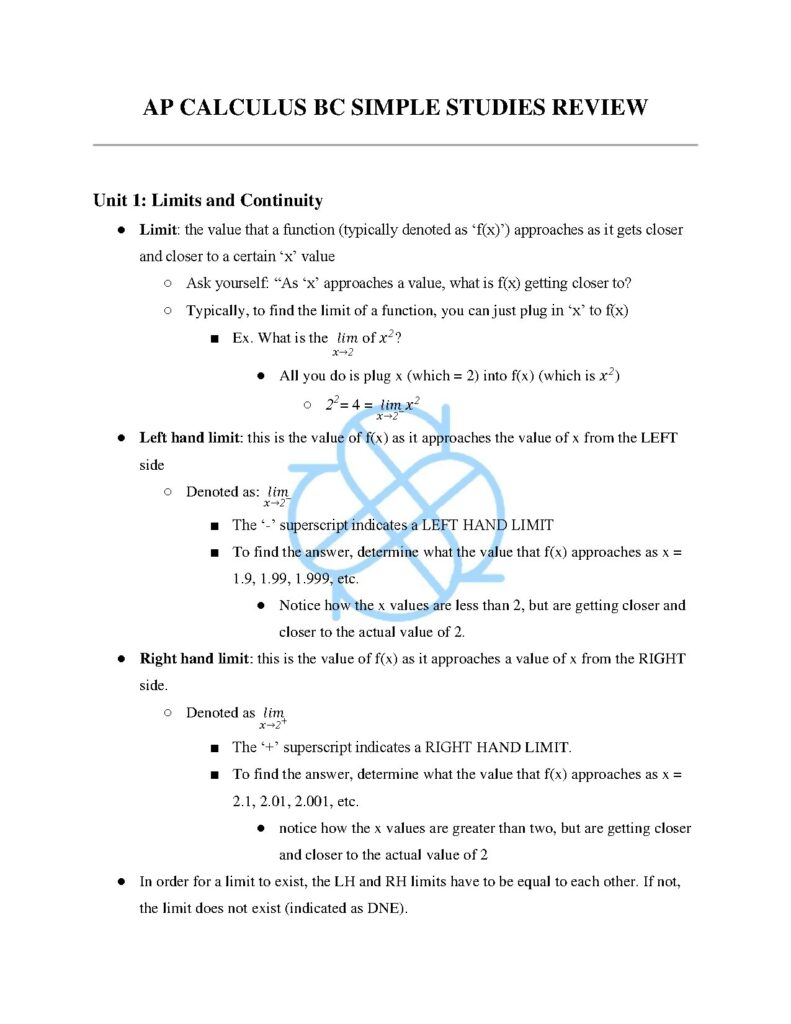
- AP Calculus BC — series, parametric, polar, and full AB+BC study guides
- AP Precalculus — functions, polynomial, exponential, and trigonometric foundations
- AP Statistics — data analysis, probability distributions, and inference
- AP Physics 1 — kinematics, forces, energy, waves, and circuits
- AP Physics 2 — electrostatics, magnetism, optics, and modern physics
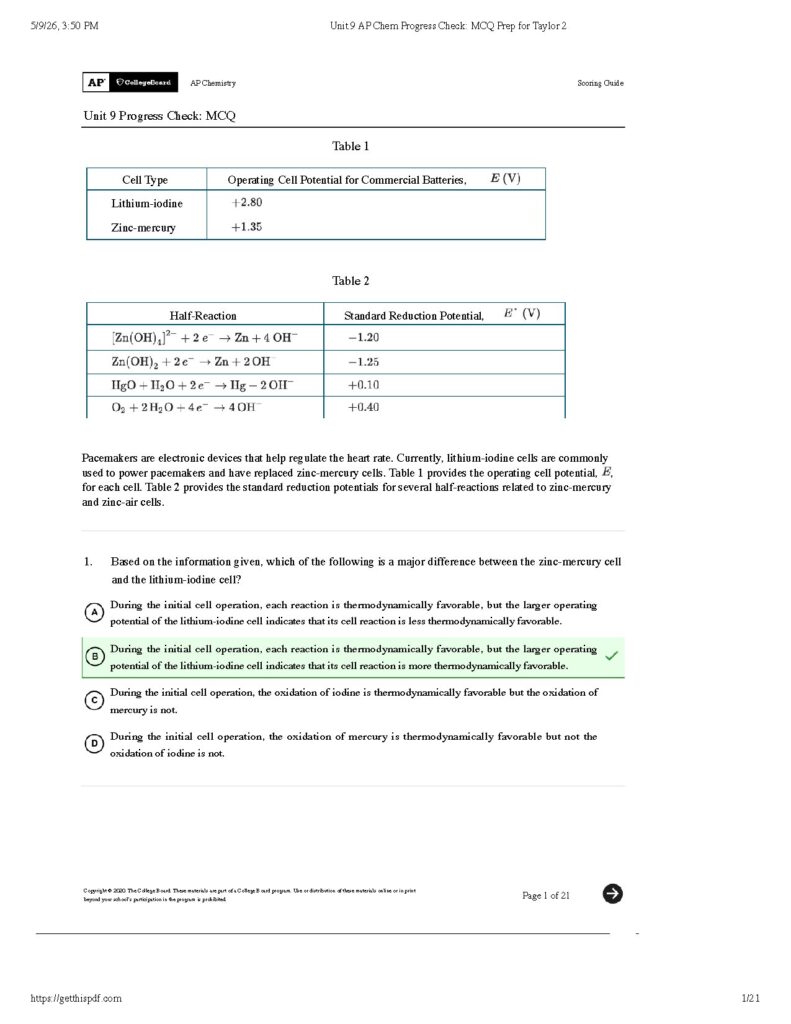
- AP Chemistry — reaction types, equilibrium, thermodynamics, and electrochemistry
- AP English Language — rhetorical analysis, synthesis essays, and argument writing
- AP Macroeconomics — GDP, fiscal and monetary policy, international trade
- AP Human Geography — population, culture, political geography, development
- Browse All AP Subjects →