

2026 AP English Language Score Calculator
Calculate your AP English Language and Composition exam score based on official College Board latest guidelines
Section 1: Multiple Choice
45% of total score
Questions correct:
Section 2: Free Response Questions
55% of total score
Essays (0–6 analytic rubric points each)
FRQ 1: Synthesis Essay
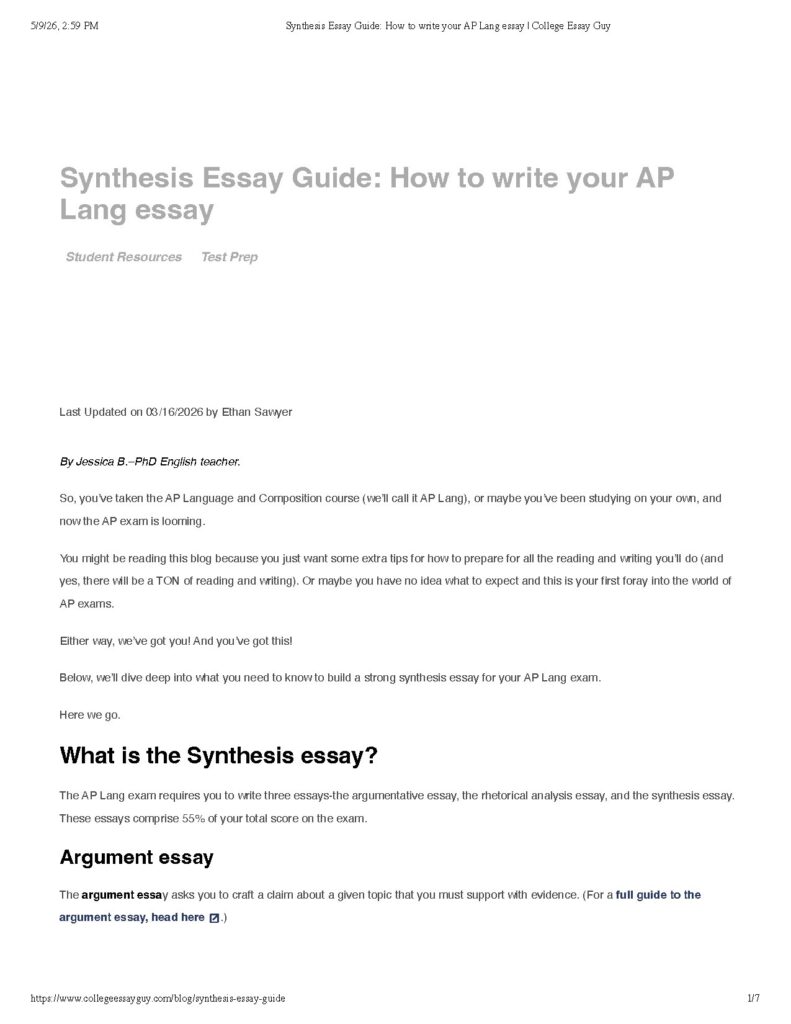
Synthesize raw evidence from multiple provided texts to form a cohesive, structured thesis arguments.
FRQ 2: Rhetorical Analysis Essay
Deconstruct a non-fiction text to explain how choices made by an author construct targeted rhetorical intentions.
FRQ 3: Argument Essay
Formulate an original position based on a philosophical or topical prompt supported via evidence and logic.
This calculator estimates your score using weighted matrices mapped against modern testing distributions. Rubrics are aligned with official College Board guidelines. Actual curve cutoffs vary annually. Historical trends compiled via AP Score Distributions.
Your Predicted AP Score
Composite Score: 64.7 / 100
FRQ: 36.7 points (55% weight)
You're On Track!
You have a solid foundation. Targeted study of weak areas will help significantly.
Access free AP Lang resources:
- Study guides & notes
- Rhetorical device lists
- Sample essays
- Rubric breakdowns
- Exam prep materials
- Style cheat sheets
National Performance (2025)
You scored better than 31.4% of test-takers
Score Distribution
Historical Score Trends (2020–2025)
Track how AP English Language distributions have changed over time
Advanced Placement (AP) Resource Hub
Explore free class notes, summaries, assignments, cheat sheets shared by students to help you prepare for your AP exams.
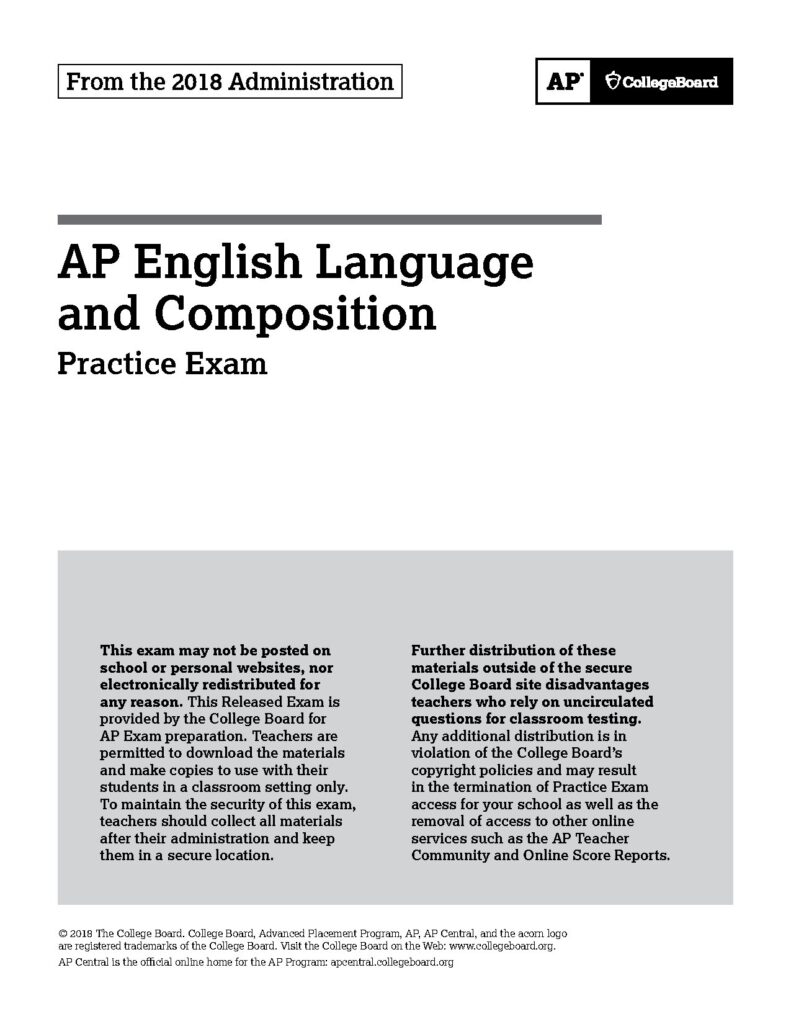
What Is the AP English Language and Composition Exam?
The AP English Language and Composition exam (commonly called AP Lang) is a College Board assessment designed to test students on the reading and writing skills expected in a college-level composition course. It focuses on rhetoric — how writers use language to persuade, inform, and engage audiences — as well as students' ability to construct well-reasoned, evidence-based arguments of their own.
Students who score a 3, 4, or 5 may earn college credit or placement out of introductory writing or composition courses at thousands of U.S. universities. In 2025, more than 570,000 students sat the AP English Language exam, making it the single most-taken AP exam in the country. The mean score was approximately 2.9, and roughly 56% of test-takers earned a 3 or higher.
AP English Language Exam Format (2026)
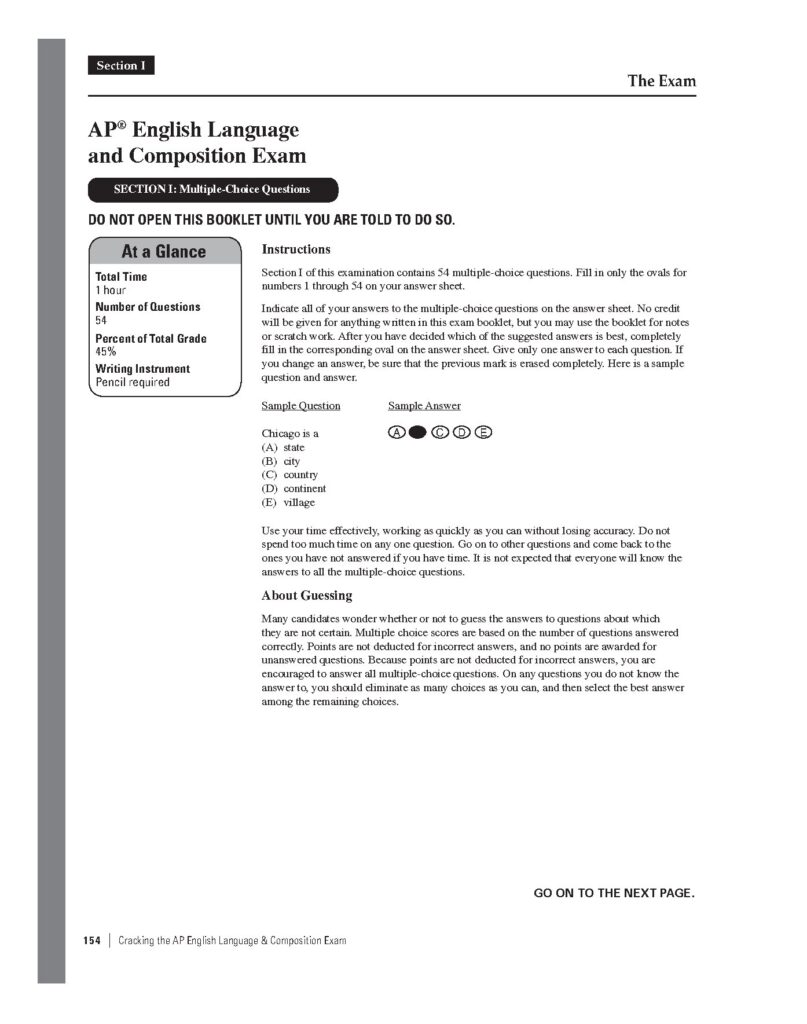
The AP English Language exam runs for 3 hours and 15 minutes and is divided into two sections. Unlike most AP science exams where sections are weighted equally, AP Lang tilts slightly toward the writing section:
| Section | Format | Questions | Time | Score Weight |
|---|---|---|---|---|
| Section 1 — MCQ | Multiple Choice | 45 questions | 60 minutes | 45% |
| Section 2 — FRQ | Free Response (Essays) | 3 essays | 135 minutes | 55% |
Scoring Formula
College Board calculates your composite AP Lang score out of 150 total points:
- MCQ Section: Each correct answer out of 45 is scaled to a maximum of 67.5 points (45% of 150).
- FRQ Section: Your combined essay points out of 18 are scaled to a maximum of 82.5 points (55% of 150).
- The two scaled scores are added for a composite out of 150, which is then converted to a 1–5 AP score.
The Three AP Lang FRQ Essay Types
The free-response section is 135 minutes long and consists of three distinct essay types, each worth up to 6 points on the same analytic rubric. Your combined FRQ score is out of 18 points. Understanding what each essay tests is critical — the skills required are meaningfully different:
The 6-Point Analytic Rubric (All Three Essays)
Every AP Lang essay is scored on the same three-row rubric. Understanding exactly what each row rewards is the fastest way to raise your scores:
| Rubric Row | Max Points | What Earns the Point(s) |
|---|---|---|
| Row A: Thesis | 0–1 | A defensible claim that responds to the prompt with a clear line of reasoning. Merely restating the prompt earns 0. |
| Row B: Evidence & Commentary | 0–4 | The core of the score. Must provide specific evidence AND explain how it supports the thesis. Higher scores require insightful, sustained commentary — not just summary or description. |
| Row C: Sophistication | 0–1 | Demonstrating complex understanding: nuanced argument, exploring tensions or limitations, explaining broader significance, or using a consistent and effective controlling metaphor/style. Rarely awarded for surface-level responses. |
AP English Language Score Cutpoints & Composite Ranges (2025)
After your MCQ and FRQ scaled scores are combined into a composite out of 150, College Board converts it to a 1–5 AP score using annual cut-points. The ranges below reflect the 2025 official scoring data used in this calculator:
| AP Score | Composite Score Range (out of 150) | College Credit Recommendation | % of Students (2025) |
|---|---|---|---|
| 5 | 115 – 150 | Extremely Well Qualified | ~11% |
| 4 | 95 – 114 | Well Qualified | ~18% |
| 3 | 73 – 94 | Qualified | ~27% |
| 2 | 46 – 72 | Possibly Qualified | ~30% |
| 1 | 0 – 45 | No Recommendation | ~14% |
Cut-points are approximate and based on 2025 College Board data. Ranges shift slightly each year. The calculator above is updated annually each August.
How Many MCQs and Essay Points Do You Need for Each Score?
Assuming average essay performance (roughly 50% of available FRQ points — about 9 out of 18), here are the approximate MCQ thresholds to hit each score:
| Target AP Score | Approx. MCQ Correct (out of 45) | Combined Essay Points Needed (out of 18) |
|---|---|---|
| 5 | 38 – 45 | 14 – 18 |
| 4 | 30 – 37 | 11 – 13 |
| 3 | 21 – 29 | 8 – 10 |
| 2 | 11 – 20 | 5 – 7 |
| 1 | 0 – 10 | 0 – 4 |
These are estimates based on 45/55 MCQ/FRQ weighting. Use the calculator above to model your specific score scenario.
How to Score More Points on Each AP Lang Essay
Because 55% of your score comes from essays, improving your writing directly moves your AP score more than almost anything else. Here's how to maximize points on each essay type:
Synthesis Essay
- Read all sources before outlining. Spend 10–12 minutes reading and annotating before you write. Knowing all 6–7 sources lets you choose the strongest 3+ to cite rather than grabbing the first ones you see.
- Take a clear position. The synthesis essay requires you to argue, not just compare. Your thesis must make a defensible claim, not simply say "there are multiple perspectives."
- Cite sources by attribution, not just parenthetical labels. Saying "According to Source C, a 2022 NIH study found…" is more effective than "(Source C)" alone. It signals you actually read the source.
- Explain the connection. After quoting or paraphrasing a source, always explain how it supports your argument. The grader is looking for your reasoning, not just the evidence.
Rhetorical Analysis Essay
- Identify specific rhetorical choices — not just devices. Saying "the author uses pathos" rarely earns points. Saying "the author's extended anecdote about her grandmother's immigration appeals to the reader's sense of familial sacrifice" earns points.
- Always connect choice to purpose. For every rhetorical choice you identify, explain why the author made it and what effect it has on the audience. The rubric rewards "how choices achieve purpose," not "what choices exist."
- Avoid plot summary. The most common mistake in rhetorical analysis is describing what the author says rather than how they say it. Keep asking yourself: "Am I analyzing technique or just summarizing?"
- Address the whole passage. Don't analyze only the first paragraph. Higher-scoring essays show awareness of how rhetoric evolves or builds across the entire text.
Argument Essay
- Choose a clear, defensible position immediately. Don't hedge. Scorers reward confidence and line of reasoning. A focused argument that slightly oversimplifies usually scores higher than a perfectly balanced non-argument.
- Use specific, concrete evidence. Vague appeals to "many people" or "studies show" rarely earn Row B points. Name the study, event, person, or text you're referencing.
- Anticipate and address a counterargument. Including a concession or rebuttal is one of the clearest paths to Row C (Sophistication). Acknowledging a limitation of your argument and explaining why your position still holds demonstrates complex thinking.
- Don't over-plan. Spend 5–7 minutes outlining, then write. Students who outline for 20 minutes often rush and fail to develop their commentary fully.
AP Lang MCQ Strategy: Getting More Right in 60 Minutes
With 45 questions in 60 minutes, you have just over a minute per question — and AP Lang MCQs often involve dense non-fiction passages. Here's how to pace and perform:
- Read the passage before the questions. Unlike some standardized tests where you can jump to questions first, AP Lang passages reward close reading. A 2-minute skim of the passage before diving into questions saves time overall.
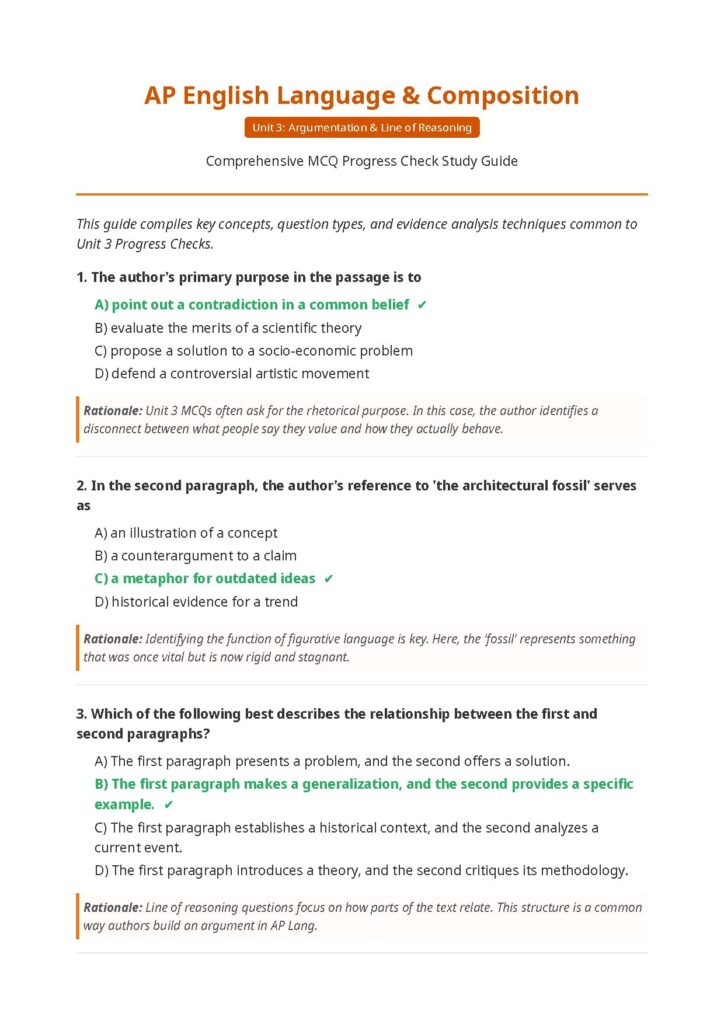
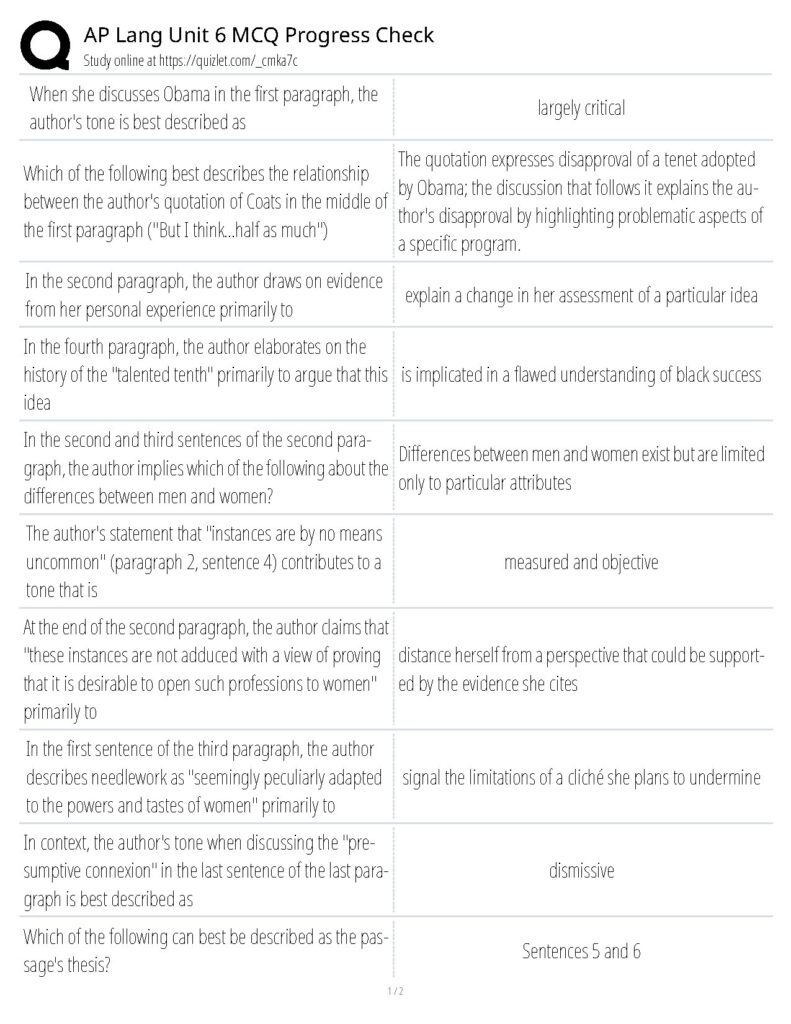
- Understand what AP Lang MCQ actually tests. Questions don't just ask what the passage says — they ask why the author made a specific word choice, what rhetorical effect a structural decision has, or how two paragraphs relate. You're always analyzing purpose, not just comprehension.
- Eliminate answers that are too broad or too extreme. AP Lang correct answers are usually precise and defensible. Choices using words like "always," "never," "only," or "proves" are often traps.
- Watch for "function" and "effect" questions. These are the most common question types: "What is the primary purpose of the third paragraph?" or "The phrase X in line 14 most likely serves to…" Practice these patterns specifically.
- Don't re-read the full passage for every question. Return to the specific lines referenced. Passage-level re-reading eats time you don't have.
- Answer every question. No points are deducted for wrong answers. A blank is guaranteed zero; a guess has a 25% chance of being right.
AP English Language Score Distribution: 2020–2025
With over half a million test-takers each year, AP English Language has one of the largest and most stable datasets of any AP exam. Here's how score distributions have shifted from 2020 to 2025:
| Year | % Score 5 | % Score 4 | % Score 3 | % Score 2 | % Score 1 | Mean Score |
|---|---|---|---|---|---|---|
| 2020 | 9.4% | 17.2% | 26.2% | 32.3% | 14.9% | 2.74 |
| 2021 | 10.6% | 17.5% | 27.1% | 30.9% | 13.9% | 2.79 |
| 2022 | 10.8% | 17.9% | 27.4% | 30.4% | 13.5% | 2.82 |
| 2023 | 10.7% | 18.0% | 27.1% | 30.7% | 13.5% | 2.82 |
| 2024 | 11.0% | 18.3% | 27.2% | 30.1% | 13.4% | 2.83 |
| 2025 | 11.2% | 18.1% | 26.5% | 29.8% | 14.4% | 2.90 |
Source: College Board AP Program national score distributions. 2025 figures are approximate based on released data.
AP Lang has one of the most stable distributions of any AP exam — the percentage earning each score has shifted only marginally year over year. This reflects the difficulty of holistically improving essay writing at scale, and underscores why targeted practice on rubric-specific skills (particularly Row B commentary) is what separates scores of 3 from scores of 4 or 5.
AP English Language College Credit: What Score Do You Need?
Most four-year colleges and universities accept AP English Language scores for credit or placement in introductory writing or composition courses. The minimum score required varies significantly by institution:
| Score | Typical Credit Policy | Example Placement |
|---|---|---|
| 5 | Credit + advanced placement at nearly all schools | Skip intro composition; may place into upper-division writing or rhetoric courses |
| 4 | Credit at most schools, including selective universities | Exempt from freshman composition (typically 3–6 credits) |
| 3 | Credit at many schools; some require 4+ | Introductory writing credit at community colleges and state universities |
| 2 | No credit at most schools | May demonstrate writing readiness for placement testing |
| 1 | No credit | — |
Credit policies vary widely. Always verify directly with your prospective college's registrar or AP credit page before making enrollment decisions.
Key Rhetorical Terms You Need to Know for AP Lang
The AP Language exam — both MCQ and FRQ — assumes familiarity with core rhetorical vocabulary. You don't need to memorize a 200-term glossary, but these are the concepts that appear most frequently in questions and rubrics:
Rhetorical Appeals
- Ethos — appeals to the speaker's credibility, authority, or character
- Pathos — appeals to the audience's emotions, values, or identity
- Logos — appeals to logic, data, statistics, or reasoned argument
- Kairos — appeals based on timing and the appropriateness of the moment
Style and Structure
- Diction — deliberate word choice and its connotations
- Syntax — sentence structure (length, complexity, parallelism, inversion)
- Tone — the writer's attitude toward the subject and audience
- Anaphora — repetition of a phrase at the start of successive clauses for emphasis
- Juxtaposition — placing contrasting ideas side by side to highlight a point
- Concession — acknowledging an opposing viewpoint before rebutting it
- Antithesis — contrasting ideas expressed in balanced parallel structure
Free AP English Language Study Resources on Learro
Use your calculator score as a diagnostic, then target the essay type or skill set where you're losing the most points. Learro's AP English Language resource library has free notes, sample essays, cheat sheets, and rhetorical analysis guides shared by students who've already taken the exam.
What You'll Find in the AP Lang Resource Hub
- Rhetorical device cheat sheets and glossaries
- Sample synthesis, rhetorical analysis, and argument essays with rubric breakdowns
- MCQ passage practice sets and comprehension guides
- Past exam FRQ prompts with official rubrics from College Board
- Student-shared class notes and review materials
- Thesis and commentary writing guides for each essay type
Other AP Score Calculators
Taking more than one AP exam this year? Use Learro's other subject-specific calculators to predict and plan across all your exams. Each calculator uses official College Board scoring data for that subject.
Explore More AP Subject Resources
Whether you're studying alongside AP English Language or preparing for next year's exams, Learro's AP resource hub covers every major subject:
- AP English Language — rhetorical analysis guides, sample essays, and composition notes
- AP Biology — unit-by-unit study guides, FRQ practice, and concept cheat sheets
- AP Chemistry — reaction types, equilibrium, thermodynamics, and electrochemistry notes
- AP Physics 1 — kinematics, forces, energy, waves, and circuits
- AP Calculus AB — limits, derivatives, integrals, and FTC
- AP Calculus BC — everything in AB plus series, parametric, and polar
- AP Statistics — data analysis, probability, and inference
- AP Human Geography — population, culture, political geography, and development
- AP World History — modern world history from 1200 CE to present
- AP Macroeconomics — GDP, fiscal/monetary policy, and international trade
- Browse All AP Subjects →