AP Calculus BC 2023 Comprehensive Study Guide

AP Calculus BC 2023 Comprehensive Study Guide

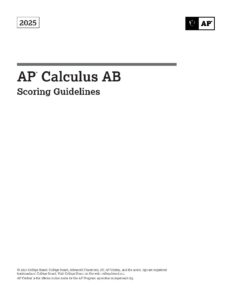
AP Calculus BC 2023 Cheat Sheet provides essential formulas, theorems, and problem-solving techniques for students preparing for the AP Calculus BC exam. Covering key topics such as limits, differentiation, integration, and differential equations, this resource is designed to help students master complex calculus concepts. It includes detailed explanations of the Fundamental Theorem of Calculus, applications of integration, and strategies for optimization problems. Ideal for high school students aiming for a strong performance on the May exam, this cheat sheet serves as a quick reference for critical calculus principles and methods.

Key Points

  • Covers limits, continuity, and differentiation techniques essential for AP Calculus BC.
  • Includes detailed explanations of integration methods and applications for solving real-world problems.
  • Explains differential equations and their applications in modeling population growth and decay.
  • Provides strategies for optimization problems and related rates with step-by-step examples.
212
/ 2
AP Calculus BC 2023 Cheat Sheet |
󰗒
See all AP Calc study guides | @thinkfiveable
👑
Unit 1
Limits & Continuity
🤓
Unit 2
Fundamentals of Differentiation
󰛇
Unit 3
Composite, Implicit, & Inverse Functions
Order of growth rates from fastest to slowest:
Methods to algebraically simplify limits if you can’t
directly plug in: Completing the square, Rationalization,
Factoring
Continuity exists if
Intermediate Value Theorem: Write “Since f(x) is
continuous on [a,b] and f(c) is between f(a) and f(b), by
the IVT there is a c in (a,b) such that
f(c)=0”
All differentiable functions are continuous, but not all continuous
functions are differentiable
Average Rate of Change=
Power Rule:
Sum/Difference Rule:
Product Rule:
Quotient Rule:
Other Differentiation Formulas:
Chain Rule:
Implicit Dierentiation: Dierentiate each term with respect to the
individual variables
Derivatives of an Inverse Trig Function:
👀
Unit 4
Contextual Applications of Differentiation
Unit 5
Analytical Applications of Differentiation
🔥
Unit 6
Integration of Accumulation of Change
Particle Motion:
Position=s(t)
Velocity=v(t)=s’(t)
Acceleration=a(t)=v’(t)=s’’(t)
If velocity is negative, the particle is moving to the left.
If velocity is positive, the particle is moving to the right.
If velocity and acceleration have the same sign, the particle is
speeding up.
If velocity and acceleration have different signs, the particle is
slowing down.
Steps for Related Rates:
1. Draw a picture and label the picture (assign variables)
2. List your knowns and unknown values
3. Write an equation to model the situation.
4. Take the derivative of both sides. Remember: d/dt
5. Plug in known values and solve for desired values. DON’T
FORGET UNITS!
Linearization:
If f(x)/g(x) are indeterminate that and are
both equal to 0 or ∞. Use L’Hopital’s Rule:
f aL or
Mean Value Theorem: Write “Since f(x) is continuous on [a,b] and
dierentiable on (a.b), there exists a c in (a,b) such that
by the MVT.
Extreme Value Theorem: Write “Since f(x) is continuous on (a,b), by
the EVT, there exists at least one local maximum and one local
minimum on (a,b).
Critical Points: where f’(x)=0 or does not exist
f’(x) > 0: increasing; f’(x) < 0: decreasing
First Derivative Test: where f ’(x) = 0, if f(x): : local min;
if f(x) : local max
Determining Concavity: f”(x) > 0: concave up; f”(x) < 0: concave
down; f”(x) = 0: inflection point
Second Derivative Test: f’(x) = 0, if f”(x) > 0: min; if f”(x) < 0: max;
if f”(x) = 0: indeterminate
Steps for Optimization:
1. Draw picture
2. Label your picture and assign variables
3. Write an equation and use given information to find relationships
among variables
4. Find extrema (min/max) and evaluate the function
The integral is the area between the graph and the x-axis
Riemann Sum can be used to approximate area (includes left, right,
midpoint, and trapezoidal sum)
where and
Fundamental Theorem of Calculus FTC- Definite Integrals
Integration Formulas NEVER FORGET + C
Integration by Parts (IBP):
Learn the Tabular Method to make IBP easier
Use Partial Fraction Decomposition to integrate rational functions
Improper Integrals:
AP Calculus BC 2023 Cheat Sheet |
󰗒
See all AP Calc study guides | @thinkfiveable
💎
Unit 7
Differential Equations
🐶
Unit 8
Applications of Integration
🦖
Unit 9
Parametric Equations, Polar Coordinates, & Vector Valued Functions
A slope field is a graphical representation of a differential
equation in the form dy/dx= f(x,y)
Logistic Differential Equation: where P is the
population, L is the carrying capacity, and k is a constant
Euler’s method can be used to find the numerical values of
functions based on a given differential equation and an initial
condition
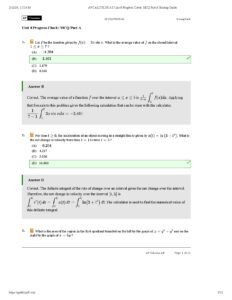
Average Value=
Average Value Theorem: Write “Since f(x) is continuous on (a,b) by the
AVT, there must be a c in (a,b) where
f(c)=
Acceleration=a(t)
Velocity=v(t)= ∫a(t) dt
Position=s(t)=∫v(t) dt
Speed = |v(t)|
Distance traveled=
Volume using the Washer Method:
Volume using the Disc Method:
Arc Length:
Second Derivative of Parametric Equation:
Arc Length for Parametric Functions:
Slope of a Tangent Line for Polar Equations:
Polar Conversions: x=rcosθ y=rsinθ
Area under Polar Curves:
Area under two Polar Curves:
Arc Length for Polar Functions:
Unit 10
Infinite Sequences & Series
💯
FRQ Tips
🔑
Formulas
Sequences: arithmetic and geometric
Series:
Harmonic series diverges, but converges
Power Series with terms converges when p>1, else it
diverges
Alternating Series: For an alternating series (terms change
sign), converges if , else it diverge
Taylor Series:
MacLaurin Series (make sure you memorize them!)
Various tests are used to determine convergence and
divergence
nth Term Test
Limit Comparison Test
Direct Comparison Test
Integral Test
Alternating Series Test
Ratio Test
Be sure to show ALL of your work (even when using a
calculator).
Work on all of the parts that you know first before moving onto
other parts. Get those easy points!
Do not round any values as you complete the problem! Wait all
the way until the end to round your answer to 3 or 4 decimal
places.
You can use abbreviations like IVT Intermediate Value
Theorem), MVT Mean Value Theorem), and FTOC
Fundamental Theorem of Calculus)
Do not simplify your answers unless specified. You don't want
to lose points on steps you don’t need to do!
Memorize your important theorems and convergence tests!
You’ll need to know the conditions where the theorems and
tests are met.
Keep an eye on the time and pace yourself.
Squeeze Theorem: If f(x)≤h(x)≤g(x) and
then
Pythagorean Identities:
sin
2
x+cos
2
x=1 1+tan
2
x=sec
2
x 1+cot
2
x=csc
2
x
Double Angle Formulas:
sin2x=2sinxcosx cos2x= cos
2
x-sin
2
x
cos2x=2cos
2
x-1 cos2x=12sin
2
x
/ 2
End of Document
212
You May Also Like
Faqs of AP Calculus BC 2023 Comprehensive Study Guide
What are the main topics covered in the AP Calculus BC cheat sheet?
The AP Calculus BC cheat sheet covers a range of essential topics including limits, continuity, differentiation, integration, and differential equations. It provides a comprehensive overview of key concepts such as the Fundamental Theorem of Calculus, applications of integration, and methods for solving optimization problems. Each section is designed to help students quickly reference important formulas and theorems needed for the AP exam.
How does the cheat sheet assist with understanding differentiation?
The cheat sheet includes various differentiation techniques such as the power rule, product rule, and quotient rule, along with examples to illustrate their application. It also covers implicit differentiation and the derivatives of inverse trigonometric functions, providing students with a solid foundation for tackling calculus problems. By summarizing these concepts, the cheat sheet helps students efficiently review and apply differentiation methods.
What integration techniques are highlighted in the cheat sheet?
Integration techniques highlighted in the cheat sheet include Riemann sums, integration by parts, and the use of partial fraction decomposition. The document explains how to calculate areas under curves and provides methods for evaluating definite integrals. These techniques are crucial for solving complex calculus problems and are essential for students preparing for the AP Calculus BC exam.
What is the significance of the Fundamental Theorem of Calculus in this cheat sheet?
The Fundamental Theorem of Calculus is a pivotal concept in calculus that connects differentiation and integration. The cheat sheet outlines its two main parts, explaining how it allows for the evaluation of definite integrals and establishes the relationship between a function and its antiderivative. Understanding this theorem is crucial for students as it forms the basis for many calculus applications and problem-solving strategies.
How does the cheat sheet address applications of integration?
The cheat sheet addresses applications of integration by providing examples related to calculating areas, volumes, and arc lengths. It explains methods such as the washer and disk methods for finding volumes of solids of revolution. These applications are vital for students to understand how calculus concepts are used in real-world scenarios, enhancing their problem-solving skills for the AP exam.