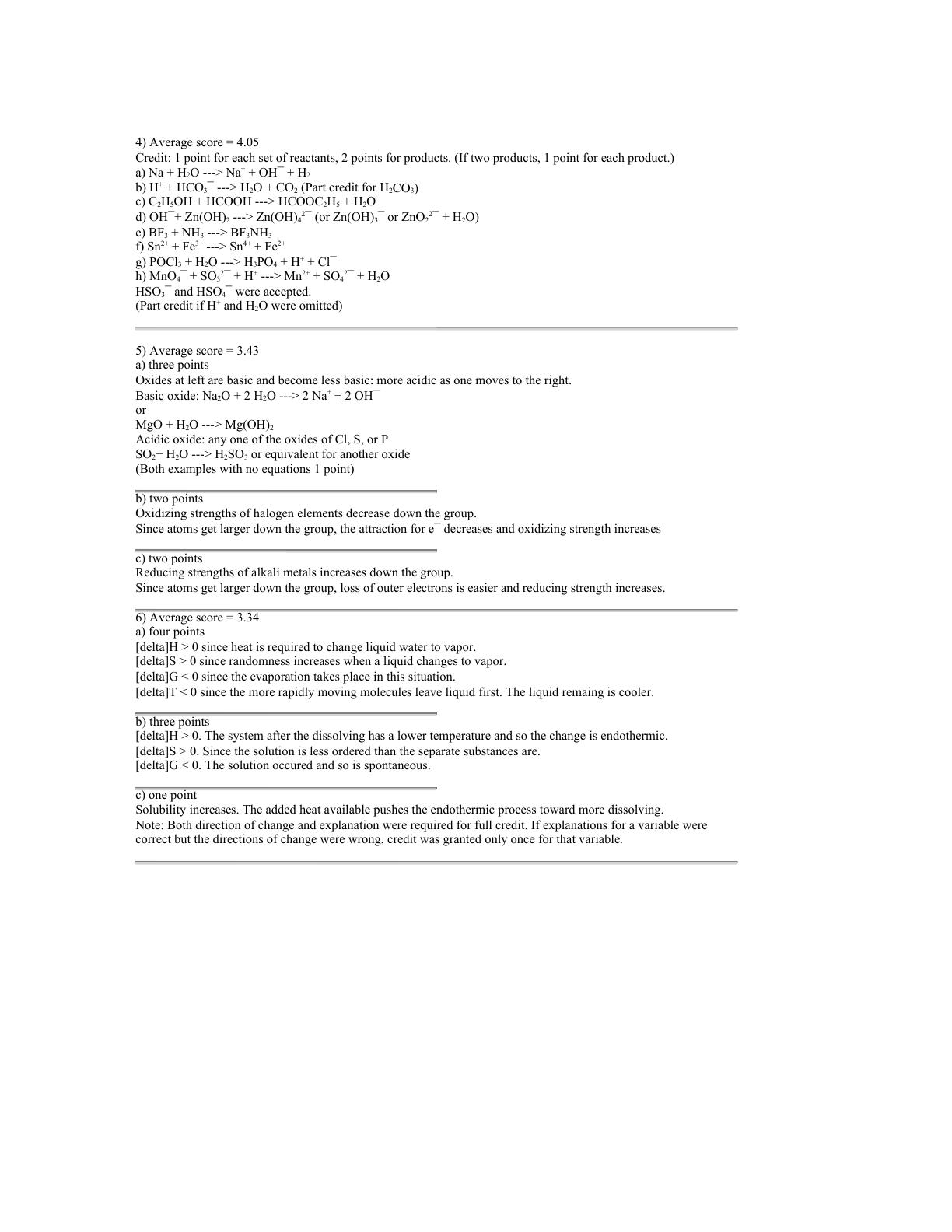
Credit: 1 point for each set of reactants, 2 points for products. (If two products, 1 point for each product.)
a) Na + H O ---> Na + OH¯ + H
2
+
2
b) H + HCO ¯ ---> H O + CO (Part credit for H
+
3 2 2 2
CO )
3
c) C OH + HCOOH ---> HCOOC + H
2
H
5 2
H
5 2
O
d) OH¯+ Zn(OH) ---> Zn(OH) ¯ (or Zn(OH) ¯ or ZnO ¯ + H
2 4
2
3 2
2
2
O)
e) BF + NH ---> BF
3 3 3
NH
3
f) Sn + Fe ---> Sn + Fe
2+ 3+ 4+ 2+
g) POCl + H O ---> H + H + Cl¯
3 2 3
PO
4
+
h) MnO ¯ + SO ¯ + H ---> Mn + SO ¯ + H
4 3
2 + 2+
4
2
2
O
HSO
3
¯ and HSO ¯ were accepted.
4
(Part credit if H and H O were omitted)
+
2
Oxides at left are basic and become less basic: more acidic as one moves to the right.
Basic oxide: Na O + 2 H O ---> 2 Na + 2 OH¯
2 2
+
Acidic oxide: any one of the oxides of Cl, S, or P
SO SO
2
+ H O ---> H
2 2 3
or equivalent for another oxide
(Both examples with no equations 1 point)
Oxidizing strengths of halogen elements decrease down the group.
Since atoms get larger down the group, the attraction for e¯ decreases and oxidizing strength increases
Reducing strengths of alkali metals increases down the group.
Since atoms get larger down the group, loss of outer electrons is easier and reducing strength increases.
[delta]H > 0 since heat is required to change liquid water to vapor.
[delta]S > 0 since randomness increases when a liquid changes to vapor.
[delta]G < 0 since the evaporation takes place in this situation.
[delta]T < 0 since the more rapidly moving molecules leave liquid first. The liquid remaing is cooler.
[delta]H > 0. The system after the dissolving has a lower temperature and so the change is endothermic.
[delta]S > 0. Since the solution is less ordered than the separate substances are.
[delta]G < 0. The solution occured and so is spontaneous.
Solubility increases. The added heat available pushes the endothermic process toward more dissolving.
Note: Both direction of change and explanation were required for full credit. If explanations for a variable were
correct but the directions of change were wrong, credit was granted only once for that variable.
AP Chemistry: 1985 Free Response Answers and Grading Criteria