AP Chemistry Unit 5 Progress Check MCQ Answers 2024

AP Chemistry Unit 5 Progress Check MCQ Answers 2024

AP Chemistry Unit 5 Progress Check focuses on reaction rates, rate laws, and the effects of concentration and catalysts on chemical reactions. This resource provides answers to multiple-choice questions related to experimental data and chemical kinetics, including the hydrolysis of sucrose and the impact of reaction conditions. Designed for AP Chemistry students preparing for the exam, it includes detailed explanations of concepts such as activation energy and collision theory. The material is essential for understanding how various factors influence reaction rates and for mastering the content required for the AP Chemistry exam.

Key Points

  • Includes answers to AP Chemistry Unit 5 multiple-choice questions
  • Explains the relationship between concentration and reaction rates
  • Covers the impact of catalysts on chemical reactions
  • Discusses activation energy and its role in reaction kinetics
328
/ 14
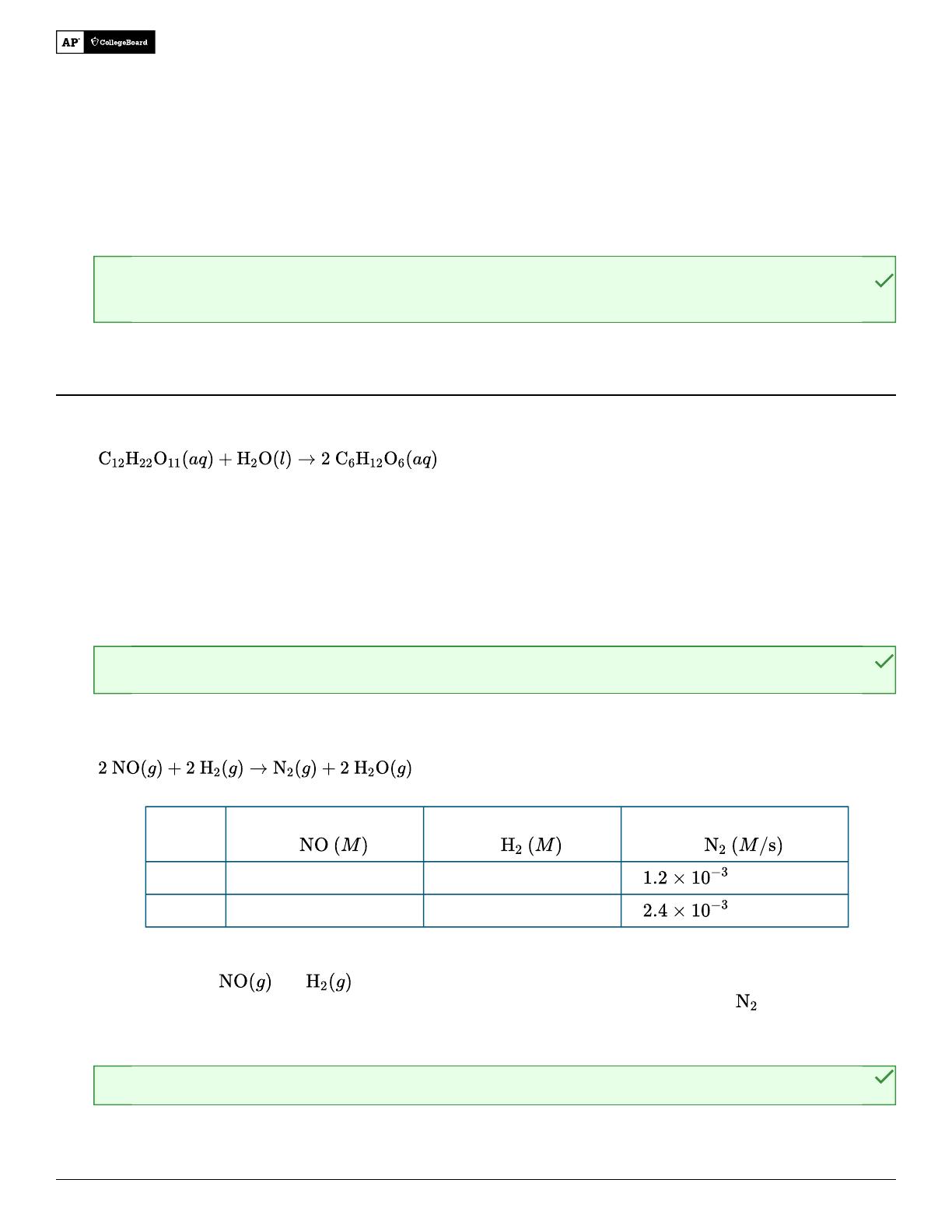
A chemist is studying the reaction between the gaseous chemical species and , represented by the equation above.
Initial rates of reaction are measured at various concentrations of reactants. The results are recorded in the following table.
Experiment
Initial Rate of Appearance
of
1 0.15 0.10 32
2 0.15 0.20 64
3 0.30 0.20 128
1. Given the information in the table above, which of the following is the experimental rate law?
(A)
(B)
(C)
(D)
2. Based on the information above, determine the initial rate of disappearance of in experiment 1.
(A)
(B)
(C)
(D)
3.
A second chemist repeated the three experiments and observed that the reaction rates were considerably greater than
those measured by the first chemist, even though the concentrations of the reactants and the temperature in the
laboratory were the same as they were for the first chemist. Which of the following is the best pairing of a claim
about a most likely cause for the greater rates measured by the second chemist and a valid justification for that
claim?
AP CHEMISTRY Scoring Guide
Unit 5 Progress Check: MCQ
AP Chemistry
Page 1 of 14
(A)
The pressures of the gases used by the second chemist must have been lower than those used by the first
chemist, thus the collisions between reacting particles were less frequent than they were in the first
chemist's experiments.
(B)
The pressures of the gases used by the second chemist must have been lower than those used by the first
chemist, thus the number of collisions with sufficient energy to cause reaction was lower than it was in
the first chemist's experiments.
(C)
The second chemist must have added a catalyst for the reaction, thus providing a different reaction
pathway for the reactant particles to react with an activation energy that was lower than that of the
uncatalyzed reaction in the first chemist's experiments.
(D)
The second chemist must have added a catalyst for the reaction, thus providing energy to reactant
particles to increase their rate of reaction compared to their rate of reaction in the first chemist's
experiments.
4.
The chemical equation shown above represents the hydrolysis of sucrose. Under certain conditions, the rate is
directly proportional to the concentration of sucrose. Which statement supports how a change in conditions can
increase the rate of this reaction?
(A)
Increasing the amount of water in which the sugar is dissolved will increase the frequency of collisions
between the sucrose molecules and the water molecules resulting in an increase in the rate of hydrolysis.
(B)
Decreasing the temperature will increase the frequency of the collisions between the sucrose molecules
and the water molecules resulting in an increase in the rate of hydrolysis.
(C)
Increasing the concentration of sucrose will increase the rate of hydrolysis by increasing the frequency
of the collisions between the sucrose and the water molecules.
(D)
Decreasing the concentration of sucrose will increase the rate of hydrolysis by increasing the frequency
of the collisions between the sucrose and the water molecules.
5.
Trial
Initial Concentration
of
Initial Concentration
of
Initial Rate of Formation
of
1 0.10 0.10
2 0.10 0.20
The information in the data table above represents two different trials for an experiment to study the rate of the
reaction between and , as represented by the balanced equation above the table. Which of the
following statements provides the correct explanation for why the initial rate of formation of
is greater in trial 2
than in trial 1? Assume that each trial is carried out at the same constant temperature.
(A) The activation energy of the reaction is smaller in trial 2 than it is in trial 1.
(B) The frequency of collisions between reactant molecules is greater in trial 2 than it is in trial 1.
(C) The value of the rate constant for the reaction is smaller in trial 2 than it is in trial 1.
(D) The value of the rate constant for the reaction is greater in trial 2 than it is in trial 1.
Scoring Guide
Unit 5 Progress Check: MCQ
Page 2 of 14
AP Chemistry

6.
reacts with according to the equation shown above. In trial 1 of a kinetics experiment, a
piece of is added to of . The rate of reaction between and is
determined by measuring the volume of
produced over time. In trial 2 of the experiment, of powdered
is added to of . Which trial will have a faster initial rate of reaction and why?
(A)
Trial 1, because there is a higher concentration of
in the reaction mixture.
(B)
Trial 1, because the sample of
has less surface area for the reaction to take place.
(C)
Trial 2, because there is a higher concentration of
in the reaction mixture.
(D)
Trial 2, because the sample of
has a greater surface area for the reaction to take place.
7.
The rate of the reaction represented by the chemical equation shown above is expressed as
. Based on this information, which of the following claims is correct?
(A) The reaction will proceed at a slower rate with increasing temperature.
(B) The rate of the reaction will double when the concentrations of both and are doubled.
(C)
The rate of the reaction will double if the concentration of is doubled while keeping the
concentration of constant.
(D) A larger amount of will be produced if the concentrations of and are halved.
8.
For the reaction represented by the equation above, the concentration of was measured over time. The
following graphs were created using the data.
Based on the graphs above, what is the order of the reaction with respect to ?
(A) Zeroth order
(B) First order
(C) Second order
(D) Third order
Scoring Guide
Unit 5 Progress Check: MCQ
AP Chemistry
Page 3 of 14
/ 14
End of Document
328
You May Also Like
Faqs of AP Chemistry Unit 5 Progress Check MCQ Answers 2024
What is the significance of the initial rate of reaction in chemical kinetics?
The initial rate of reaction is crucial in chemical kinetics as it provides insight into how quickly reactants are converted into products at the beginning of the reaction. It is influenced by the concentrations of the reactants and the temperature. By measuring the initial rate, chemists can determine the rate law, which describes the relationship between the rate of reaction and the concentration of reactants. Understanding the initial rate helps in predicting how changes in conditions will affect the overall reaction speed.
How does a catalyst affect the rate of a chemical reaction?
A catalyst increases the rate of a chemical reaction by providing an alternative reaction pathway with a lower activation energy. This allows more reactant molecules to have sufficient energy to undergo the reaction, thereby increasing the frequency of successful collisions. Catalysts are not consumed in the reaction, meaning they can be used repeatedly. Their presence can significantly enhance reaction rates, making them essential in both industrial processes and laboratory experiments.
What factors can influence the rate of hydrolysis of sucrose?
The rate of hydrolysis of sucrose can be influenced by several factors, including the concentration of sucrose, temperature, and the presence of catalysts. Increasing the concentration of sucrose enhances the frequency of collisions between sucrose and water molecules, leading to a higher reaction rate. Additionally, raising the temperature generally increases kinetic energy, resulting in more frequent and energetic collisions. The introduction of a catalyst can also accelerate the reaction by lowering the activation energy required for hydrolysis.
What is the role of activation energy in chemical reactions?
Activation energy is the minimum energy required for reactants to undergo a chemical reaction. It represents the energy barrier that must be overcome for reactants to be converted into products. A higher activation energy means that fewer molecules will have sufficient energy to react at a given temperature, resulting in a slower reaction rate. Conversely, lowering the activation energy through catalysts or increased temperature can enhance reaction rates by allowing more molecules to participate in the reaction.
How do changes in temperature affect reaction rates?
Changes in temperature have a significant impact on reaction rates. Generally, increasing the temperature raises the kinetic energy of the molecules, leading to more frequent and forceful collisions between reactants. This increase in collision frequency often results in a higher reaction rate. Conversely, lowering the temperature decreases molecular motion, reducing the number of effective collisions and slowing down the reaction. Understanding this relationship is essential for controlling reaction conditions in both laboratory and industrial settings.