7.1
The Industrial Revolution
Essential
Question:
How
did the Industrial Revolution facilitate the
growth and diffusion
of
industrialization?
Economic
activity and development have brought dramatic changes to the
world. Industry, the process
of
using machines and large-scale processes to
convert raw materials into manufactured goods, has stimulated social, political,
demographic, and economic changes
in
societies at all scales. Industry requires
raw materials, the basic substances such
as
minerals and crops needed to
manufacture finished goods.
Growth and Diffusion of Industrialization
Before the
18
th
century, people made for themselves most clothes, tools, and
other items they used. They bought only a
few
items, often textiles
or
metal
goods,
in
a market, a place where products are sold. What they did buy
was
usually made by other families working in their own homes who had a contract
to make products for a merchant. These small home-based businesses that made
goods are called cottage industries. These industries depended
on
intensive
human labor since people used simple spinning wheels, looms, and other tools.
Starting
in
the 18
th
century, a series
of
technological advances known
as
the Industrial Revolution resulted in more complex machinery driven by
water
or
steam power
that
could make products faster and at lower costs than
could cottage industries. Because the new machinery was so large and required
so much investment money,
or
capital, manufacturing shifted from homes to
factories. The replacement
of
labor-intensive cottage industry with capital-
intensive factory production reshaped not only how people worked, but where
they lived and how they related to each other spatially.
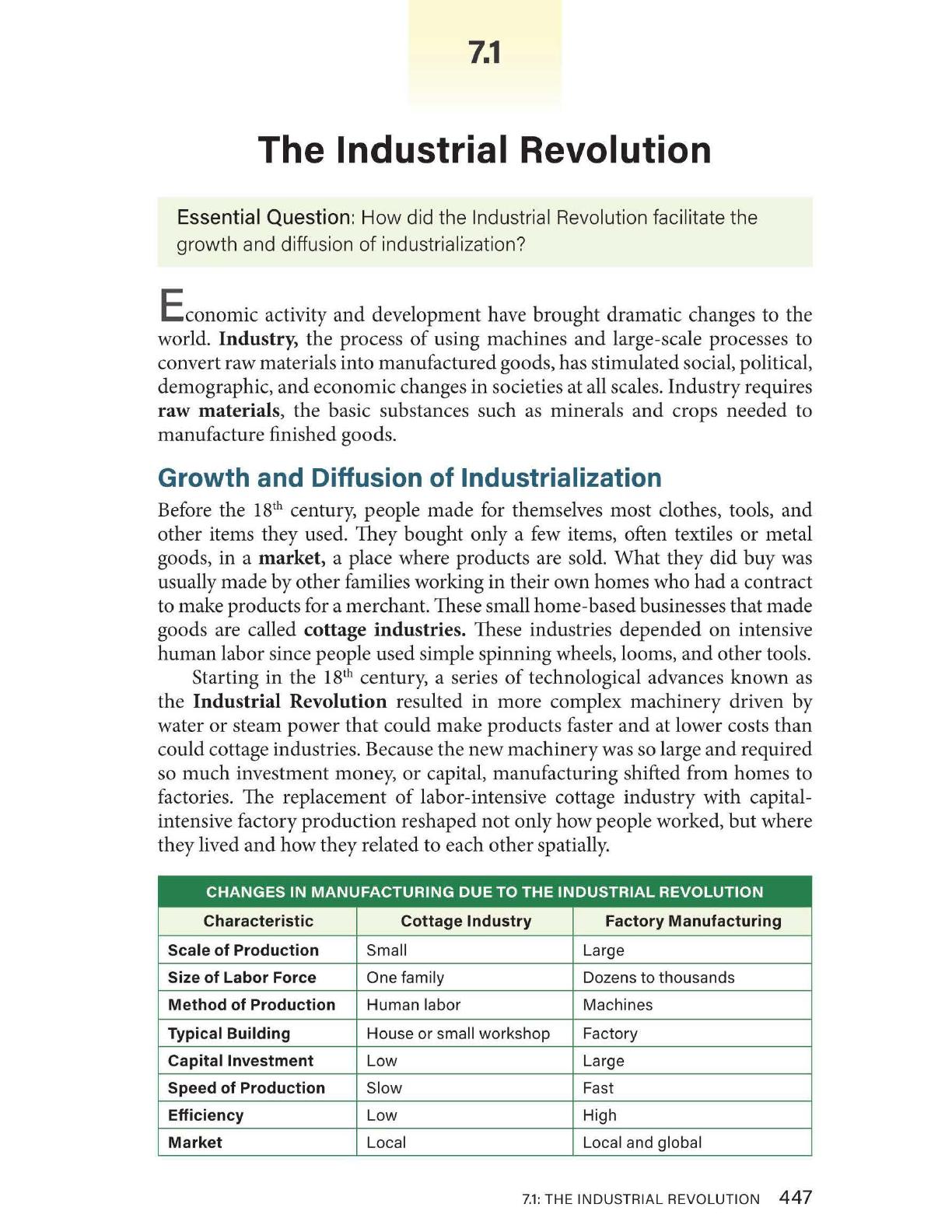
CHANGES
IN
MANUFACTURING DUE TO THE INDUSTRIAL REVOLUTION
Characteristic Cottage Industry Factory Manufacturing
Scale of Production Small Large
Size of Labor Force One family Dozens
to
thousands
Method of Production Human labor Machines
Typical Building House or small workshop Factory
Capital Investment Low Large
Speed of Production Slow Fast
Efficiency Low High
Market
Local Local and global
7.1:
THE INDUSTRIAL REVOLUTION
447