
AP Precalculus Unit 1B Multiple Choice Answers

AP Precalculus Unit 1B Multiple Choice Answers

AP Precalculus Unit 1B focuses on key concepts in precalculus, including functions, rational expressions, and asymptotic behavior. This resource provides answers to multiple-choice questions designed to assess understanding of these topics. Ideal for students preparing for the AP exam, it includes various questions that cover the material typically found in the first unit of a precalculus course. The content is aligned with the AP curriculum, ensuring relevance for exam preparation.

Key Points

  • Includes answers to multiple-choice questions from Unit 1B of AP Precalculus.
  • Covers essential precalculus topics such as functions and asymptotic behavior.
  • Designed for students preparing for the AP Precalculus exam.
  • Aligns with the AP curriculum to support effective study strategies.
195
/ 11
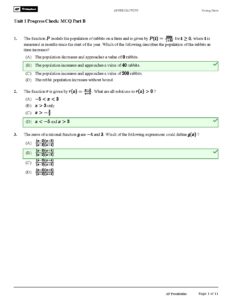
1. The function models the population of rabbits on a farm and is given by for , where is
measured in months since the start of the year. Which of the following describes the population of the rabbits as
time increases?
(A) The population decreases and approaches a value of
rabbits.
(B) The population increases and approaches a value of
rabbits.
(C) The population increases and approaches a value of rabbits.
(D) The rabbit population increases without bound.
2. The function
is given by . What are all solutions to ?
(A)
(B) only
(C)
(D) and
3. The zeros of a rational function are and . Which of the following expressions could define ?
(A)
(B)
(C)
(D)
AP PRECALCULUS Scoring Guide
Unit 1 Progress Check: MCQ Part B
AP Precalculus
Page 1 of 11
4.
The graph of the rational function is shown. Which of the following tables could be used to describe the
asymptotic behavior of at and at ?
Scoring Guide
Unit 1 Progress Check: MCQ Part B
Page 2 of 11
AP Precalculus
(A)
(B)
(C)
(D)
5. For the function , it is known that and . The function is given by .
Which of the following must be a solution to ?
Scoring Guide
Unit 1 Progress Check: MCQ Part B
AP Precalculus
Page 3 of 11
/ 11
End of Document
195
You May Also Like
Faqs of AP Precalculus Unit 1B Multiple Choice Answers
What topics are covered in AP Precalculus Unit 1B?
AP Precalculus Unit 1B covers fundamental precalculus concepts, including functions, rational expressions, and their properties. Students will explore the behavior of functions as they approach certain values, including limits and asymptotic behavior. The unit emphasizes understanding how to analyze and interpret graphs of rational functions, which is crucial for success in higher-level mathematics.
How can the answers in this resource help with exam preparation?
The answers provided in this resource serve as a valuable tool for students preparing for the AP Precalculus exam. By reviewing the multiple-choice questions and their correct answers, students can identify areas where they may need further study. This targeted approach allows for efficient revision and reinforces understanding of key precalculus concepts that are essential for the exam.
What types of questions are included in the Unit 1B assessment?
The Unit 1B assessment includes a variety of multiple-choice questions that test students' understanding of precalculus concepts. Questions may cover topics such as the behavior of functions, limits, and the characteristics of rational expressions. This format helps students practice critical thinking and problem-solving skills, which are vital for success in mathematics.
Who is the intended audience for this AP Precalculus resource?
This resource is intended for high school students enrolled in AP Precalculus courses, particularly those preparing for the AP exam. It is also useful for educators seeking to provide additional support to their students. The content aligns with the AP curriculum, making it a relevant study aid for anyone looking to enhance their understanding of precalculus.
What is the significance of understanding asymptotic behavior in precalculus?
Understanding asymptotic behavior is crucial in precalculus as it helps students analyze how functions behave as they approach certain values or infinity. This concept is foundational for calculus, where limits and continuity are explored in greater depth. Mastering asymptotic behavior allows students to make predictions about function behavior, which is essential for solving complex mathematical problems.