AP Biology Unit 5 Progress Check MCQ Study Guide

AP Biology Unit 5 Progress Check MCQ Study Guide

Unit 5 Progress Check for AP Biology focuses on key concepts in genetics, including meiosis, inheritance patterns, and chi-square analysis. This study guide is designed for AP Biology students preparing for the May exam, providing multiple-choice questions that cover essential topics such as Mendelian genetics and phenotypic ratios. It includes detailed explanations of the principles of inheritance, the role of meiosis in genetic variation, and the application of statistical methods in genetics. Students will find valuable practice questions that align with the AP curriculum, enhancing their understanding and exam readiness.

Key Points

  • Covers key genetics concepts including meiosis and inheritance patterns.
  • Includes multiple-choice questions aligned with the AP Biology curriculum.
  • Explains the application of chi-square analysis in genetics.
  • Designed for AP Biology students preparing for the May exam.
359
/ 17
R. C. Punnett conducted experiments on the inheritance of traits in the sweet pea, . In one experiment,Lathyrus odoratus
he crossed two different true-breeding sweet pea plant strains, one with erect petals and long pollen, and the other with
hooded petals and round pollen. All the offspring ( generation) had erect petals and long pollen (Figure 1).
Figure 1. Sweet pea plant cross
Next, Punnett allowed the generation to self-fertilize and recorded the phenotypes of their offspring. The data are
shown in Table 1.
Table 1. results of self-fertilization cross
Phenotype of Number of Offspring
Erect petals, long pollen 765
Hooded petals, round pollen 220
Total 1,118
1.
Sweet pea plants have a diploid chromosome number of 14.
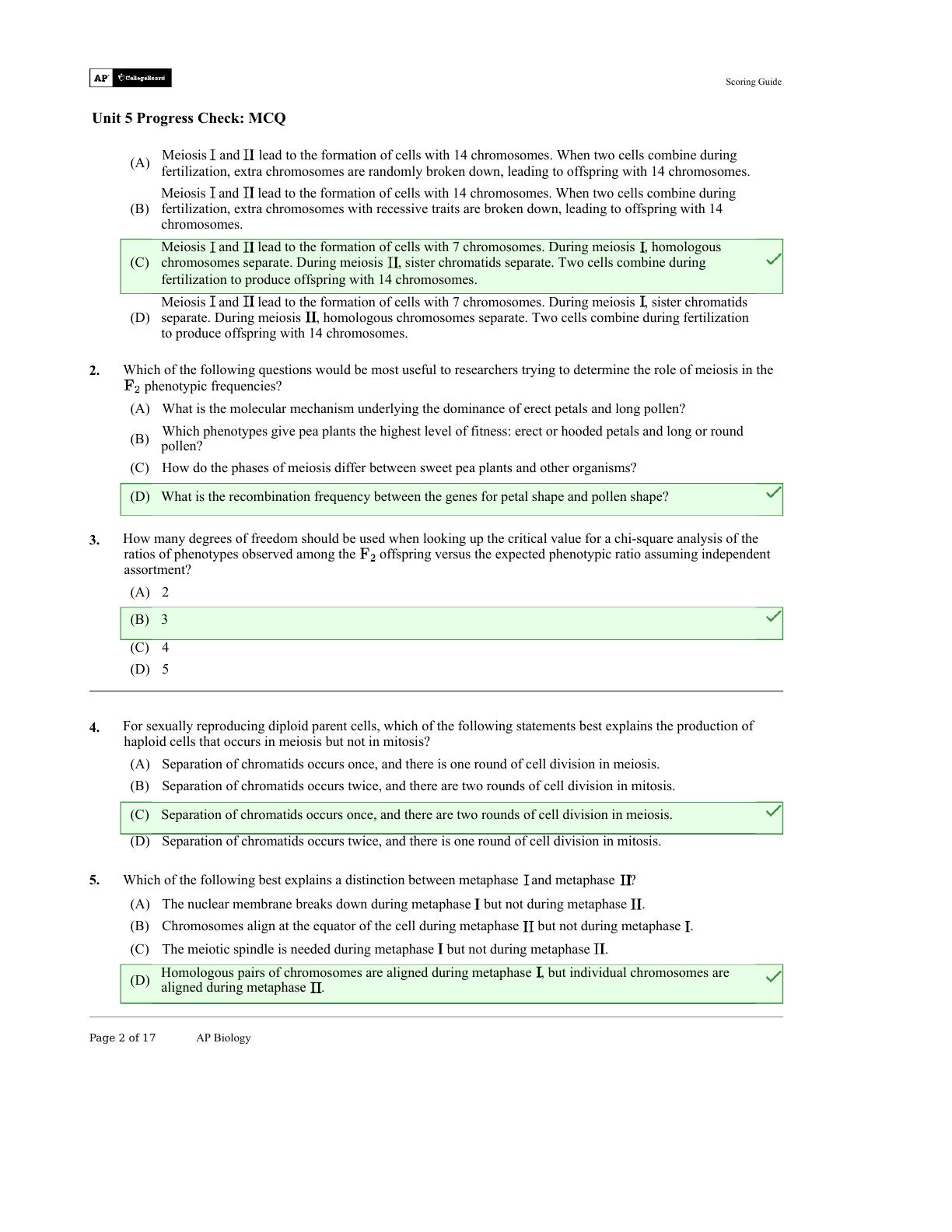
Which of the following best explains how the sweet pea plants in the parental generation produce offspring with
14 chromosomes?
AP BIOLOGY Scoring Guide
Unit 5 Progress Check: MCQ
AP Biology Page 1 of 17
5/11/26, 2:01 AM
Unit 5 Progress Check: MCQ - AP Biology Study Guide

https://getthispdf.com
1/17
(A)
Meiosis and lead to the formation of cells with 14 chromosomes. When two cells combine during
fertilization, extra chromosomes are randomly broken down, leading to offspring with 14 chromosomes.
(B)
Meiosis and lead to the formation of cells with 14 chromosomes. When two cells combine during
fertilization, extra chromosomes with recessive traits are broken down, leading to offspring with 14
chromosomes.
(C)
Meiosis and lead to the formation of cells with 7 chromosomes. During meiosis , homologous
chromosomes separate. During meiosis , sister chromatids separate. Two cells combine during
fertilization to produce offspring with 14 chromosomes.
(D)
Meiosis and lead to the formation of cells with 7 chromosomes. During meiosis , sister chromatids
separate. During meiosis , homologous chromosomes separate. Two cells combine during fertilization
to produce offspring with 14 chromosomes.
2.
Which of the following questions would be most useful to researchers trying to determine the role of meiosis in the
phenotypic frequencies?
(A) What is the molecular mechanism underlying the dominance of erect petals and long pollen?
(B)
Which phenotypes give pea plants the highest level of fitness: erect or hooded petals and long or round
pollen?
(C) How do the phases of meiosis differ between sweet pea plants and other organisms?
(D) What is the recombination frequency between the genes for petal shape and pollen shape?
3.
How many degrees of freedom should be used when looking up the critical value for a chi-square analysis of the
ratios of phenotypes observed among the offspring versus the expected phenotypic ratio assuming independent
assortment?
(A) 2
(B) 3
(C) 4
(D) 5
4.
For sexually reproducing diploid parent cells, which of the following statements best explains the production of
haploid cells that occurs in meiosis but not in mitosis?
(A) Separation of chromatids occurs once, and there is one round of cell division in meiosis.
(B) Separation of chromatids occurs twice, and there are two rounds of cell division in mitosis.
(C) Separation of chromatids occurs once, and there are two rounds of cell division in meiosis.
(D) Separation of chromatids occurs twice, and there is one round of cell division in mitosis.
5. Which of the following best explains a distinction between metaphase and metaphase ?
(A) The nuclear membrane breaks down during metaphase but not during metaphase .
(B) Chromosomes align at the equator of the cell during metaphase but not during metaphase .
(C) The meiotic spindle is needed during metaphase but not during metaphase .
(D)
Homologous pairs of chromosomes are aligned during metaphase , but individual chromosomes are
aligned during metaphase .
Scoring Guide
Unit 5 Progress Check: MCQ
Page 2 of 17 AP Biology
5/11/26, 2:01 AM
Unit 5 Progress Check: MCQ - AP Biology Study Guide

https://getthispdf.com
2/17
6.
In anaphase of meiosis, cohesion between the centromeres of sister chromatids is maintained while homologous
chromosomes migrate to opposite poles of the cell along the meiotic spindle as represented in Figure 1.
Figure 1. Migration of homologous chromosomes during anaphase of meiosis
A compound that prevents the separation of the homologous chromosomes in anaphase is being studied. Which of
the following questions can be best answered during this study?
(A)
Will the cells produced at the end of meiosis still be genetically identical to each other in the presence of
this compound?
(B) Will the long-term development of the individual be affected by this meiotic error?
(C) When do the centrosomes start to move apart during meiosis as compared to meiosis ?
(D) Is there a pattern to the movement of homologous chromosomes in the presence of this compound?
Scoring Guide
Unit 5 Progress Check: MCQ
AP Biology Page 3 of 17
5/11/26, 2:01 AM
Unit 5 Progress Check: MCQ - AP Biology Study Guide
https://getthispdf.com
3/17
/ 17
End of Document
359
You May Also Like
Faqs of AP Biology Unit 5 Progress Check MCQ Study Guide
What topics are covered in the AP Biology Unit 5 Progress Check?
The AP Biology Unit 5 Progress Check covers essential topics in genetics, including the principles of inheritance, the mechanisms of meiosis, and the application of statistical methods like chi-square analysis. Students will explore Mendelian genetics, including dominant and recessive traits, and how these principles apply to real-world scenarios. The guide also addresses the significance of genetic variation and the role of recombination in evolution.
How does meiosis contribute to genetic diversity?
Meiosis is a crucial process in sexual reproduction that reduces the chromosome number by half, resulting in haploid gametes. During meiosis, homologous chromosomes undergo recombination, exchanging genetic material, which increases genetic diversity among offspring. Additionally, the independent assortment of chromosomes during meiosis ensures that gametes contain a unique combination of alleles, further contributing to variation in traits.
What is the significance of chi-square analysis in genetics?
Chi-square analysis is a statistical method used to determine whether observed genetic ratios align with expected ratios based on Mendelian inheritance. This analysis helps researchers assess the validity of their hypotheses regarding gene segregation and inheritance patterns. By comparing observed data to expected outcomes, chi-square tests can indicate whether deviations are due to random chance or suggest other underlying genetic factors.
What types of inheritance patterns are explored in this study guide?
The study guide explores various inheritance patterns, including autosomal dominant, autosomal recessive, and X-linked traits. Each pattern is illustrated with examples and practice questions that help students understand how traits are passed from parents to offspring. The guide emphasizes the importance of recognizing these patterns in predicting phenotypic ratios and understanding genetic disorders.
How can students use this guide to prepare for the AP Biology exam?
Students can use this guide to reinforce their understanding of key concepts in genetics and practice applying these concepts through multiple-choice questions. The guide provides explanations for each question, allowing students to learn from their mistakes and deepen their comprehension. By reviewing the material and practicing with the questions, students can enhance their confidence and readiness for the AP Biology exam.