
AP Physics 1 Unit 2 FRQ Practice Scoring Guide and Solutions
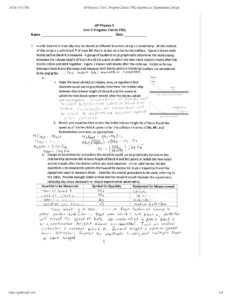
AP Physics 1 Unit 2 focuses on free-response questions (FRQs) that assess students' understanding of key physics concepts. This scoring guide provides detailed solutions and scoring criteria for various FRQs, including topics such as circular motion, forces, and friction. Designed for AP Physics students preparing for the exam, it includes step-by-step derivations and explanations to enhance comprehension. The guide is essential for mastering the application of Newton's laws and understanding the dynamics of objects in motion.
Key Points
Includes scoring criteria for AP Physics 1 FRQs on circular motion and forces.
Provides detailed solutions for problems related to tension and friction.
Covers derivations of expressions for speed and force in physics scenarios.
Aids AP Physics students in preparing for the exam with practical examples.
This link leads to an external site. We do not know or endorse its content, and are not responsible for its safety. Click the link to proceed only if you trust this site.
Faqs of AP Physics 1 Unit 2 FRQ Practice Scoring Guide and Solutions
What topics are covered in the AP Physics 1 Unit 2 FRQs?
The AP Physics 1 Unit 2 FRQs cover a variety of topics including circular motion, forces acting on objects, and the principles of tension and friction. Students are required to analyze scenarios involving a sphere in circular motion and a sled sliding down a ramp, applying Newton's laws of motion. The questions assess both conceptual understanding and the ability to perform calculations related to these topics.
How does the scoring guide assist students in AP Physics 1?
The scoring guide assists students by providing clear criteria for evaluating their responses to FRQs. It outlines the specific points awarded for correct answers, including the necessary steps for derivations and explanations. By reviewing the scoring guide, students can identify areas for improvement and understand what examiners are looking for in high-scoring responses.
What is the significance of tension in circular motion problems?
Tension plays a crucial role in circular motion problems as it is the force that keeps an object moving in a circular path. In scenarios where a mass is attached to a string and swung in a circle, the tension must counteract the gravitational force and provide the necessary centripetal force. Understanding how to calculate and analyze tension helps students grasp the dynamics of circular motion and the forces involved.
What methods are used to derive expressions for speed in physics problems?
Deriving expressions for speed in physics problems typically involves applying Newton's second law and analyzing the forces acting on an object. Students often break down the forces into components, apply trigonometric relationships, and set up equations that relate tension, gravitational force, and centripetal acceleration. This systematic approach allows for the derivation of speed expressions in various contexts, such as a sphere in circular motion.
How can students effectively prepare for the AP Physics 1 exam using this guide?
Students can effectively prepare for the AP Physics 1 exam by using this guide to practice solving FRQs and understanding the scoring criteria. By working through the provided solutions, students can learn the correct methodologies for tackling complex physics problems. Additionally, reviewing the scoring guide helps students focus on key concepts and common pitfalls, enhancing their exam readiness.
What types of problems are included in the AP Physics 1 Unit 2 practice?
The AP Physics 1 Unit 2 practice includes problems related to circular motion, forces acting on objects, and the effects of friction. Specific scenarios may involve analyzing the motion of a sphere attached to a string or a sled sliding down a ramp. These problems require students to apply their knowledge of physics principles to derive solutions and demonstrate their understanding of the subject.
What is the role of friction in the sled problem presented in the guide?
Friction plays a significant role in the sled problem as it affects the sled's motion down the ramp. The coefficient of kinetic friction determines how much resistance the sled encounters as it slides, influencing its speed and acceleration. Understanding the relationship between friction and motion is essential for solving these types of problems and for applying Newton's laws effectively.