
AP Physics 1 Equations Sheet for Exam Preparation

AP Physics 1 Equations Sheet for Exam Preparation

AP Physics 1 Equations Sheet provides essential formulas and constants for students preparing for the AP Physics 1 exam. It includes key equations related to mechanics, fluids, and energy, helping students quickly reference important concepts. This resource is designed for high school students enrolled in AP Physics 1, ensuring they have the necessary tools for success in their coursework and the May exam. The sheet also features units of measurement and conversion factors relevant to the curriculum, making it a comprehensive study aid.

Key Points

  • Includes essential formulas for mechanics, fluids, and energy topics in AP Physics 1.
  • Provides conversion factors and units of measurement relevant to the exam.
  • Covers key concepts such as acceleration, force, and energy calculations.
  • Designed for high school students preparing for the AP Physics 1 exam.
212
/ 3
AP
®
Physics 1
2026 EXAM REFERENCE INFORMATION
Name: ___________________________________________________
NOTE: You may use any blank space in this booklet for scratch work during the exam. Proctors should collect this
reference information at the conclusion of the exam.
g = 9.8 N kg
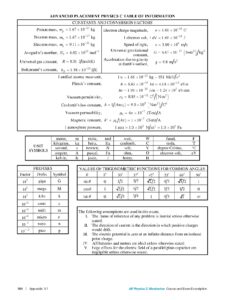
ADVANCED PLACEMENT PHYSICS 1 TABLE OF INFORMATION
© 2025 College Board
AP Physics 1: Algebra-Based
CONSTANTS AND CONVERSION FACTORS
Universal gravitational constant,
1 atmosphere of pressure,
Magnitude of the acceleration due to gravity at Earth’s
surface,
Magnitude of the gravitational field strength at
Earth’s surface,
PREFIXES
Factor Prefix Symbol
10
12
tera T
10
9
giga G
10
6
mega M
10
3
kilo k
10
2
centi c
10
3
milli m
10
6
micro
μ
10
9
nano n
10
12
pico p
UNIT
SYMBOLS
hertz, Hz
joule, J
kilogram, kg
meter, m
newton, N
pascal, Pa
second, s
watt, W
VALUES OF TRIGONOMETRIC FUNCTIONS FOR
COMMON ANGLES
0° 30° 37° 45° 53° 60° 90°
0
12 35 22 4 5 32
1
1
23 4 5 22 35 12
0
0
33 34
1
4 3
3
The following conventions are used in this exam:
The frame of reference of any problem is assumed to be inertial unless otherwise stated.
Air resistance is assumed to be negligible unless otherwise stated.
Springs and strings are assumed to be ideal unless otherwise stated.
Fluids are assumed to be ideal, and pipes are assumed to be completely filled by fluid, unless otherwise
stated.
GEOMETRY AND TRIGONOMETRY
Rectangle
A = bh
Triangle
Circle
Rectangular Solid
Cylinder
Sphere
r
s
A = area
b = base
C = circumference
h = height
= length
r = radius
s = arc length
S = surface area
V = volume
w = width
q = angle
Right Triangle
c
a
b
90°
1
MECHANICS AND FLUIDS
at
a = acceleration
d = distance
E = energy
F = force
J = impulse
k = spring constant
K = kinetic energy
m = mass
p = momentum
P = power
r = radius or distance
t = time
U = potential energy
v = velocity or speed
W = work
x = position
y = vertical position
= angle
m = coefficient of friction
© 2025 College Board
AP Physics 1: Algebra-Based
a = acceleration
A = amplitude or area
d = distance
f = frequency
F = force
h = height
I = rotational inertia
k = spring constant
K = kinetic energy
= length
L = angular momentum
m = mass
M = mass
P = pressure
r = radius or distance
t = time
T = period
v = velocity or speed
V = volume
W = work
x = position
y = vertical position
= angular acceleration
= angle or angular
position
= density
t = torque
w = angular speed
2
/ 3
End of Document
212
You May Also Like
Faqs of AP Physics 1 Equations Sheet for Exam Preparation
What formulas are included in the AP Physics 1 Equations Sheet?
The AP Physics 1 Equations Sheet includes critical formulas for mechanics, such as Newton's laws of motion, kinematic equations, and work-energy principles. It also covers fluid dynamics equations, including Bernoulli's principle and continuity equations. Additionally, students will find formulas for rotational motion, energy conservation, and momentum, providing a comprehensive reference for exam preparation.
How does the AP Physics 1 Equations Sheet assist with exam preparation?
The AP Physics 1 Equations Sheet serves as a quick reference guide, allowing students to efficiently recall essential formulas during practice and exams. By consolidating key equations and constants, it helps students focus on problem-solving rather than memorization. This resource is particularly useful for reviewing concepts before the exam, ensuring students can apply the correct formulas to various physics problems.
What topics are covered in the AP Physics 1 curriculum?
The AP Physics 1 curriculum encompasses a range of topics, including kinematics, dynamics, circular motion, and gravitation. It also includes concepts related to energy, momentum, and simple harmonic motion. Students explore the principles of fluid mechanics and thermodynamics, as well as waves and sound. This comprehensive coverage prepares students for the AP exam and builds a strong foundation in physics.
What is the significance of understanding units and conversion factors in AP Physics 1?
Understanding units and conversion factors is crucial in AP Physics 1 as it ensures accurate calculations and interpretations of physical quantities. Students must be able to convert between different units, such as meters to kilometers or joules to calories, to solve problems effectively. Mastery of these concepts enhances students' ability to analyze data and apply physics principles in real-world scenarios.