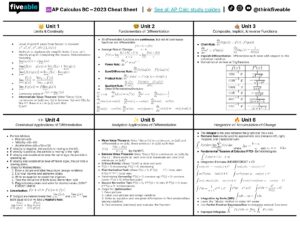
cos sin sin cosu du u C u du u C
1
,1
1
n
n
x
x dx C n
n
ln
u
u u u
a
e du e C a du C
a
f g x g x dx f g x C
____________________________________________________________________________________________
Definition of a Critical Number:
Let f be defined at c. If
is undefined at c, then c is a critical number of f.
_______________________________________________________________________
First Derivative Test:
Let c be a critical number of a function f that is continuous on an open interval I
containing c. If f is differentiable on the interval, except possibly at c, then
changes from negative to positive at c, then
is a relative
minimum of f.
2) If
changes from positive to negative at c, then
is a relative
maximum of f.
Second Derivative Test:
Let f be a function such that the second derivative of f exists on an open interval containing c.
1) If
is a relative minimum.
2) If
is a relative maximum
______________________________________________________________________________
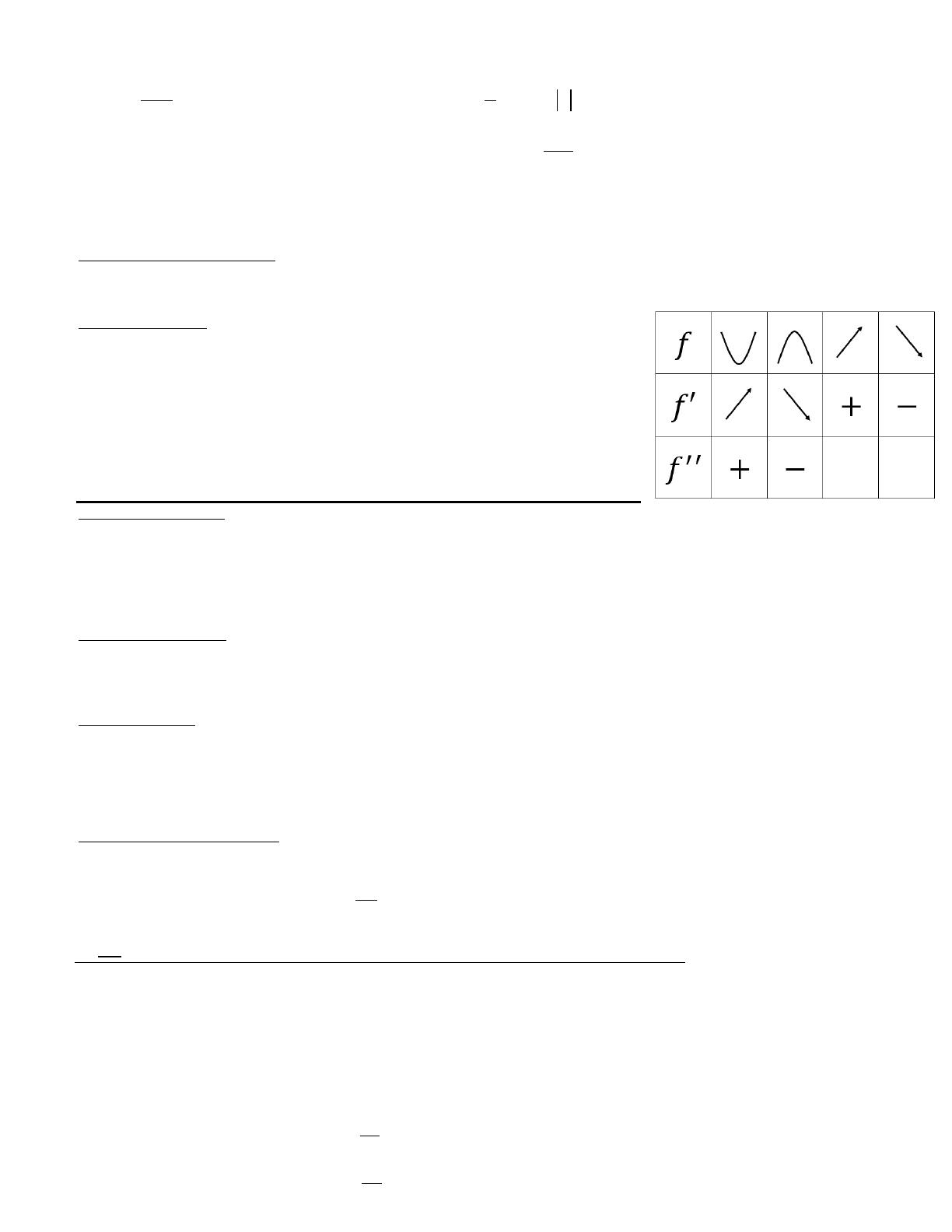
Definition of Concavity:
Let f be differentiable on an open interval I. The graph of f is concave upward on I if
is increasing on the interval and
concave downward on I if
is decreasing on the interval.
______________________________________________________________________________
Test for Concavity:
Let f be a function whose second derivative exists on an open interval I.
1) If
for all x in I, then the graph of f is concave upward in I.
2) If
for all x in I, then the graph of f is concave downward in I.
______________________________________________________________________________
Definition of an Inflection Point:
A function f has an inflection point at
0 or f c f c
changes sign from positive to negative or negative to positive at
changes from increasing to decreasing or decreasing to increasing at x = c.
First Fundamental Theorem of Calculus:
b
a
f x dx f b f a
final initial + change
initial final change
b
a
b
a
f b f a f x dx
f a f b f x dx
Second Fundamental Theorem of Calculus:
gx
a
d
f t dt f g x g x
dx