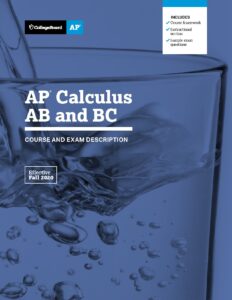

AP Precalculus Course and Exam Description 2023

AP Precalculus Course and Exam Description 2023

AP Precalculus focuses on functions that model dynamic phenomena, preparing students for college-level calculus. The course covers polynomial, rational, exponential, logarithmic, trigonometric, and polar functions, emphasizing their applications in various fields. Students develop symbolic manipulation skills and learn to analyze functions through graphical, numerical, analytical, and verbal representations. This course is essential for students aiming to excel in advanced mathematics and related disciplines, providing a solid foundation for further studies. The curriculum aligns with the AP Exam, ensuring comprehensive preparation for college credit.

Key Points

  • Covers polynomial, rational, exponential, logarithmic, trigonometric, and polar functions.
  • Emphasizes symbolic manipulation and multiple representations of functions.
  • Prepares students for college-level calculus and advanced mathematics courses.
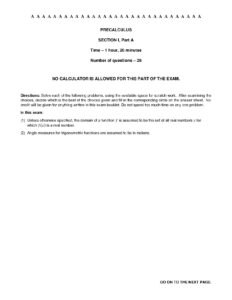
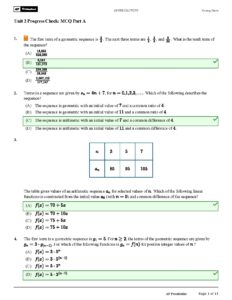
  • Includes sample exam questions and scoring guidelines for effective study.
134
/ 195
Effective
Fall 2023
INCLUDES
Course framework
Instructional
section
Sample Multiple-
choice questions
Sample Free-
response
questions with
Scoring Guidelines
AP
®
Precalculus
COURSE AND EXAM DESCRIPTION
Effective
Fall 2023
THIS PAGE IS INTENTIONALLY LEFT BLANK.
AP
®
Precalculus
COURSE AND EXAM DESCRIPTION
AP COURSE AND EXAM DESCRIPTIONS ARE UPDATED PERIODICALLY
Please visit AP Central (apcentral.collegeboard.org) to determine whether
a more recent course and exam description is available.
Effective
Fall 2023
/ 195
End of Document
134
You May Also Like
Faqs of AP Precalculus Course and Exam Description 2023
What types of functions are covered in AP Precalculus?
AP Precalculus includes a comprehensive study of various function types, such as polynomial, rational, exponential, logarithmic, trigonometric, and polar functions. Each function type is explored in depth, focusing on its properties, transformations, and applications. Students learn to model real-world phenomena using these functions, which is crucial for understanding advanced mathematical concepts. The curriculum is designed to prepare students for the AP Exam and future college-level mathematics courses.
How does AP Precalculus prepare students for calculus?
The AP Precalculus course lays a strong foundation for calculus by emphasizing the understanding of functions and their behaviors. Students learn to analyze and manipulate different types of functions, which is essential for calculus concepts such as limits, derivatives, and integrals. The course also includes practical applications of functions, helping students see the relevance of precalculus in real-world scenarios. By mastering these skills, students are better equipped to tackle the challenges of calculus and succeed in advanced mathematics.
What skills are emphasized in the AP Precalculus curriculum?
The AP Precalculus curriculum emphasizes several key skills, including procedural and symbolic fluency, the ability to express functions in equivalent forms, and the construction of new functions using transformations and compositions. Students are also trained to analyze functions through multiple representations—graphical, numerical, analytical, and verbal. This multifaceted approach not only enhances their mathematical understanding but also prepares them for the analytical thinking required in calculus and other advanced courses.
What is the significance of the AP Exam in the Precalculus course?
The AP Exam serves as a critical assessment tool for students in the AP Precalculus course, measuring their understanding of the material covered throughout the year. Performing well on the exam can earn students college credit and advanced placement in future mathematics courses. The exam includes multiple-choice and free-response sections that test a range of skills and knowledge, ensuring that students are well-prepared for the rigors of college-level mathematics. Additionally, the exam's structure aligns closely with the curriculum, reinforcing the importance of mastering the content.