AP Human Geography Unit 2: Cultural Patterns and Processes

AP Human Geography Unit 2: Cultural Patterns and Processes

AP Human Geography Unit 2 focuses on cultural patterns and processes that shape human behavior and societal development. It explores how cultural landscapes are formed, the diffusion of cultural traits, and the interaction of various cultural groups. Key topics include the significance of language, religion, ethnicity, and the impact of globalization on cultural identity. This unit is essential for students preparing for the AP Human Geography exam, providing insights into historical and contemporary cultural dynamics.

Key Points

  • Examines the role of cultural landscapes in shaping human geography.
  • Discusses the processes of cultural diffusion and their effects on societies.
  • Explores the significance of language and religion in cultural identity.
  • Analyzes the impact of globalization on traditional cultures.
95
/ 61
UNIT3
.•
+
+cultural Patterns and Processes
Chapter 6 Cultural Landscapes, Patterns,
and
Diffusion
Chapter 7 Historical
and
Contemporary Processes
of
Diffusion
Unit Overview
While some
human
attributes, such
as
hair color, are heavily influenced by
biological inheritance, most are not. In general, how people think
and
act
is
shaped, formally
and
informally, by what they learn from other people. All
of
the practices, attitudes, and behaviors that people learn from others are part
of
their culture.
Behaviors People Share
Areas where many people share an element
of
culture-such
as
speaking a
particular
language-form
cultural regions. Geographers use maps, from
small to large
scale-to
show the boundaries
of
these regions.
When
people
of
different cultures meet, they sometimes have conflicts, but
they always adjust
to
each other. For example,
if
they speak different languages,
one group might adopt the other's language over time.
Or
people might blend
the two languages to create a new one (creolized language). Improvements
in
transportation and communication have increased the interaction
of
cultures
throughout history. Culture spreads ( diffusion)
as
people move from one place
to another and
as
people interact
and
learn from each other.
In
1500, the region
where most people spoke English was a small area on the northwest corner
of
Europe. Today, English
is
the most widely spoken language around the world.
Variations in Culture
Culture changes over time
and
so
do
the spatial patterns and processes.
Geographers use maps to show regions and spatial patterns, such
as
where
specific languages are spoken. Additionally, they utilize various types
of
charts
and diagrams to show relationships and changes among the elements
of
culture.
For example, a tree diagram can show how several languages, including French
and Spanish, are branches
that
diverge from a common ancestor, Latin.
ENDURING
UNDERSTANDINGS
PS0-3: Cultural practices vary across geographical locations because
of
physical
geography and available resources.
IMP-3: The interaction of people contributes
to
the spread of cultural practices.
SPS-3: Cultural ideas, practices, and innovations change or disappear over time.
Source:
AP
" Human Geography Course
and
Exam Description. Effective Fall 2020. (College Board).
130
HUMAN
GEOGRAPHY: AP' EDITION
CHAPTER 6
Cultural Landscapes,
Patterns, and Diffusion
Topics
3.7-3.4
Topic
3.1
Introduction to Culture
Learning Objective: Define the characteristics, attitudes, and trai
ts
that
influence geographers when they study culture. (PS0-3.A)
Topic 3.2 Cultural Landscapes
Learning Objectives: Describe the characteristics
of
cultural landscapes.
(PS0-3
.B
)
Explain
how
landscape features and land and resource use reflect cultural
beliefs and identities. (PS0-3.C)
Topic 3.3 Cultural Patterns
Learning Objective: Explain patterns and landscapers
of
language, religion,
ethnicity, and gender. (PS0-3.D)
Topic 3.4 Types of Diffusion
Learning Objective: Define the types
of
diffusion. (IMP-3.A)
The
Buffalo was
part
of
us,
his flesh
and
blood
being absorbed
by
us until
it
became our own flesh
and
blood. Our clothing, our tipis,
everything we needed for life came from the buffalo's body.
It
was
hard to say where the animals ended
and
the human began.
- John (Fire) L
ame
Deer, Lame Deer, Seeker
of
Visions,
19
72
Source:
Getty Images
Diffusion
and
migration
in
fl
uence
the cultural landscape
of
Chinatown in San
Francisco. (See Topic
3.2 for characteristics
of
t
he
cultural landscape.)
CHAPTER 6: CULTURAL
LAND
SCAPES, PATTERNS,
AND
DIFFUSION
131
3.1
Introduction to Culture
Essential
Question:
What are the characteristics, attitudes, and traits
that influence geographers when they study culture?
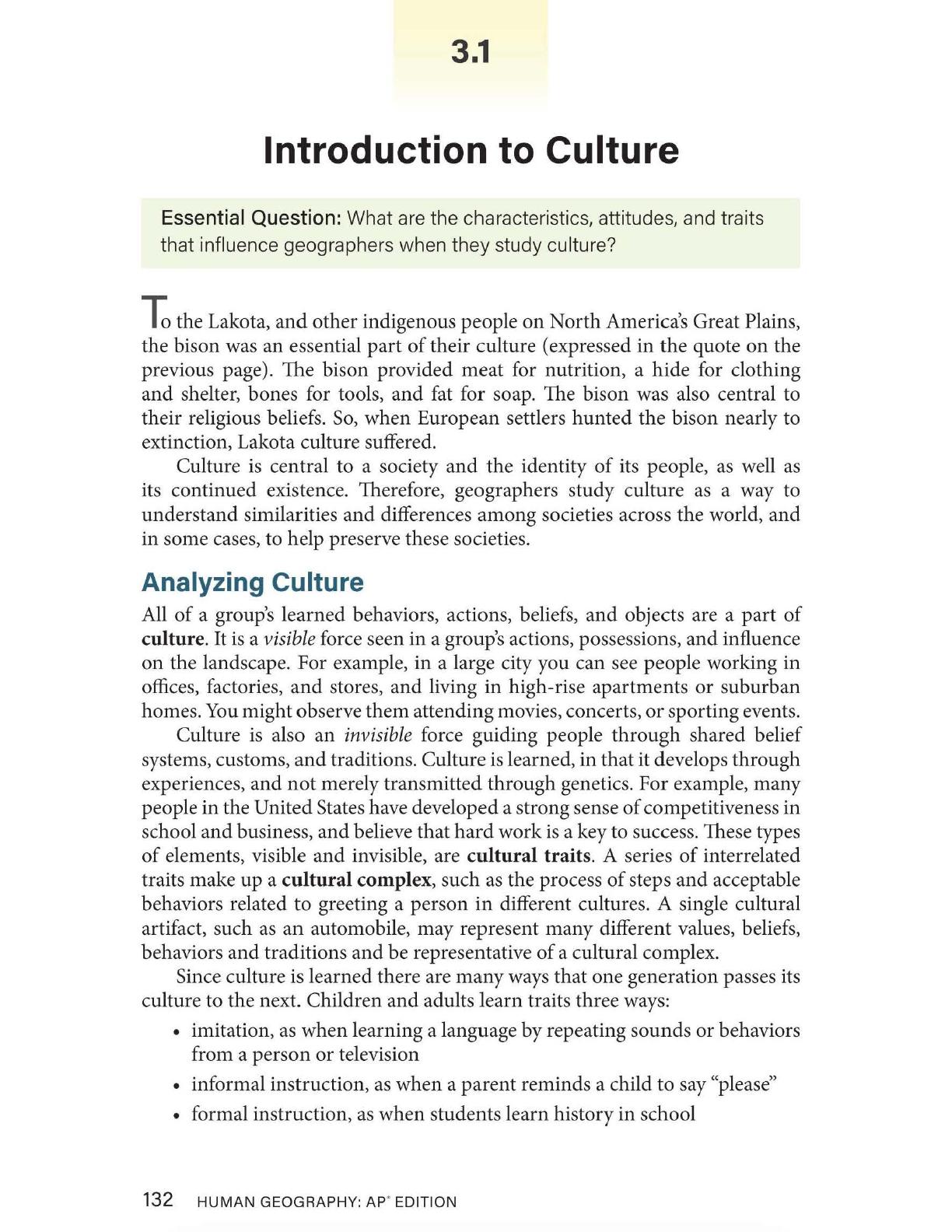
To
the Lakota,
and
other indigenous people
on
North America's Great Plains,
the bison was an essential
part
of
their culture ( expressed in the quote
on
the
previous page). The bison provided meat for nutrition, a hide for clothing
and
shelter, bones for tools,
and
fat for soap. The bison was also central to
their religious beliefs.
So,
when European settlers hunted the bison nearly to
extinction, Lakota culture suffered.
Culture
is
central to a society and the identity
of
its people, as well as
its continued existence. Therefore, geographers study culture
as
a way to
understand similarities and differences among societies across the world, and
in
some cases, to help preserve these societies.
Analyzing Culture
All
of
a group's learned behaviors, actions, beliefs, and objects are a
part
of
culture. It
is
a visible force seen
in
a group's actions, possessions, and influence
on
the landscape. For example, in a large city you can see people working
in
offices, factories,
and
stores, and living in high-rise apartments
or
suburban
homes.
You
might observe them attending movies, concerts,
or
sporting events.
Culture
is
also an invisible force guiding people through shared belief
systems, customs,
and
traditions. Culture
is
learned, in that it develops through
experiences, and
not
merely transmitted through genetics. For example, many
people
in
the United States have developed a strong sense
of
competitiveness
in
school and business, and believe that hard work
is
a key to success. These types
of
elements, visible and invisible, are cultural traits. A series
of
interrelated
traits make
up
a cultural complex, such as the process
of
steps and acceptable
behaviors related to greeting a person
in
different cultures. A single cultural
artifact, such as
an
automobile, may represent many different values, beliefs,
behaviors and traditions and be representative
of
a cultural complex.
Since culture is learned there are many ways that one generation passes its
culture to the next. Children and adults learn traits three ways:
imitation, as when learning a language by repeating sounds
or
behaviors
from a person
or
television
informal instruction, as when a parent reminds a child to say "please"
formal instruction, as when students learn history in school
132
HUMAN
GEOGRAPHY: AP" EDITION

/ 61
End of Document
95
You May Also Like
Faqs of AP Human Geography Unit 2: Cultural Patterns and Processes
What are the main cultural patterns discussed in Unit 2?
Unit 2 of AP Human Geography covers various cultural patterns, including language distribution, religious beliefs, and ethnic identities. It emphasizes how these patterns influence human behavior and societal structures. The unit also examines how cultural traits diffuse across regions and the resulting changes in cultural landscapes. Understanding these patterns is crucial for analyzing the complexities of human geography.
How does globalization affect cultural identity?
Globalization significantly impacts cultural identity by promoting the spread of popular culture and often leading to cultural homogenization. As cultures interact, traditional practices may diminish, and unique cultural traits can be lost. However, globalization can also foster cultural exchange, allowing for the preservation and revitalization of local traditions. The unit discusses both the positive and negative effects of globalization on cultural identity.
What is the significance of language in cultural geography?
Language plays a critical role in cultural geography as it serves as a primary means of communication and a key marker of cultural identity. The unit highlights how languages can reflect historical migrations and social structures. It also discusses the concept of language families and dialects, illustrating how language shapes cultural landscapes and influences interactions among different cultural groups.
What are the types of cultural diffusion mentioned in Unit 2?
Unit 2 outlines several types of cultural diffusion, including relocation diffusion, where cultural traits spread through migration, and expansion diffusion, which occurs when cultural traits spread from a central point. The unit also discusses contagious diffusion, where cultural traits spread rapidly through direct contact, and hierarchical diffusion, where traits spread from influential individuals or urban centers to wider populations. Understanding these diffusion processes is essential for analyzing cultural interactions.
How do cultural landscapes reflect societal values?
Cultural landscapes are a visible representation of a society's values, beliefs, and practices. They include elements such as architecture, land use, and public spaces that reflect cultural identity. The unit explores how different cultures shape their environments and how these landscapes can change over time due to cultural interactions and globalization. Analyzing cultural landscapes helps geographers understand the relationship between culture and space.