
2022 AP Chemistry Scoring Guidelines for Exam Administration

2022 AP Chemistry Scoring Guidelines for Exam Administration

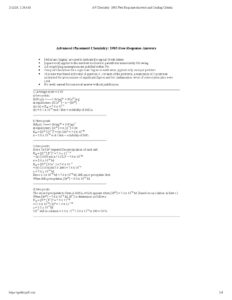
The 2022 AP Chemistry Scoring Guidelines provide detailed criteria for evaluating student responses during the AP Chemistry exam. These guidelines outline the scoring rubrics for various question types, including long answer and short answer questions. Designed for educators and examiners, the document ensures consistent and fair assessment of student performance. Key topics include calculations, chemical reactions, and conceptual explanations relevant to the AP Chemistry curriculum. This resource is essential for AP Chemistry teachers preparing students for the exam and for understanding the expectations set by the College Board.

Key Points

  • Includes scoring criteria for long answer and short answer questions in AP Chemistry.
  • Outlines specific calculations and chemical concepts relevant to the AP Chemistry exam.
  • Provides educators with a framework for consistent student assessment.
  • Covers key topics such as thermodynamics, chemical reactions, and molecular structure.
160
/ 11
2022
AP
®
Chemistry
Scoring Guidelines
© 2022 College Board. College Board, Advanced Placement, AP, AP Central, and the acorn logo are registered
trademarks of College Board. Visit College Board on the web: collegeboard.org.
AP Central is the official online home for the AP Program: apcentral.collegeboard.org.
AP® Chemistry 2022 Scoring Guidelines
Question
1:
Long
Answer
10 points
(a)
For the correct
calculated value:
1 mol C H O 1 mol HC H O
138.12 g
8 83 7 53
0.300 g C H O × × × = 0.272 g HC H O
8 83 7 53
152.15 g 1 mol C H O 1 mol HC H O
8 83 7 53
1 point
(b)
For
the correct answer
and
a valid justification:
Yes (consistent). Because the acid is soluble in water, some crystals may dissolve during
rinsing, causing the mass of the collected precipitate to be lower than expected. This would
lead to a percent yield less than 100%.
1 point
(c)
For the correct
calculated
value of
either
q:
Accept one of the following:
q
heat
T = (0.105 g)(1.17 J/(g C))(159 C ° = 16.5 J = mc ⋅° ° 25 C)
1 mol 27,100 J
q
melt
= 0.105 g × × = 20.6 J
138.12 g 1 mol
1 point
For
the correct
calculated
value of the
other
q
and the
total heat:
q = q + q = 16.5 J + 20.6 J = 37.1 J
total heat melt
1 point
Total for part (c) 2 points
(d)
For a correct
explanation:
Molecules of
salicylic acid
have
more
hydrogen bonding sites
than
molecules of
methyl
salicylate have, which
leads
to
stronger intermolecular forces
and a higher melting point
for salicylic acid.
1 point
(e)
For the correct answer:
The
pK
a
is approximately 3.
1 point
(f)
For the correct answer and a valid justification, consistent with part (e):
Accept one of the following:
The conjugate base,
C HO
7 5
.
When
pH = 4
, the titration is beyond the half-
equivalence point, where
3
][HC HO ] = [C HO
7 53 7 53
. Thus,
][C H O
7 53
must be
greater
than
[HC H O ]
7 5
.
The conjugate base,
C HO
7 5
.
Because the
pH
of the solution is
greater than the
3
pK
a
of the acid, the majority of
the
molecules will be deprotonated.
1 point
(g)
© 2022 College Board
For
the
correct calculated value:
5
pK = log(6.3 × 10 ) = 4.20
a
1 point
AP® Chemistry 2022 Scoring Guidelines
(h) For a curve that shows a correct starting and half-equivalence point, consistent with part (g):
The curve starts at
pH 3.11
and passes through the
pK
a
calculated in part (g) at
5 mL
.
See example response below.
1 point
For
a curve that shows the correct equivalence point:
The curve inflects vertically at
10 mL
showing the same volume of base needed to reach
the equivalence point.
1 point
Total for part (h) 2 points
Total for question 1 10 points
© 2022 College Board
/ 11
End of Document
160
You May Also Like
Faqs of 2022 AP Chemistry Scoring Guidelines for Exam Administration
What are the main scoring criteria for AP Chemistry long answer questions?
The scoring criteria for long answer questions in AP Chemistry focus on accuracy, clarity, and completeness of the response. Students must demonstrate their understanding of chemical principles through calculations and explanations. Each response is evaluated based on specific points awarded for correct answers, valid justifications, and the logical flow of ideas. The guidelines also emphasize the importance of using proper chemical terminology and notation.
How are short answer questions scored in the AP Chemistry exam?
Short answer questions in the AP Chemistry exam are scored based on a rubric that assesses the correctness of the answer and the reasoning provided. Each question typically has a set number of points assigned, with partial credit possible for partially correct responses. The guidelines specify what constitutes a complete answer, including necessary calculations, explanations, and the use of appropriate chemical concepts. This structured approach helps ensure fairness in scoring.
What topics are covered in the AP Chemistry scoring guidelines?
The AP Chemistry scoring guidelines cover a wide range of topics essential for the exam, including stoichiometry, thermodynamics, chemical kinetics, and equilibrium. Each topic is addressed with specific scoring criteria that reflect the depth of understanding required. The guidelines also include examples of acceptable responses and common misconceptions to help educators prepare students effectively. This comprehensive approach ensures that all relevant content areas are assessed.
How can educators use the AP Chemistry scoring guidelines?
Educators can use the AP Chemistry scoring guidelines as a tool for developing assessments that align with the expectations of the AP exam. By understanding the scoring criteria, teachers can create practice questions that mimic the structure and complexity of the actual exam. Additionally, these guidelines can help instructors provide targeted feedback to students, highlighting areas for improvement and reinforcing key concepts. This resource is invaluable for preparing students for success on the AP Chemistry exam.
What is the significance of the AP Chemistry scoring guidelines?
The AP Chemistry scoring guidelines are significant as they provide a standardized framework for evaluating student performance on the AP exam. By establishing clear criteria for scoring, the guidelines promote fairness and consistency across different exam administrations. They also serve as a valuable resource for educators, helping them understand the expectations of the College Board and how to best prepare their students. Ultimately, these guidelines contribute to the integrity of the AP Chemistry program.