AP Physics C Equations Sheet for Mechanics and Electricity

AP Physics C Equations Sheet for Mechanics and Electricity

AP Physics C Equations Sheet provides essential formulas and constants for mechanics and electricity, tailored for AP Physics C students. This resource includes key equations related to motion, forces, energy, and electric fields, making it an invaluable tool for exam preparation. Students can find crucial constants such as the speed of light, gravitational constant, and Planck's constant, along with trigonometric values for common angles. Ideal for those studying for the AP Physics C exam, this sheet aids in understanding complex concepts and solving problems efficiently.

Key Points

  • Includes essential mechanics equations for AP Physics C students
  • Covers electricity and magnetism formulas necessary for the exam
  • Provides a list of fundamental constants and their values
  • Features trigonometric values for common angles relevant to physics problems
228
/ 3
ADVANCED PLACEMENT PHYSICS C TABLE OF INFORMATION
CONSTANTS AND CONVERSION FACTORS
AP Physics C: Mechanics Course and Exam Description
164 
|
Appendix V.1
00762-139-CED-Physics C-Mechanics_Appendixes.indd 164 3/13/19 12:15 PM
Proton mass,
m =
p
1.67 ´ 10
27
kg
Neutron mass,
27
1.67 10 kg
n
m
= ´
Electron mass,
31
9.11 10 kg
e
m
= ´
Avogadro's number,
23 1
0
6.02 10 molN
= ´
Universal gas constant,
I
.
8.31 J (mol K)R
Boltzmann's constant,
23
1.38 10 J K
B
k
= ´
I
Electron charge magnitude,
19
1.60 10 Ce
= ´
1 electron volt,
19
1 eV 1.60 10 J
= ´
Speed
of
light,
8
3.00 10 m sc = ´
I
Universal gravitational
constant,
I
11 2 2
6.67 10 N m kgG
= ´
.
Acceleration due to gravity
at Earth's surface,
2
9.8 m sg
I
1 unified atomic mass unit,
27 2
1 u 1.66 10 kg 931 MeV c
=´=
I
Planck's constant,
34 15
6.63 10 J s 4.14 10 eV sh

=´=´
.
.
25 3
1.99 10 J m 1.24 10 eV nmhc
=´=´
.
.
Vacuum permittivity,
12 2 2
0
8.85 10 C N me
= ´
.
I
Coulomb's law constant,
9 22
0
1 4 9.0 10 N m Ck pe= = ´
I
I
.
Vacuum permeability,
7
0
4 10 (T m) Amp
= ´
.
I
Magnetic constant,
7
0
4 1 10 (T m) Ak mp
= = ´
¢
I
I
.
1 atmosphere pressure,
52 5
1 atm 1.0 10 N m 1.0 10 Pa=´=´
I
UNIT
SYMBOLS
meter,
kelvin,
m
mole,
mol
watt,
w farad,
F
kilogram, kg hertz,
Hz
coulomb,
C
tesla,
T
second,
s
newton,
N
volt,
V degree Celsius,
°C
ampere, A pascal, Pa ohm,
W
electron volt, eV
K
joule,
J
henry,
H
PREFIXES
Factor Prefix
Symbol
10
9
giga
G
10
6
mega
M
10
3
kilo
k
10
2
centi
C
10
3
milli m
10
6
micro
m
10
9
nano
n
10
12
pico
p
VALUES OF TRIGONOMETRIC FUNCTIONS FOR COMMON ANGLES
q
0
30
37
45
53
90
sinq
0
12
I
35
I
22
r;
45
I
32
r;
1
cosq
1
32
r;
45
I
22
r;
35
I
12
I
0
tan q
0
33
r;
34
I
1
43
I
¥
The following assumptions are used in this exam.
I. The frame
of
reference
of
any problem is inertial unless otherwise
stated.
II. The direction
of
current is the direction in which positive charges
would drift.
III. The electric potential is zero at
an
infinite distance from an isolated
point charge.
IV. All batteries and meters are ideal unless otherwise stated.
V.
Edge effects for the electric field
of
a parallel plate capacitor are
negligible unless otherwise stated.

AP Physics C: Mechanics Course and Exam Description
Appendix V.1
|
165
1
max
f
k
00762-139-CED-Physics C-Mechanics_Appendixes.indd 165 3/13/19 12:15 PM
ADVANCED PLACEMENT PHYSICS C EQUATIONS
MECHANICS
0
ÃÃ
xx
at
x
2
00
2
Ã
xx
x x t at
1
2
2
00
2ÃÃ
xx x
ax x
net
F
F
a
mm
å
dp
F
dt
D
ò
J F dt p
p mv
m£
fN
FF
I - I
1~
I
D
ò
E W F dr
2
2
ÃKm
1
dE
P
dt
P Fv
DD
g
U mg h
2
2
Ã
w
c
ar
r
t = ´rF
t
t
a
å
net
II
22
I r dm mr
å
ò
ii
cm
i
mx
x
m
å
å
Ãw r
w=´=LrpI
2
1
2
KIw
0
tww a
2
00
1
2
ttqq w a
D
s
F kx
2
2
D
s
U kx
cos(xx twf 
21
T
p
w
F
2
s
m
T p
2
p
T
g
p
f
12
2
G
Gm m
F
r
I - I
12
G
Gm m
U
r
a
=
acceleration
E=
energy
F=
force
f
=
frequency
h
=
height
I
=
rotational inertia
J
=
impulse
K=
kinetic energy
k
=
spring constant
£ =
length
L =
angular momentum
m=
mass
P=
power
p
=
momentum
r
=
radius or distance
T=
period
t
=
time
U=
potential energy
v
=
velocity or speed
W=
work done on a system
x position =
=
=
=
m
coefficient
of
friction
q
= angle
t
= torque
w
angular speed
a
angular acceleration
f
= phase angle
-2-
ELECTRICITY AND MAGNETISM
2
12
0
1
4pe
E
qq
F
r
E
F
E
q
0
e
ò
Q
E dA
x
dV
E
dx
D
ò
V E dr
0
1
4pe
å
i
i
i
q
V
r
12
0
1
4pe
E
qq
U qV
r
D
Q
V
C
0
ke
A
C
d
pi
i
CC
å
1
s
i
i
C
å
1
C
dQ
I
dt
2
11
22
C
U QV C VDD
R
A
r
e
rEJ
d
I Nev A
D
V
I
R
i
i
s
RR
å
11
i
i
p
RR
å
DP IV
F
M
= qv ´ B
0
m
ò
Bd I
0
£
0
2
4
m
p
´
Id r
dB
r
£
= ´
ò
F Id B
£
0
s
B nIm
F
ò
B
B dA
e
F
ò
B
d
Ed
dt
-
0
.
£
dI
L
dt
e
2
1
2
L
U LI
A=
area
B=
magnetic field
C=
capacitance
d =
distance
E=
electric field
e
=
emf
F=
force
I
=
current
J
=
current density
L
=
inductance
=
length
n
=
number
of
loops
of
wire
per unit length
N=
number
of
charge carriers
per
unit
volume
P=
power
Q=
charge
q
=
point charge
R=
resistance
r
=
radius or distance
t
=
time
U=
potential or stored energy
V
= electric potentia
l
v = velocity
or
speed
r
= resistivity
F
= flux
k
= dielectric constant
-
.
.
AP Physics C: Mechanics Course and Exam Description
166 
|
Appendix V.1
00762-139-CED-Physics C-Mechanics_Appendixes.indd 166 3/13/19 12:15 PM
ADVANCED PLACEMENT PHYSICS C EQUATIONS
GEOMETRY AND TRIGONOMETRY
Rectangle
A bh
Triangle
1
2
A bh
Circle
2
Arp
2Crp
srq
Rectangular Solid
V wh
f
Cylinder
2
Vrp
2
22Sr rpp
q
Sphere
3
4
3
Vrp
2
4Srp
Right Triangle
22 2
ab c
sin
a
c
q
cos
b
c
q
tan
a
b
q
~a
~
b
A
=area
C =circumference
V =volume
S = surface area
b
=base
h =height
= length
w =width
r =radius
s = arc length
q
= angle
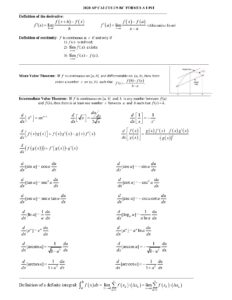
CALCULUS
df df du
dx du dx
1nn
d
x nx
dx
ax ax
d
e ae
dx
d
ax
dx x
1
ln
sin cos
d
ax a ax
dx
cos sin
d
ax a ax
dx
1
1
,1
1
nn
x dx x n
n
= ¹-
ò
1
ò
ax ax
e dx e
a
ln
ò
dx
xa
xa
1
cos sin
ò
ax dx ax
a
1
sin cos
ò
ax dx ax
a
VECTOR PRODUCTS
cosA B AB q
sinA B AB q´=
/ 3
End of Document
228
You May Also Like
Faqs of AP Physics C Equations Sheet for Mechanics and Electricity
What are the key equations for mechanics in AP Physics C?
The key equations for mechanics in AP Physics C include Newton's second law, kinematic equations for motion, and formulas for work, energy, and momentum. For instance, the equation F = ma relates force, mass, and acceleration, while the work-energy theorem connects work done to the change in kinetic energy. Additionally, students will encounter equations for rotational motion, such as torque and angular momentum, which are crucial for understanding dynamics in physics.
What constants are included in the AP Physics C Equations Sheet?
The AP Physics C Equations Sheet includes several fundamental constants essential for solving physics problems. These constants encompass the speed of light (c = 3.00 x 10^8 m/s), the gravitational constant (G = 6.67 x 10^-11 N m²/kg²), and Planck's constant (h = 6.63 x 10^-34 J s). Additionally, it lists the electron charge magnitude and Avogadro's number, providing students with quick access to critical values needed for calculations.
How does the AP Physics C Equations Sheet assist in exam preparation?
The AP Physics C Equations Sheet assists students in exam preparation by consolidating essential formulas and constants into a single, easy-to-reference resource. This organization allows students to quickly locate the equations they need during practice problems and the actual exam. By familiarizing themselves with these key concepts, students can enhance their problem-solving skills and improve their confidence when tackling complex physics questions.
What topics in electricity and magnetism are covered in the sheet?
The sheet covers various topics in electricity and magnetism, including Coulomb's law, electric fields, and circuits. Key equations such as E = k(q1q2/r²) for electric force and V = IR for Ohm's law are included, providing a foundation for understanding electric interactions and circuit behavior. Additionally, it addresses magnetic fields and forces, essential for grasping the principles of electromagnetism.